
Blog
Do You Need a Health Advocate?
Published
Updated
Written by Lee Grunberg, M.B.A. — President & CEO
Reviewed by Bethel McMaster, BScN, RN — Director of Business Development

On this page15 sections
Key Takeaways
- A health advocate helps patients and families navigate care, ask the right questions, and reduce stress.
- In home care, advocacy can support appointments, records, insurance issues, and communication with providers.
- Some people are entitled to advocacy support through statutory or local services, depending on their needs.
- The right advocate should be calm, organized, trusted, and experienced with healthcare systems.
- Patient advocacy can improve understanding, reduce errors, and help patients feel more in control.
A serious illness, a new diagnosis, or a hospital stay can change everyday life almost overnight. One day you are trying to understand a complex new diagnosis; the next, you are coordinating between three different specialists, chasing down prescriptions, and trying to make sense of a rushed five-minute conversation with a doctor. Even the most capable family caregivers can feel stretched. Medical appointments often move quickly, unfamiliar terms can be difficult to understand, and different providers may each have only part of the picture. When questions arise after an appointment or a care plan changes unexpectedly, it's easy to wonder if something important was missed.
A health advocate helps bring clarity, continuity, and confidence to those moments. They help organize information, make sure concerns are addressed, and support communication between everyone involved in a person's care. Rather than replacing family members, a health advocate works alongside them so important decisions are based on clear information and the person's needs remain at the centre of every conversation. In home care, that support can make a real difference because many people are managing appointments, medications, records, and questions from several providers at once.
At Integracare, advocacy is part of compassionate home health care. When someone is ill, recovering, or simply overwhelmed by the healthcare system, having a calm and knowledgeable advocate can help turn confusion into clarity and stress into confidence.
What Does a Health Care Advocate Do?
A health care advocate helps patients understand their care, communicate with healthcare providers, organize medical information, and make informed healthcare decisions. A health advocate serves as your trusted voice when navigating medical decisions, treatment options, and healthcare systems that can feel overwhelming, especially during times of illness or vulnerability. In home healthcare, advocacy also includes coordinating care between family members and healthcare professionals so nothing important is overlooked.
How Integracare Helps
Integracare's healthcare professionals naturally provide advocacy as part of personalized home care. Our Registered Nurses, Registered Practical Nurses, and Personal Support Workers collaborate with families and healthcare providers to support appointments, monitor changing care needs, improve communication, and help ensure every care decision remains centred on the client's goals and well-being. Additionally, our coordinated care team can help provide references to other advocacy services, including financial, estate planning, taxation, and downsizing, which can be arranged with trustworthy partners.
Who Are Canadian Health Advocates?
It is difficult to navigate the healthcare system, and it is even more challenging to do so while ill. A health advocate is someone who can be calm, organized, and assertive when they’re dealing with the medical system, particularly hospitals and primary care providers. A health advocate is someone who can clearly explain the kind of help you or your loved one needs, provide details about your medical history to medical professionals, take detailed notes when dealing with health care providers, and navigate the complexities of care.
Integracare’s Registered Nurses, Registered Practical Nurses and Personal Support Workers are available on-call and can assist clients 24/7. Whenever needed, your family member’s advocate can prepare for appointments ahead of time and help review the results afterward. Having the ears and eyes of a healthcare professional who is present during any meetings is also useful should any legal issues arise.
Patient Advocacy in Home Care
A health advocate becomes part of the day-to-day rhythm of care, helping families stay organized as needs change over time. Instead of reacting to problems, they help keep communication consistent so everyone involved in a loved one's care is working from the same information.
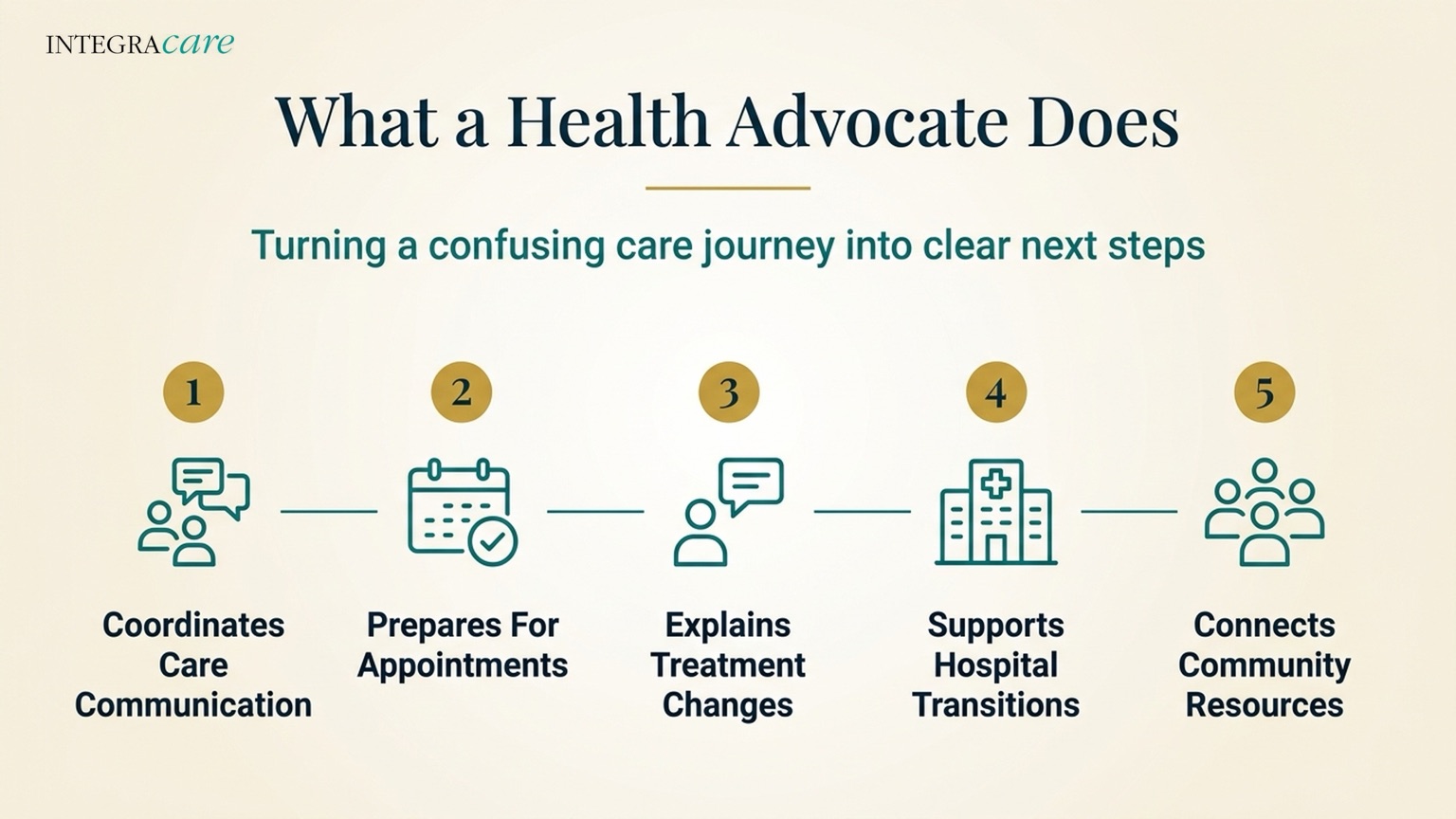
- Coordinates communication between physicians, specialists, Registered Nurses, Registered Practical Nurses, Personal Support Workers, therapists, and family caregivers.
- Helps prepare for medical appointments by organizing questions, health updates, and medical documentation.
- Reviews treatment recommendations and medication changes so families understand what happens next.
- Supports safe care transitions after a hospital stay, rehabilitation, or emergency department visit.
- Monitors changes in health and communicates concerns to the appropriate healthcare providers.
- Connects families with community programs, support services, and other resources that can make aging at home easier.
- Encourages open family communication so decisions reflect the older adult's preferences, goals, and evolving care needs.
When care is coordinated, families spend less time trying to connect the dots between providers and more time supporting their loved one. That consistency helps reduce misunderstandings, supports better continuity of care, and gives everyone greater confidence as needs evolve.
Why Advocacy Matters in Home Care
Home care allows older adults to remain in familiar surroundings, but coordinating care often becomes the responsibility of family members. As appointments, medications, and providers increase, having someone who helps keep everyone informed can make daily care feel much more manageable.
- Keeps communication clear between physicians, specialists, nurses, therapists, and family caregivers.
- Helps organize medical records, care plans, and appointment information in one place.
- Explains treatment recommendations and medical terminology in clear, everyday language.
- Supports smoother care transitions after a hospital stay or specialist appointment.
- Ensures changes to medications, follow-up care, and care plans are communicated and understood.
- Connects families with community resources and services that support aging safely at home.
When everyone involved in care has the same information, it's easier to make confident decisions and avoid unnecessary confusion. A health advocate helps families spend less time coordinating care and more time focusing on what matters most: the well-being of their loved one.
Challenges Patient Advocates Help With
Many families reach out for advocacy when care feels too complex to manage alone. Common challenges of the medical experience include medical jargon, limited appointment time, confusing instructions, and the emotional strain of trying to coordinate everything while also caring for a loved one.
Advocacy can also help when people are unsure how to follow up after a hospital visit, how to ask the right questions, or how to make sense of next steps. In Ontario, there are also complaint and support pathways for certain care concerns, which can be helpful when families need guidance on where to go next.
Advocacy reduces stress, improves communication, and helps families feel more confident about the care decisions they are making.
Financial and Coordination Challenges
The financial aspects of healthcare can be overwhelming. Billing errors, insurance issues, and unexpected medical bills create stress when patients should be focusing on recovery. Advocates help identify these errors, understand coverage limitations, and connect families with financial assistance programs when needed.
Care coordination becomes particularly challenging when multiple providers are involved. Without a central point person, important details can slip through the cracks. Advocates serve as that consistent presence who tracks information across different appointments and specialties.
For those with language barriers or lower health literacy, these challenges become increasingly more difficult to manage. Translation services and simplified explanations become crucial elements of effective advocacy, ensuring everyone has equal access to quality care regardless of background or education.
The Benefit of Working with an Ontario Health Advocate
A health advocate is someone who puts your care and treatment needs first. They assist in developing complex treatment plans, communicating between you and health care providers, and ensuring that you have all of the care and assistance you need to heal physically and emotionally. A health advocate is a cornerstone of ensuring that compassion and comfort are part of your care experience.
Your health advocate is also an educator. They make sure that you understand what your treatment plan entails, what happens when you’re in the hospital, how your recovery will play out, and offer perspectives on the efficacy of your treatment. They help make sure that you don’t have to make decisions alone.
Choosing a Health Care Advocate You Can Trust
Finding the right health care advocate doesn't have to add more stress during an already challenging time. Whether the advocate is a trusted family member or an experienced healthcare professional, the goal is the same: to help you or your loved one navigate the healthcare system with confidence while ensuring care decisions remain informed, organized, and centred around the individual's needs.
The right advocate should feel calm, organized, compassionate, and easy to talk to. They should understand how the healthcare system works, communicate clearly with healthcare providers, and be able to explain how they can support everything from preparing for appointments and organizing medical records to coordinating follow-up care and helping families better understand treatment recommendations.
It can also help to ask whether the advocate works independently or as part of a healthcare organization, and whether they have experience supporting older adults receiving care at home. At Integracare, advocacy is built into our home healthcare services. Our Registered Nurses (RNs), Registered Practical Nurses (RPNs), and Personal Support Workers (PSWs) work closely with clients, families, physicians, specialists, and other healthcare professionals to help coordinate care, communicate changes, and ensure everyone is working toward the same goals.
Questions to Ask Before Choosing a Health Care Advocate
Choosing someone to support important healthcare decisions is a personal decision. Asking a few thoughtful questions can help you determine whether they're the right fit.
- What experience do you have supporting older adults or people with similar healthcare needs?
- How do you communicate with physicians, specialists, and other members of the healthcare team?
- Can you help coordinate appointments, organize medical documentation, and explain treatment recommendations?
- How do you keep family members informed when several people are involved in care?
- How do you adapt when a person's healthcare needs or care plan changes over time?
A good advocate does more than help navigate the healthcare system; they help people feel heard, respected, and supported. When communication is clear, and care is well coordinated, families can spend less time managing logistics and more time focusing on what matters most: supporting the health, comfort, and well-being of the person they love.
Working With a Health Care Advocate
Deciding to seek an advocate or other private health care services for yourself, a family member, or a dear friend is difficult. We understand your concerns. From the moment you contact us, we promise to provide compassionate and practical assistance. We offer a comprehensive list of other services provided by Registered Nurses, Practical Nurses, Physiotherapists, Massage Therapists, and Certified Personal Support Workers. We deliver quality home health care that is tailored to client needs, beliefs, and cultural practices, whether at home, at a residence, or at a health care facility. We believe in fostering independence and comfort with an emphasis on enhancing joyful living.
Impact and Outcomes of Patient Advocacy
When advocacy works well, families usually feel more informed, less overwhelmed, and better able to take part in care decisions. It creates space for clearer conversations, fewer misunderstandings, and better follow-through, which can make a real difference when a loved one is managing care at home.
In home care, that support can be especially valuable because so much depends on good communication. Medication changes, appointment instructions, and follow-up care can be easy to miss when several people are involved, but an advocate helps keep those details organized and easier to understand. This collaborative approach reflects the principles of patient-centred care and coordinated care that many Canadian health organizations encourage.
For Integracare, advocacy is about helping clients and families feel informed, respected, and included in every decision while supporting communication that contributes to safer, more consistent care at home. Learning more about care coordination can also help families better understand how healthcare providers work together to support older adults.
Measuring the Success of Patient Advocacy
How do we know advocacy is working? Success indicators include:
- Increased patient satisfaction with care experiences
- Reduced incidence of medical errors and complications
- Better adherence to treatment plans and follow-up care
- Decreased stress levels for both patients and family caregivers
- More efficient use of healthcare resources
Perhaps most importantly, advocacy helps patients feel empowered rather than passive recipients of care. This shift in perspective can have profound effects on both physical and emotional well-being, creating a positive cycle that supports better health outcomes.
When patients feel their voices are heard and their preferences respected, they become more engaged in their care journey, asking questions, expressing concerns, and participating actively in decisions that affect their health. This engagement is one of the most powerful predictors of positive health outcomes, making advocacy not just helpful but essential.
What It Takes to Become a Patient Advocate
For those considering a career in patient advocacy, the path combines healthcare knowledge with interpersonal skills that allow for effective navigation of complex systems. While formal requirements vary by position and setting, certain competencies are universally valued.
Educational backgrounds often include degrees in healthcare management, nursing, social work, or related fields. Many advocates begin their careers as clinicians or care coordinators before specializing in advocacy. Certification programs are available through various professional organizations, though requirements vary by region and type of advocacy.
Beyond formal education, successful advocates possess strong communication skills that allow them to translate complex medical information into understandable terms. They must be detail-oriented enough to track appointments, medications, and care plans across multiple providers, while also maintaining the empathy needed to support patients during vulnerable moments.
Essential Skills for Effective Advocacy
The most effective advocates combine technical knowledge with soft skills that build trust and facilitate communication. These include:
- Medical terminology skills that allow for accurate documentation and communication
- Interpersonal skills that enable rapport-building with patients, families, and providers
- Problem-solving abilities that help navigate bureaucratic hurdles and system barriers
- Cultural competency that ensures respectful care across diverse populations
- Persistence that advocates for patients' needs even when faced with resistance
For those interested in specializing in home care advocacy, additional training in geriatric care, family dynamics, and community resources can be particularly valuable. Understanding the unique challenges of coordinating care in home settings requires specific knowledge that goes beyond general healthcare systems.
Whether pursuing advocacy as a career or seeking to develop these skills to better support a loved one, the combination of knowledge and compassion makes a meaningful difference.
Confident Care Begins With the Right Advocate
Every family deserves someone who helps bring clarity when healthcare feels overwhelming. Through personalized home healthcare and built-in advocacy, Integracare helps coordinate care, answer questions, and support informed decisions that put your loved one's well-being first. Book a free in-home assessment. It's thoughtful care designed around the person, not just the condition. Together, we help make aging at home safer, more comfortable, and more connected.
Frequently Asked Questions
What is a health advocate in home care?
A health advocate in home care helps patients and families understand medical information, prepare for appointments, ask questions, and stay organized throughout care. In a home setting, this can include helping with treatment plans, medication instructions, follow-up care, and communication between providers. The goal is to reduce confusion and support better decision-making. For families managing complex care at home, this kind of support can make the experience feel calmer, clearer, and more manageable.
Why is patient advocacy important in home care?
Patient advocacy is important in home care because care often involves several people and several moving parts. Families may be coordinating nurses, personal support workers, doctors, specialists, and medications at the same time. Without clear communication, important details can be missed. An advocate helps keep the care plan organized, supports follow-through, and makes sure the client’s concerns are heard. That added support can improve confidence and reduce stress for everyone involved.
How does a health advocate help families?
A health advocate helps families by making healthcare feel easier to navigate. They can explain medical terms, keep track of questions, attend appointments, and help families understand what comes next. They also help make sure that information is shared clearly between the client, caregivers, and healthcare providers. This is especially useful when a loved one is recovering, dealing with chronic illness, or needs ongoing support at home. The result is often less stress and better coordination.
What does a patient advocate do during medical appointments?
During medical appointments, a patient advocate helps the client prepare, stay organized, and remember key details. They may write down questions before the visit, take notes during the appointment, and help review the doctor’s instructions afterward. They can also help clarify next steps and make sure nothing important is overlooked. For families, this is a practical way to improve communication and make appointments more productive, especially when care needs are complex.
Can a family caregiver act as a health advocate?
Yes, a family caregiver can act as a health advocate, and many do. Family members often know the client best and understand their preferences, routines, and concerns. However, caregiving can be demanding, and it is not always easy to manage every detail alone. That is why some families choose additional professional support. At Integracare, advocacy can complement family caregiving by adding experienced, compassionate help when it is needed most.
How does advocacy improve communication in home care?
Advocacy improves communication by helping everyone stay on the same page. In home care, instructions may come from different providers, and families may need to coordinate care across several people. A health advocate helps organize information, explain it in plain language, and make sure questions are answered clearly. This can reduce misunderstandings, improve follow-through, and help the client feel more confident about the care they are receiving at home.
Can a health advocate help with medication questions?
Yes, a health advocate can help families understand medication instructions and raise questions about changes, side effects, or timing. In home care, medication routines can become confusing when prescriptions are updated, or several medications are being used at once. An advocate helps organize the information and make sure the client and family understand what each medication is for and how it fits into the care plan. That support can improve safety and reduce confusion.
What are the benefits of advocacy for seniors?
For seniors, advocacy can make care feel more personal, respectful, and less overwhelming. Older adults may be managing multiple health conditions, appointments, or medications, which can make it harder to keep track of everything. A health advocate helps clarify instructions, support communication, and reduce the risk of important details being missed. This can lead to better follow-through, greater confidence, and a stronger sense of dignity in care.
How does a patient advocate support comfort and dignity?
A patient advocate supports comfort and dignity by making sure the client’s voice is heard and respected. They help reduce confusion, explain information clearly, and support the client’s preferences in care decisions. In home care, that matters because people often feel more secure when their routines, concerns, and goals are understood. Advocacy helps make care feel more human and personal, rather than rushed or impersonal. That is a core part of compassionate home support.
When should a family consider patient advocacy services?
Families should consider patient advocacy services when care feels confusing, stressful, or difficult to coordinate. This is often the case during recovery, after a hospital discharge, when multiple providers are involved, or when a loved one needs help understanding next steps. Advocacy can also be helpful when families are unsure how to ask questions or follow up on care instructions. The earlier support begins, the easier it can be to avoid miscommunication and reduce stress.
What makes a good health advocate?
A good health advocate is calm, organized, compassionate, and confident in communicating with healthcare providers. They should be able to explain information clearly, listen carefully, and help families feel supported rather than overwhelmed. Experience with the healthcare system is also important, especially in home care where coordination matters. At Integracare, advocacy is guided by these same values: clarity, compassion, and practical help that puts the client first.
How does Integracare support patient advocacy?
Integracare supports patient advocacy by offering compassionate home care that helps clients and families feel informed, respected, and supported. The focus is on understanding the client’s needs, helping with communication, and making care easier to manage at home. Advocacy is part of a broader commitment to quality care that values comfort, dignity, and trust. For families facing complex health decisions, this kind of support can make a meaningful difference every day.
Free In-Home Assessment
The Care Your Family Deserves Starts Here
Speak with our team about a personalized care plan. Book a free, no-obligation in-home assessment and we will help you find the right support for your loved one.
About the Author: Lee Grunberg

President & CEO, M.B.A.
Lee joined Integracare as President & CEO on August 2, 2016 after an approximately 20 year career in Private Equity and Investment Banking. Lee brings tremendous operational knowledge and governance experience along with an incredible passion and energy to Integracare.