
Transfers and walking
A transfer means getting from bed to chair, onto the toilet or into a car, which calls for caution when one side is weak. The aide uses the method the hospital therapists taught and stays close on stairs.
Private home care · Winnipeg
Nurse-led support from Health Care Aides (HCAs) in the weeks after a hospital stay. They help with getting up and moving safely, washing and dressing, meals, and practising the exercises the rehab team set.
Free in-home assessment. No obligation.

After a stroke
In a single day, a stroke can change how a person walks, talks, swallows or does up a button. The first nights home raise practical questions: who helps on the stairs, who stays close in the shower, what to do when a word will not come.
The Winnipeg Regional Health Authority (WRHA) says hospital teams begin discharge planning almost as soon as a patient is admitted. Calling during the stay gives our Winnipeg team time to meet your family and prepare for the day your parent comes home.
Talk through your optionsWhat our aides do
A Health Care Aide works under a nurse's supervision on personal care and routines at home.
A transfer means getting from bed to chair, onto the toilet or into a car, which calls for caution when one side is weak. The aide uses the method the hospital therapists taught and stays close on stairs.
Help at the sink or in the shower, and with shaving, hair and teeth. The HCA puts the weaker arm into a sleeve first and leaves the person time to manage what they can.
A speech-language pathologist, the specialist who treats swallowing problems, may set how soft food must be or call for thickened drinks. Our aides prepare meals that way, stay at the table and tell the nurse about any coughing.
Aphasia, a language problem caused by the stroke, can make words hard to find or follow. The HCA allows time, asks short questions and follows the therapist's advice.
Rehab teams may send people home with a written exercise program. The aide gives a reminder when each session is due, keeps the person steady and records how it went.
Prompts at the prescribed times, a record of each dose, and a call to the nurse about a missed one.
Safety
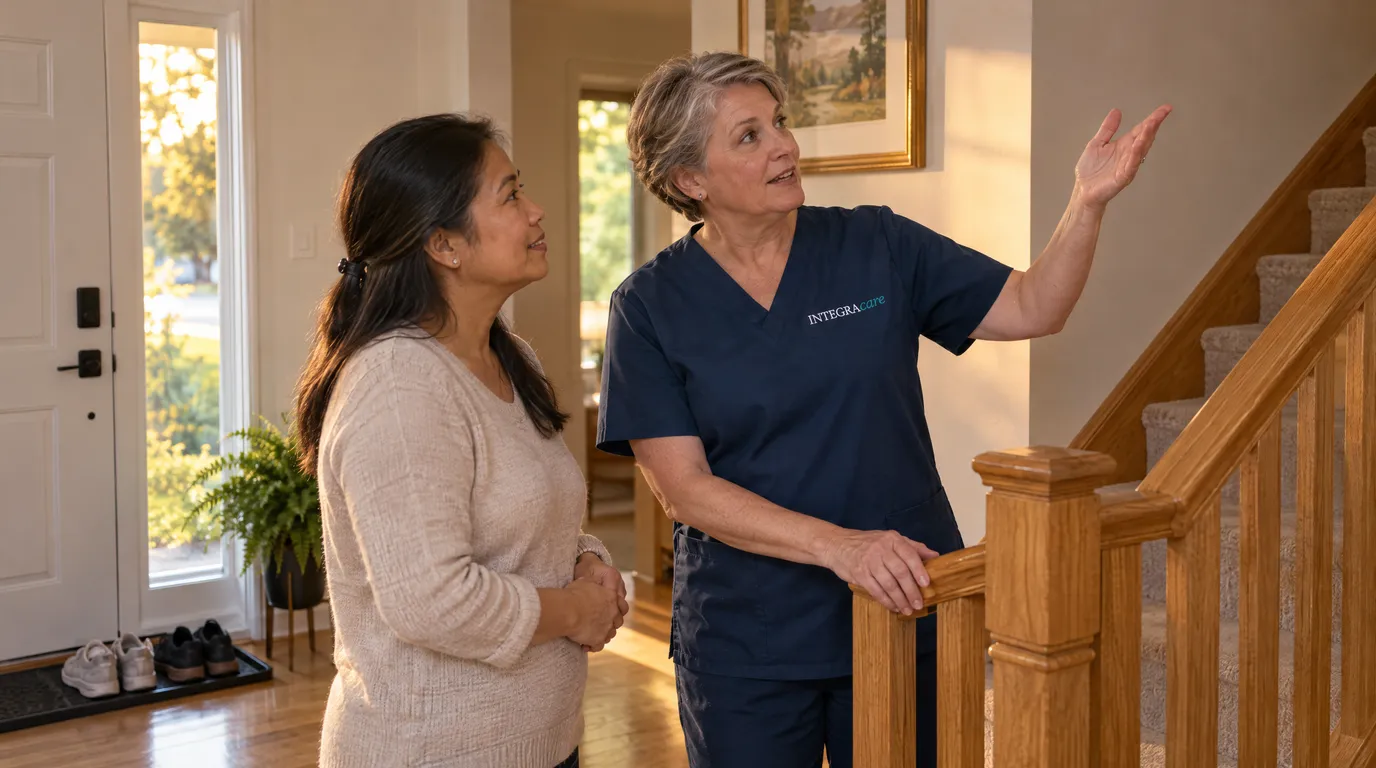
At the in-home assessment, a nurse walks through the rooms with your family. A clear path from bedroom to bathroom, a sturdy railing on every staircase, a shower chair and grab bars all lower the chance of a fall. If the hospital's occupational therapist has recommended equipment, we plan around it.
Winnipeg winters add work at the front door. Our aides keep the entry clear of boots and mats, help with coats and footwear while the person sits, and plan outings around icy days.
The first weeks
Needs shift quickly after a stroke, so the nurse reviews the plan often.
Call when the ward starts talking about a discharge date. We go over the hospital's instructions, the therapy schedule and how many hours of help you need.
Visits can be longer at the start, covering mornings and evenings when washing, dressing and transfers take the most effort. For the first few nights, a family can add around-the-clock care.
Hours can come down as the person manages more alone. The aide's notes appear in the Family Room, a website where relatives you invite can see the visit schedule and read each note as it is recorded.
Help may last a few weeks or many months. When a spouse or adult child has carried most of the load, planned respite visits give them time away.
Share the discharge plan with us, and a nurse will help you set the visit schedule for the first weeks.

Energy and outlook
Fatigue after a stroke can be heavy and hard to predict, and may last for months. One long appointment might leave a person tired until bedtime. The HCA spreads out the harder tasks, plans rest after therapy and keeps evenings quiet.
Sadness and frustration are common too. Our aides watch for changes in sleep, appetite and interest in usual pastimes, and report them to the nurse.
Lowering the risk
The doctor decides the treatment. Our aides help in 3 ways.
Help keeping track of follow-up appointments, so none are missed.
HCAs know the warning signs of a new stroke: a drooping face, a weak arm, slurred speech. At any sign, the HCA dials 9-1-1, because a stroke is an emergency, and tells the nurse on call.
The HCA stays within reach on stairs and in the bathroom. A fall or new leg swelling goes to the nurse straight away.
Side by side
Details from the WRHA and from Shared Health, Manitoba's provincial health organization, are as of October 2026.
Local Resources
Other organizations run these programs. Each sets its own rules, and Integracare is separate from all of them.
Health Sciences Centre (HSC), run by Shared Health, is Manitoba's only Regional Stroke Centre. When appropriate, it can give clot-dissolving medication or remove a clot in the first hours. St. Boniface Hospital's emergency department also receives stroke patients on referral.
Riverview runs inpatient stroke rehab on its 4 East unit, which Shared Health lists as the Provincial In-patient Stroke Rehabilitation Unit. Admission starts with a physician's written application.
Misericordia's Transitional Care Unit serves people who need a longer recovery after a hospital stay. It plans their discharge from the day they arrive.
This WRHA early supported discharge program lets people with a new mild to moderate stroke leave hospital sooner and continue rehab at home. HSC, Riverview and St. Boniface refer patients directly. Referrals from other hospitals and community sites are considered case by case. Patients and families cannot sign up on their own.
After a transient ischemic attack (TIA, often called a mini-stroke) or a stroke with good recovery, a health care provider may refer the person to one of Manitoba's 2 stroke prevention clinics, at Health Sciences Centre and Brandon Regional Health Centre.
The Stroke Recovery Association of Manitoba, (204) 942-2880, runs programs for survivors, such as the Speak Easy Club for communication and a Winnipeg peer support group. Registration is required. Shared Health also lists WRHA's Powerful Tools for Caregivers classes, Heart & Stroke's Care Supporters' Community and A & O: Support Services for Older Adults.
Good to know
For families getting ready for a relative's discharge from a Winnipeg hospital.
During the hospital stay, once a discharge date comes up, so there is time for the nurse's home visit. Our intake team responds within one business day.
Your rehab team: hospital therapists, the Community Stroke Care Service or an outpatient program. Our HCAs follow the written routine your family member brings home.
Yes. A case coordinator, the health professional who assesses your family member for WRHA Home Care, sets any public visits, and our hours are scheduled around them. Case coordinators rarely contact private agencies themselves, so share your coordinator's contact details with our nurse and we will keep in touch.
Yes. A nurse assesses your family member at home, writes the care plan with you and updates it as recovery goes on. Nursing support is available 24 hours a day, 7 days a week.
Other Services
We also provide stroke care in Greater Toronto and stroke care in Ottawa.
Free In-Home Assessment
Tell us about the stroke, the discharge plan and the help you have in mind. Our team responds within one business day and arranges a free assessment at home.
Call our local number, or the toll-free line from out of town.
Prefer to talk?
Winnipeg(204) 977-7575 ↗Toll-free1 (800) 891-4197 ↗We serve families across Greater Winnipeg. See the areas we cover
Clinically reviewed by Bethel McMaster, BScN, RN ·