
Blog
What Your Hospital Discharge Planner Doesn't Tell You
Published
Written by Dennis Fancy
On this page7 sections
When a parent is ready to leave hospital, the call often comes with less notice than families expect. One day you're visiting during posted hours, and the next, a discharge planner is asking when someone can pick your father up. It's not that the hospital is being careless. It's that Manitoba's hospital system is built to move people through as efficiently as possible, and the planning for what happens after discharge doesn't always match the pace of the decision.
Families arranging care for an aging parent in Winnipeg deserve a clearer picture of how discharge really works, where the gaps are, and what to do about them. Integracare provides nurse-led care at home, and our team works with families navigating exactly this transition every week. Here is what the discharge paperwork often leaves out.
Discharge Planning Starts Early, But It Has Limits
Under the Winnipeg Regional Health Authority, your care team actually begins preparing for discharge almost from the day of admission, which is meant to give families time to line up the right supports before the day arrives. Before you leave, the hospital is required to give you a discharge information sheet covering follow-up appointments, prescriptions, recommended resources, and help connecting with community supports such as home care, mental health services, or public health programs (WRHA).
In practice, that information sheet is a starting point, not a finished plan. It tells you what exists. It doesn't arrange it for you, and it doesn't account for how long some of those supports take to actually begin.
The Pressure to Leave Can Feel Sudden
One detail that catches families off guard: once a doctor determines a patient no longer medically needs the hospital bed, declining to move forward with the discharge or transfer plan has real consequences. Manitoba's healthcare system treats this as limiting a bed that someone else needs, and the person can be charged a daily rate set by Manitoba Health, Seniors and Long-Term Care for remaining in a space that's no longer medically necessary (WRHA).
This is rarely spelled out plainly in conversation. Families often learn about it only when they ask for more time to arrange care, and are told a clock is already running. Knowing this ahead of time changes how you plan: the moment discharge is on the table, it's worth having a home care conversation in parallel, not after.
The Real Wait Isn't Leaving Hospital, It's Getting Assessed at Home
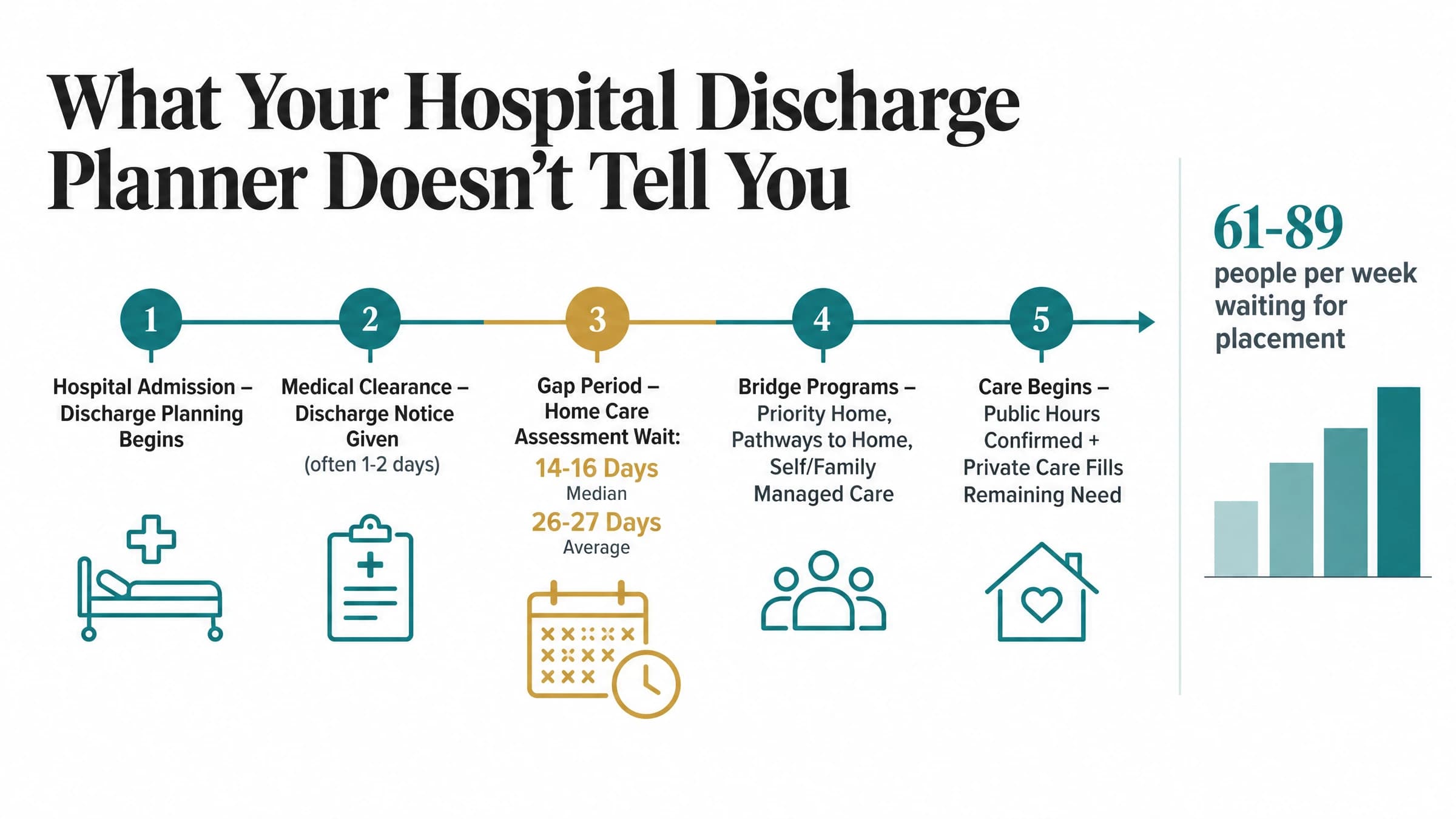
Here's the part that surprises almost every family: being discharged from hospital doesn't mean public home care starts right away. Between 2021 and 2025, the median wait time for a home care assessment in the Winnipeg health region ranged from 14 to 16 days, with average waits stretching to 26 or 27 days over the same period (CBC News). During that same window, the number of people waiting for a personal care home placement while still occupying a hospital bed hit five-year highs, ranging from 61 to 89 people per week over a six-week stretch in August and September 2025 (CBC News).
So a parent can be medically cleared to go home on a Tuesday, and still be waiting two to four weeks later for the public home care assessment that determines what support they'll actually receive. That gap, not the discharge itself, is where most families feel the strain.
Programs That Exist to Shorten the Gap
Manitoba has recognized this pressure point. Programs like Priority Home and Pathways to Home were introduced in the WRHA specifically to shorten hospital stays by delivering more intensive care and support directly in the home, rather than leaving people waiting in hospital for a personal care home bed (Canada.ca). It's worth asking your discharge planner directly whether either program applies to your family's situation, since they aren't always raised unless you ask.
There's also Manitoba's Self/Family Managed Care program, which lets an eligible Home Care client or their family direct their own non-professional care. Instead of waiting for assigned staff, the family receives funding to hire caregivers directly or engage an agency (WRHA). This option exists specifically for people already assessed as eligible for attendant or homemaker services, so it's a useful question to raise during the assessment conversation, not after.
Eligibility Isn't Automatic
To qualify for Manitoba's public Home Care Program, a person must be a Manitoba resident registered with Manitoba Health, require health services or help with daily activities, and need more support than family, friends, or existing community resources can reasonably provide (Nova Scotia Centre on Aging / MSVU). In practice, this means the assessment looks closely at what support already exists at home, including a working spouse or adult children living nearby, before determining how much public care is approved. Families are sometimes surprised the approved hours are fewer than hoped, which is often the moment they start looking at private options to fill the rest.
Filling the Gap With Private Care
This is where many Winnipeg families turn to private home care, either to bridge the wait for a public assessment or to add hours once public care is in place but isn't quite enough. A caregiver can typically begin within days rather than weeks, which matters enormously in that first disorienting stretch after a hospital stay.
Integracare's care plans are built with registered nurse supervision, 24/7, so a parent coming home after a hospital stay, whether recovering from surgery, a fall, or a health event, has a plan that's actually monitored, not just handed over. Depending on what's needed, that might mean personal support with daily routines, short-term recovery help, or 24-hour home care while a family gets its bearings. For a parent managing a progressive condition, it may also mean dementia care planned around the realities of hospital-to-home transitions, which can be especially disorienting for someone living with cognitive change.
If you're facing a discharge date in the next week or two, the most useful first step is a direct conversation about what's actually possible at your parent's address. Contact us about home care in Winnipeg and we can talk through timing, options, and how private care can work alongside whatever public support is already in motion.
Frequently Asked Questions
How much notice does a hospital have to give before discharge in Winnipeg?
There's no fixed legal notice period, and in practice notice can be as short as a day or two once a doctor determines a patient no longer medically needs the bed. It's best to start asking about discharge timing early in the hospital stay rather than waiting for a formal date.
Can I say no to a hospital discharge plan?
You can raise concerns and ask questions, but declining a transfer or discharge once care is no longer medically necessary can result in a daily charge set by Manitoba Health, Seniors and Long-Term Care. It's better to request more time to arrange supports than to refuse the plan outright.
How long does it take to get a home care assessment after leaving hospital?
Recent data shows a median wait of 14 to 16 days for a Winnipeg home care assessment, with average waits closer to 26 to 27 days. Many families arrange private care to cover this gap while the public assessment is pending.
What is the difference between a health care aide and a registered nurse in home care?
In Manitoba, health care aides (HCAs) provide hands-on daily support such as bathing, mobility, and personal care, while registered nurses (RNs) and licensed practical nurses (LPNs) handle clinical tasks and oversee the overall care plan. Integracare's model has an RN involved in planning and supervision throughout.
Does private home care replace the need for a public home care assessment?
No, and the two often work together well. Many Winnipeg families use private care to bridge the wait for an assessment, then adjust the private hours once public home care hours are confirmed.
Free In-Home Assessment
The Care Your Family Deserves Starts Here
Speak with our team about a personalized care plan. Book a free, no-obligation in-home assessment and we will help you find the right support for your loved one.