
Blog
Why Waiting Too Long for Home Care Can Backfire
Published
Written by Dennis Fancy
On this page7 sections
Most families don't decide to get help for an aging parent all at once. They wait. They tell themselves things are manageable, that next month will be a better time to look into it, that Mom or Dad isn't quite ready. Integracare provides nurse-led care at home, and our team sees this pattern often: the wait usually ends with a fall, a hospital stay, or a crisis that forces a decision nobody had time to plan for.
This article looks at why the wait happens, what it actually costs families in Winnipeg, and what to watch for so you can act before a crisis makes the decision for you.
Why Families Wait Longer Than They Should
The reasons are almost always the same. Parents resist because accepting help feels like losing independence. Adult children hesitate because they're juggling jobs, their own kids, and guilt about "putting someone in care." And everyone assumes there will be a clear moment when help becomes obviously necessary.
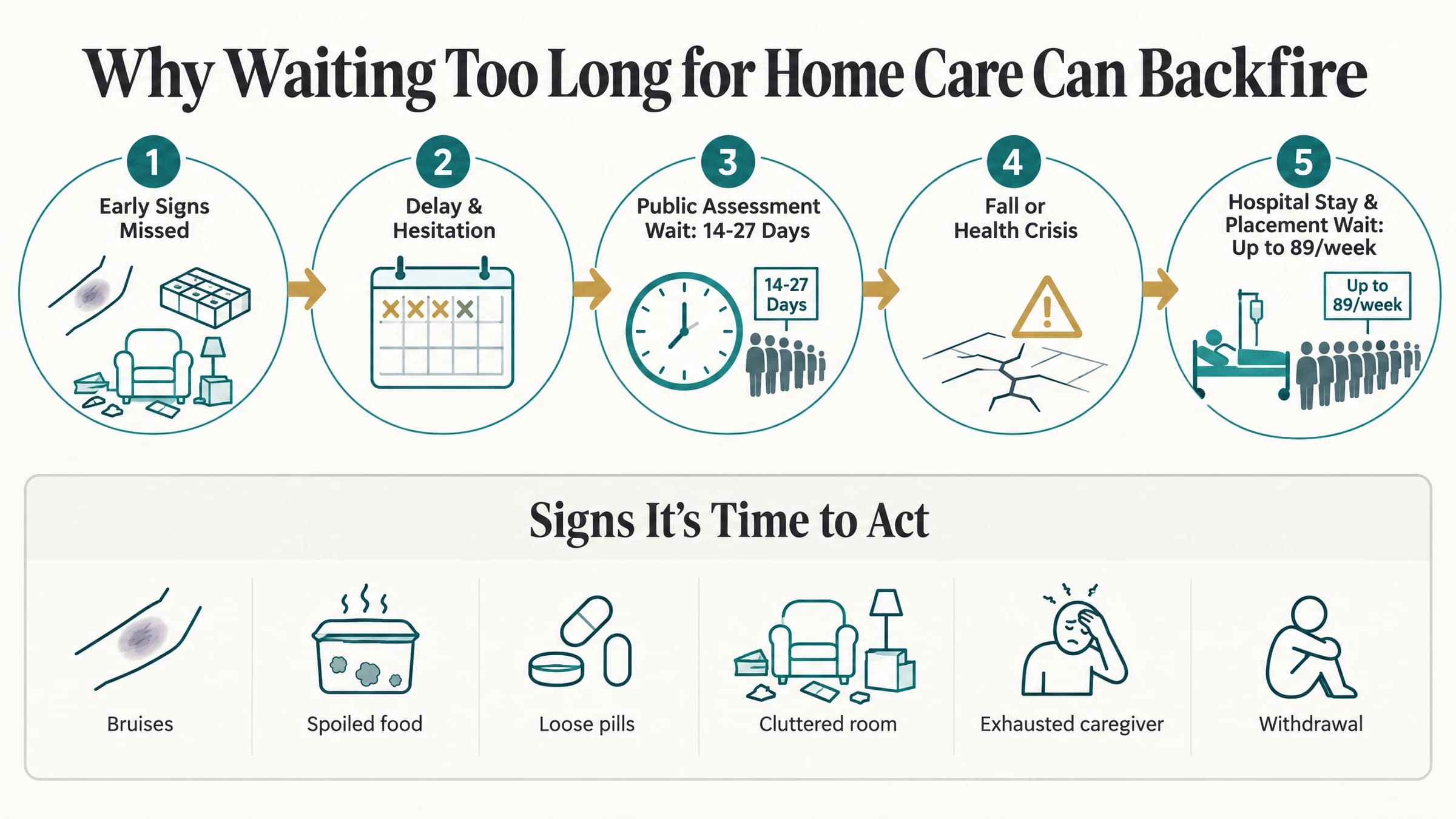
In practice, that moment rarely arrives with a flashing sign. Decline is gradual: a missed pill here, a skipped meal there, a bruise nobody mentions. Families often tell us they wish they had called sooner, not because anything dramatic happened right away, but because the transition to care is gentler when it isn't rushed.
The Wait Times Are Longer Than Most People Expect
Even families who decide to act can run into delays in the public system. Between 2021 and 2025, the median wait for a home care assessment in the Winnipeg health region ranged from 14 to 16 days, with average waits stretching to 26 or 27 days, according to Winnipeg Regional Health Authority data. Connie Newman of the Manitoba Association of Senior Communities has said that for someone waiting weeks for an assessment, that delay can feel like a lifetime, since home care is often what keeps a senior independent and out of hospital in the first place (source).
Manitoba's Health Minister has acknowledged that these wait times haven't improved in five years even as demand has grown, and that the province needs to hire, train, and retain more home care workers to close the gap (source). That's not a criticism of the people doing the work. It's simply the reality families need to plan around: if you wait until a crisis to request an assessment, you may be waiting weeks for a call back while the situation at home keeps changing.
What Delay Actually Costs: Falls and Hospital Stays
The risk of waiting isn't abstract. Falls are the leading cause of injury-related hospitalization, death, and emergency department visits among older Canadians, with 20 to 30 percent of older adults falling each year (source). In Manitoba, falls caused 6,261 injury-related hospitalizations across all ages in 2020-21 alone (source). In the Winnipeg health region specifically, an average of 87 people die and 1,649 are hospitalized each year because of a fall, and half of those falls happen inside the home (source).
Once a senior is hospitalized, getting back home isn't guaranteed to be quick either. Over one recent six-week stretch, the number of people waiting in Winnipeg hospitals for a personal care home placement ran as high as 61 to 89 people per week, each a five-year high (source). A hospital stay meant to last a few days can turn into weeks, simply because the next step in the system is also backed up.
This is the chain families often don't see coming: a small safety gap at home leads to a fall, the fall leads to a hospital stay, and the hospital stay leads to a long wait for placement, all of which could often have been prevented with the right support in place earlier.
How Private Home Care Closes the Gap
Manitoba's public Home Care program, run through the Winnipeg Regional Health Authority since 1974, exists specifically to help people stay independent at home for as long as possible and delay or avoid a move into long-term care (source). It's a valuable program, but assessment waits mean it isn't always available the moment a family needs it.
Private home care can start sooner and flex around what a family actually needs, whether that's a few hours of personal support a week or 24-hour home care after a hospital discharge. With Integracare, registered nurse supervision, 24/7, means a plan of care is set up by a nurse and adjusted as needs change, not left static for months at a time. For families noticing early memory changes, our dementia care team can also help put routines and safety measures in place before a crisis, rather than after one.
Signs It's Time to Act Now, Not Later
You don't need a diagnosis or a hospital discharge to justify arranging help. Watch for:
- Unexplained bruises, or a fall the person downplays
- Weight loss, or food in the fridge that's gone bad
- Missed medications, found loose in a drawer or pillbox
- A home that's become noticeably less tidy or more cluttered
- A spouse or family caregiver who seems exhausted or overwhelmed
- Withdrawal from calls, visits, or activities they used to enjoy
Any one of these on its own might mean nothing. Two or three together are worth a conversation, ideally before an ER visit forces one.
How to Start Without the Long Wait
The most useful thing you can do today is get the ball rolling on two tracks at once. Request a Home Care assessment through Manitoba's public system so that process is underway, and separately speak with a private provider about what can be arranged in the meantime. Our home care in Winnipeg team can often confirm availability and put a care plan in place within days, which gives your family breathing room while the public assessment works through its queue.
If you're not sure where to start, a short conversation is usually enough to map out options for your specific situation, cost included. Contact us about Winnipeg care and we'll walk through what's possible for your parent's address and needs.
Frequently Asked Questions
How long does it take to get home care started in Winnipeg?
Through Manitoba's public Home Care program, assessments have recently taken a median of 14 to 16 days, with averages closer to 26 or 27 days (source). Private care, like the services Integracare arranges, can often begin much faster once a family's needs are confirmed.
Is it too early to look into care if Mom or Dad is still managing okay?
It's rarely too early. Setting up light support, like a weekly check-in or help with housekeeping, is far easier to introduce before a crisis than after one, and it gives everyone time to adjust gradually.
What's the real risk of waiting too long?
The biggest risk is a fall or health event that leads to a hospital stay, which can then mean a long wait for a personal care home bed if independent living is no longer safe. Falls remain the leading cause of injury-related hospitalization for older adults in Manitoba (source).
Can private home care work alongside Manitoba's public Home Care program?
Yes. Many families use both: public Home Care for certain supports, and private care to fill gaps in scheduling, hours, or specialized needs like dementia or palliative support. Speak with your care coordinator and a private provider to see how the two can complement each other.
What should I ask a doctor before arranging care?
Ask your parent's doctor whether their current medical needs call for a registered nurse or licensed practical nurse involved in care, and whether any mobility or cognitive changes raise fall risk. That guidance helps shape a safer, more accurate care plan from the start.
Free In-Home Assessment
The Care Your Family Deserves Starts Here
Speak with our team about a personalized care plan. Book a free, no-obligation in-home assessment and we will help you find the right support for your loved one.