
Blog
How Palliative Care at Home Works in Ottawa: A Family’s Guide
Published
Written by Lee Grunberg, M.B.A. — President & CEO
Reviewed by Kristine McGinn, BScN — Director of Integracare East
On this page11 sections
Key Takeaways
- Palliative care can begin early, not only during the final stages of illness.
- In-home palliative care helps Clients remain comfortable in familiar surroundings.
- Nurses and Caregivers provide different but complementary support as the Client’s needs change.
- Public and private home care services can work together to provide additional support.
- Care can adapt over time to support comfort, independence and the Client’s wishes.
Home holds the routines and familiar comforts that can become especially important when someone is living with a serious illness.
For many Families, palliative care at home means their loved one can remain in familiar surroundings while receiving nursing care, personal support, and help managing changing symptoms. It can also reassure Families of knowing they have experienced professionals to turn to as care needs change.
And palliative care is not only for the final days of life. A palliative approach can begin earlier in a serious illness, with care focused on comfort, symptom management, and helping a Client continue living as well as possible at home.
What Does a Palliative Approach to Care Mean?
A palliative approach focuses on helping a Client live as comfortably and fully as possible while managing a serious or life-limiting illness. It can begin earlier in an illness and be incorporated into regular care rather than waiting until the final stages of life.
Comfort is an important part of that care, but it is not limited to physical symptoms.
Care Shaped Around What Brings Comfort
Pain and other physical symptoms are only part of what can make living with a serious illness difficult. A Client may also be worried about losing independence, anxious about what comes next, or have cultural or spiritual wishes that become increasingly important as their health changes.
Palliative care makes room for those concerns. For one Client, comfort may mean staying involved in decisions and continuing a familiar morning routine. For another, it may mean having quiet time for prayer, observing cultural traditions, or having Family close by when they are feeling anxious. Understanding these preferences helps the care team provide support that feels respectful and familiar to the individual Client.
Families are affected too. Spouses and adult children may be balancing caregiving responsibilities with worry, uncertainty, and anticipatory grief. Connecting Families with appropriate emotional, grief, and bereavement support can help them navigate those changes both during a loved one’s illness and after a loss.
Making Care Decisions Before a Crisis
An important part of a palliative approach is having conversations about what the Client wants from their care.
Through Advance Care Planning and ongoing goals-of-care discussions, Clients can share their values, wishes, and preferences with their Family and healthcare team. Having these conversations earlier can help everyone understand what is most important to the Client before a sudden change in health requires difficult decisions.
Palliative care also does not have to come only from a specialist team. Family physicians, nurses, and other healthcare professionals can incorporate palliative principles into regular care, with specialist palliative care available when more complex needs require additional expertise. For a Client receiving care at home, these pieces come back to one goal: understanding what is important to the person and shaping care around those wishes. With nursing support for changing health needs and Caregivers helping with comfort and familiar routines, Families can feel supported as their loved one’s needs evolve.
How Can Families Arrange Palliative Care at Home in Ottawa?
There is no single way that palliative care at home begins. A Client may be returning home from hospital, already receiving public home care, or their Family may simply recognize that more support is needed.
Coming Home From the Hospital
For a Family preparing to bring a loved one home from an Ottawa hospital, discharge planning can help coordinate what needs to be in place before they arrive.
Depending on the Client’s needs, that can include prescriptions, medical equipment, community services, and home visits. Bruyère’s Hospital to Home Transition Guide provides additional information for Families preparing for the transition home.
Arranging Publicly Funded Home Care
Clients already living at home may also be connected with Ontario Health atHome . A Care Coordinator can assess the Client’s needs and determine which publicly funded home care services they are eligible to receive.
Adding Private Home Care
Families can also arrange private home care directly.
This can be particularly helpful when a Client needs more consistent support than publicly funded visits provide. At Integracare, a Registered Nursing Coordinator can assess the Client’s needs and develop a person-centred care plan that works alongside the Client’s physician and other members of their existing care team.
Who Can Support a Client Receiving Palliative Care at Home?
Palliative care is a team effort. Who is involved will depend on the Client’s health, symptoms, and level of support required.
For a Family, understanding everyone’s role can make an unfamiliar situation feel more manageable.
- Registered Nurses (RNs) and Registered Nursing Coordinators can assess changing clinical needs, support symptom management and oversee the nursing care plan.
- Registered Practical Nurses (RPNs) can provide hands-on nursing care within their scope of practice, including medication administration, monitoring and wound care when required.
- Personal Support Workers (PSWs) can assist with personal care, hygiene, repositioning, mobility and other daily routines while helping the Client remain comfortable.
- Physicians and palliative care specialists provide medical direction and can help manage more complex symptoms. In Ottawa, the Champlain Regional Palliative Consultation Team supports community healthcare professionals caring for Clients with complex palliative needs.
For Families, the important part is not simply how many professionals are involved. It is how well everyone communicates as the Client’s needs change.
How Do Private Home Care Services Integrate with Public Support?
Private home care offers flexibility for Families: it can function independently as a dedicated, nurse-supervised care plan, or it can work alongside public healthcare visits and community hospice programs.
| Care Provider | Primary Focus | Typical Scheduling | Clinical Supervision |
| Ontario Health atHome | Public baseline visits and overall system coordination | Intermittent blocks (e.g., 1–2 nursing visits/day; short PSW visits) | Public Care Coordinator manages allocations |
| Hospice Care Ottawa | Volunteer support, day programs, and residential beds | Scheduled day programs or residential admission (subject to waitlists) | Hospice clinical staff for residential patients |
| Private Home Care | Dedicated, one-on-one nurse-supervised care | Continuous blocks (4-, 8-, 12-hour shifts) up to 24/7 care | Dedicated RN supervisor manages bedside team |
These supports often work side by side. For instance, an Ontario Health atHome visiting nurse may attend to specific clinical tasks, while a private PSW assists with morning routines, meals, and gentle companionship throughout the day. If a Client is awaiting admission to Hospice Care Ottawa , private care provides consistent support at home during the interim.
When Nights Become More Difficult
Nighttime can feel very different when someone you love is seriously ill.
A Client may become restless, need help changing position, wake up feeling uncomfortable, or need assistance getting safely to the bathroom. For a spouse or adult child who has been providing care all day, being awake throughout the night can quickly become exhausting.
Overnight home care can provide another set of attentive hands.
Depending on the Client’s care plan, an overnight Caregiver may help with:
- Changes in comfort or restlessness
- Safe movement and transfers
- Repositioning and personal care
- Observing changes that should be communicated to the nursing team
Just as importantly, overnight support can allow Family members to rest.
A daughter can go back to being a daughter. A husband can sit beside his wife without also feeling responsible for every aspect of her care. Professional support does not replace the Family’s role; it can give Families more precious time with their loved one.
How Can Home Care Change as an Illness Progresses?
Palliative care at home should not remain static while a Client’s needs change.
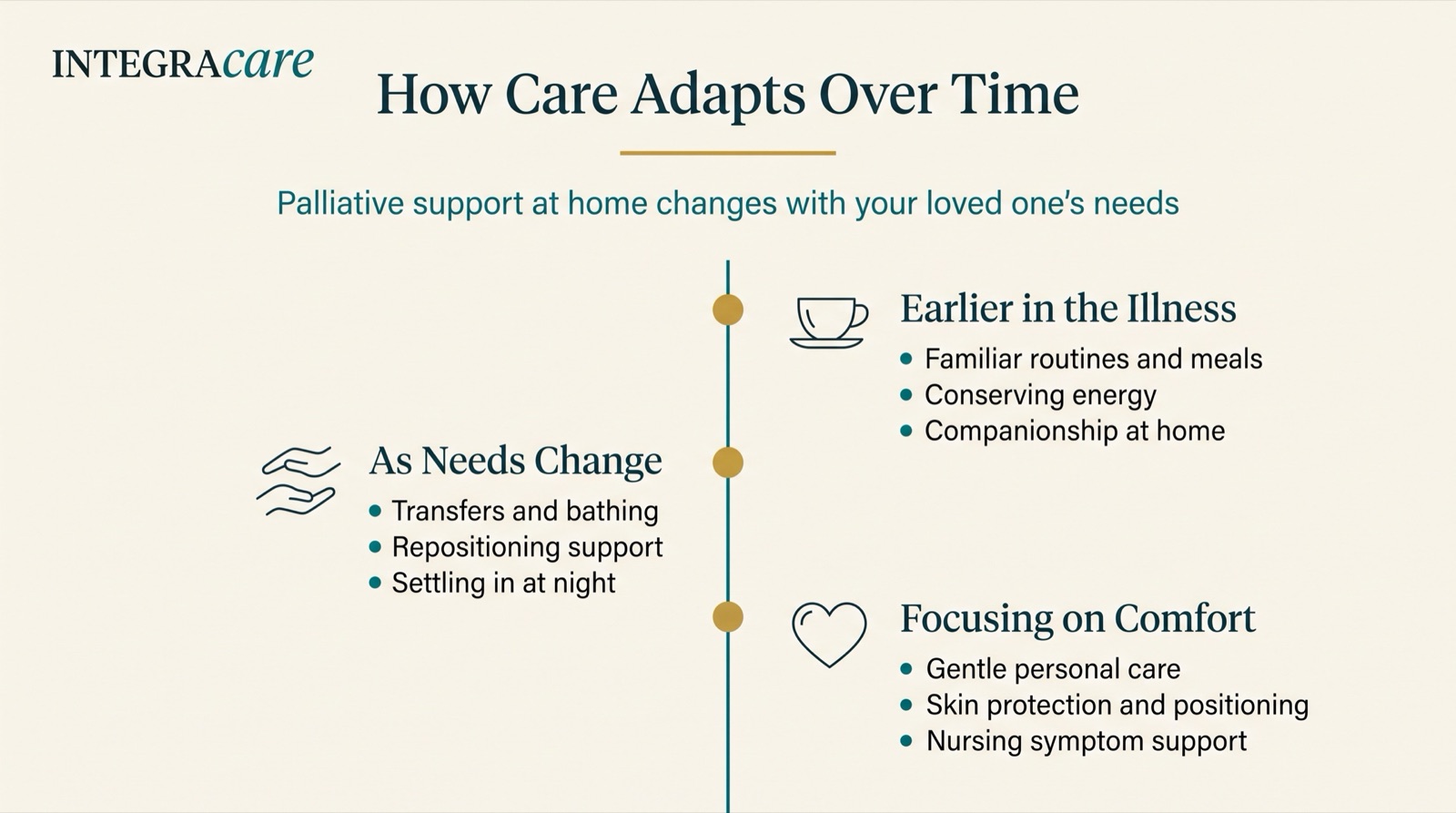
Earlier on, someone may still move around independently but need help conserving their energy, preparing meals, or keeping up with personal routines.
As mobility and stamina change, more hands-on support may be needed with transfers, bathing, repositioning, or getting comfortably settled for the night.
Later, the focus may shift further toward comfort: gentle personal and oral care, skin protection, positioning and nursing support for symptom management.
This is where having Caregivers who know the Client can be particularly valuable. A familiar Caregiver learns what is usual for that person, how they normally communicate, how much assistance they typically need, and what helps them feel comfortable.
When something changes, that familiarity provides important context for the Caregiver, Family, and nursing team.
Why Families Choose Integracare for Palliative Home Care in Ottawa
For Families navigating a serious illness, bringing care into the home is about more than completing clinical tasks. It is about helping a loved one remain somewhere familiar while making sure the right support is around them.
Since 1991, Integracare has provided nurse-supervised home care to Ontario Clients and Families. In Ottawa, Registered Nursing Coordinators oversee Client-centred care plans, while Caregivers are thoughtfully matched to Clients and can work alongside physicians, Ontario Health atHome and other members of the Client’s care team.
Most importantly, care continues to adapt to the person.
For one Client, that may mean a few additional hours of support with personal routines. For another Family, it may mean nursing care and overnight assistance as their loved one’s needs become more complex.
Help Your Loved One Stay Comfortable at Home

If someone you love is living with a serious illness, you do not have to wait for a crisis to begin talking about additional support. Connect with us to discuss your loved one’s needs and how nurse-supervised palliative home care can help them remain comfortable, supported, and surrounded by the familiarity of home.
Palliative Care FAQs
What is in-home palliative care, and when can it begin?
In-home palliative care is person-centred support for people living with a serious or life-limiting illness. It focuses on comfort, symptom management, stress reduction and quality of life, while respecting the Client’s priorities, beliefs and wishes. Palliative care is not limited to the final days of life or to hospice care. It can begin early, continue alongside treatments and adapt as the illness, symptoms and care needs change. It is available in homes, hospitals, hospices and other settings.
What palliative care services does Integracare offer in Ottawa?
Integracare offers private in-home palliative care in Ottawa that combines nursing care, personal support, companionship and practical daily living assistance. Depending on the Client’s needs, the care plan may include support with mobility, meals, personal routines, comfort and symptom management. Integracare’s Ottawa team includes Registered Nurses, Registered Practical Nurses and Personal Support Workers, with Nursing Care Manager oversight available around the clock for Clients, Families and Caregivers. Services may be scheduled for short-term or ongoing needs.
How can a Family arrange palliative care at home in Ottawa?
Families can arrange private palliative home care by contacting Integracare Ottawa for a free in-home assessment. The assessment is an opportunity to discuss the Client’s health needs, daily routines, cultural or spiritual preferences, existing supports and goals of care. Integracare then develops a person-centred plan in collaboration with the Client, Family and healthcare team. Families can also contact Ontario Health atHome to request an assessment for publicly funded home and community services.
Can Integracare’s private home care work alongside Ontario Health atHome services?
Yes. Private palliative home care can complement publicly funded services coordinated by Ontario Health atHome. An Ontario Health atHome care coordinator assesses eligibility and helps arrange available home and community supports, while Integracare can provide additional private nursing, personal support or companionship based on the Family’s preferences. Sharing the care plan, medication information and contact details between providers helps the broader care team coordinate care safely as the Client’s needs change.
What should Families consider before a hospital discharge to palliative care at home?
Begin discharge planning early by asking the hospital care team about medications, equipment, follow-up appointments, warning signs, and who to contact with questions. Confirm which in-home supports are already arranged and whether an Ontario Health atHome referral or assessment is needed. If additional private care would help, Integracare can assess needs and coordinate nursing or personal support before the Client returns home. Clear written instructions help make the transition more manageable.
What does advance care planning mean in palliative care?
Advance care planning gives a Client time to reflect on what matters most, discuss values and wishes, and prepare for future healthcare decisions. It can include identifying a substitute decision-maker and having ongoing goals-of-care conversations with Family and healthcare professionals. It does not replace informed consent for a current treatment decision. Starting these discussions early can help the care team understand the Client’s priorities if illness progression makes communication more difficult later.
Who may be part of an in-home palliative care team?
An in-home palliative care team may include a family physician or nurse practitioner, Registered Nurses, Registered Practical Nurses, Personal Support Workers, a care coordinator, pharmacists, hospice staff, and other specialists. Their roles differ, but the shared purpose is to support the Client’s physical, emotional, spiritual, and practical needs. Integracare’s Nursing Care Managers work with Clients, Families, and healthcare providers to coordinate their private care plan and communicate changing needs. The exact mix depends on the Client’s needs and choices.
How does palliative care support Family members and Caregivers?
Palliative care supports Families and Caregivers by providing practical help, emotional support, education, and connections to community resources. Personal Support Workers can assist with daily routines, mobility, meals, and personal care, while nursing support can help address changing clinical needs within the appropriate scope of practice. Ontario Health atHome can also provide information about respite, hospice programs, bereavement support and other community services. This shared support can reduce caregiver strain and uncertainty.
Can overnight palliative home care help when nights become difficult?
Overnight palliative home care can provide reassurance when a Client needs more support with comfort, mobility, personal care, or safety during the night. The appropriate level of support depends on the person’s assessed needs and care plan. Integracare offers 24/7 home care in Ottawa, and its Nursing Care Managers are available around the clock to Clients, Families and Caregivers. Overnight care can also allow Family Caregivers to rest.
How can a palliative care plan change as illness progresses?
A palliative care plan should be reviewed as symptoms, mobility, stamina, communication, or Family needs change. Earlier support may focus on conserving energy, meals, and familiar routines. Later, a Client may require more assistance with personal care, repositioning, comfort or nursing oversight. Integracare develops care plans collaboratively and states that they adapt as needs evolve. Regular communication between the Client, Family and care team helps ensure support remains appropriate and person-centred.
When is specialist palliative care consultation needed in Ottawa?
Specialist palliative care may be helpful when symptoms are complex, difficult to manage or require additional expertise, or when Families need support with goals-of-care discussions. In the Ottawa region, the Champlain Regional Palliative Consultation Team provides consultation for healthcare professionals supporting people with actively progressing life-limiting illness, complex symptoms or end-of-life needs. Referrals require specific clinical criteria and ongoing involvement from a primary care provider; Families should speak with their care team.
What should Families ask when choosing a private palliative home-care provider?
Ask who will supervise care, how the provider matches Caregivers to the Client, how plans are updated, and how concerns are communicated after hours. Families should also ask about the qualifications of nurses and Personal Support Workers, the services available, scheduling flexibility, and how the provider collaborates with physicians and public services. Integracare describes 24/7 Nursing Care Manager support, free in-home assessments, and personalized, collaborative care plans for Ottawa Clients and Families.
Free In-Home Assessment
The Care Your Family Deserves Starts Here
Speak with our team about a personalized care plan. Book a free, no-obligation in-home assessment and we will help you find the right support for your loved one.
About the Author: Lee Grunberg

President & CEO, M.B.A.
Lee joined Integracare as President & CEO on August 2, 2016 after an approximately 20 year career in Private Equity and Investment Banking. Lee brings tremendous operational knowledge and governance experience along with an incredible passion and energy to Integracare.