
Blog
How to Access Publicly Funded Home Care and How High-Quality Private Home Care Can Fill the Gaps
Published
Updated
Written by Lee Grunberg, M.B.A. — President & CEO
Reviewed by Kristine McGinn, BScN — Director of Integracare East
On this page15 sections
Key Takeaways
- Ontario Health at Home assists Ottawa families with accessing publicly funded home care, contingent on eligibility and assessed needs.
- Public home care offers support for essential medical and personal tasks, but often has limitations such as reduced hours, waitlists, and service gaps.
- Private home care provides flexible scheduling, consistent caregivers, respite options, and daily support.
- Combining public and private care can create a more comprehensive care plan for families.
- Financial aid and tax credits are available to help offset the costs of private care.
When someone you love begins needing a little extra help, the changes are often subtle at first. A parent who once managed everything independently starts asking for help with meals, a spouse feels less steady walking around the house, or recovery after a hospital stay takes longer than expected. Over time, those small moments can leave families wondering what support is available and where to begin.
For many Ottawa families, the first step is reaching out to Ontario Health atHome, which helps coordinate access to publicly funded home care services. These services provide valuable support for eligible individuals, but depending on a person’s health, mobility, and daily routines, families may find that additional care is needed to fill the gaps between scheduled visits.
Home care in Ontario combines publicly funded services with private care options, giving families the flexibility to build support around their loved one’s unique needs. Understanding how Ontario Health atHome works, what services are available, and when private home care can complement publicly funded care helps families make informed decisions with greater confidence as needs continue to evolve.
What Is Ontario Health atHome?
If you’ve started looking into home care in Ottawa, you’ve probably come across the name Ontario Health atHome . At first glance, it may seem like a new organization, but many families will recognize its previous names, including Community Care Access Centres (CCACs), Local Health Integration Networks (LHINs) such as Champlain LHIN, and Home and Community Care Support Services.
Today, Ontario Health atHome coordinates access to publicly funded home and community care services across Ontario. Its role is to assess a person’s care needs, connect eligible individuals with appropriate healthcare services, coordinate care between providers, and adjust support as those needs change. Rather than delivering care directly, it helps families navigate the healthcare system and access services that allow more people to recover, manage health conditions, and remain safely at home.
What Services Does Ontario Health atHome Coordinate?
Following an assessment, Ontario Health atHome may arrange services such as nursing care, Personal Support Worker (PSW) visits, physiotherapy, occupational therapy, speech-language pathology, social work, dietitian support, and recommendations for medical equipment or other community resources. Care coordinators also work closely with hospitals, family physicians, specialists, and caregivers to help ensure services are organized around the individual’s health needs.
While publicly funded home care provides an essential foundation of support, visits are based on clinical eligibility, available resources, and assessed needs. As health conditions change or additional day-to-day assistance becomes necessary, many families choose compassionate private home care services. Private support often provides greater flexibility, continuity, and personalized care, helping older adults remain comfortable, well supported, and living safely at home for as long as possible.
How Ontario Health atHome Supports Care at Home
Support often begins when daily tasks start taking longer or require assistance. This might include help getting in and out of the bath, remembering medications, or managing recovery after a hospital stay.
Ontario Health atHome provides access to care through a structured process. A care coordinator completes a comprehensive assessment to understand how health needs are affecting daily function.
Based on this assessment, they develop a care plan that may include:
- Personal support services for bathing, dressing, and mobility
- Registered nurse visits for medical care such as wound management
- Occupational therapy assessments to improve safety at home
- Rehabilitation services such as physiotherapy
- Ongoing care coordination and reassessment
Care is allocated based on need, with a focus on maintaining safety and supporting essential daily activities.
Who May Qualify for Publicly Funded Home Care in Ontario?
One of the most common misconceptions about publicly funded home care is that it is based on age or income. In reality, eligibility is primarily determined by assessed healthcare needs.
Ontario Health atHome considers whether someone can safely remain at home with appropriate support and whether publicly funded services can help maintain their health, independence, and overall function.
People who may qualify include:
- Older adults experiencing changes in mobility or independence.
- Individuals recovering after surgery or hospitalization.
- People living with chronic or progressive health conditions.
- Adults requiring nursing care at home.
- Individuals living with dementia or other cognitive conditions.
- People receiving palliative or end-of-life care.
- Adults with physical disabilities or complex medical needs.
During the assessment, a care coordinator looks beyond a medical diagnosis alone. They consider how health conditions affect everyday activities such as walking safely, preparing meals, managing personal care, taking medications, moving around the home, and performing daily routines independently.
Because eligibility is needs-based, two people with the same medical condition may receive different levels of publicly funded support depending on how that condition affects their ability to live safely at home.
How to Access Ontario Health atHome Services in Ottawa
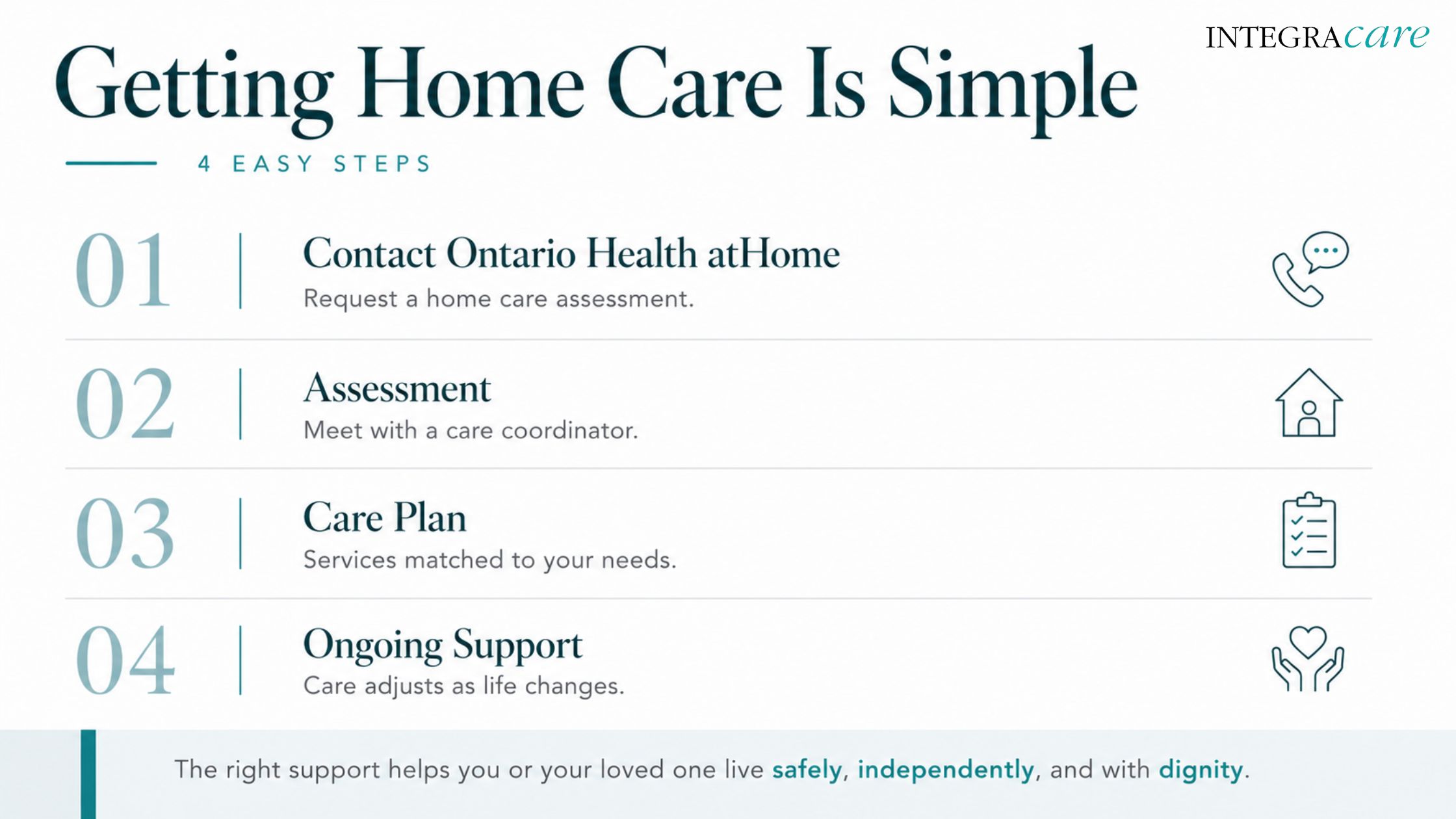
Knowing where to begin often makes the process feel much more manageable. Ontario residents do not usually need a physician referral to request a home care assessment. Families can contact Ontario Health atHome directly, or referrals may come from hospitals, healthcare providers, or community organizations when additional support is needed.
Step 1: Contact Ontario Health atHome
The first step is requesting a home care assessment through Ontario Health atHome. During the initial conversation, you’ll be asked questions about your loved one’s health, current challenges, living situation, and immediate care needs.
Having information such as recent hospital discharge summaries, current medications, mobility concerns, and physician contact information available can help streamline the intake process.
Step 2: Complete a Comprehensive Care Assessment
If appropriate, a care coordinator will arrange a comprehensive assessment, often in the person’s home.
This visit looks at much more than medical conditions alone. The assessment considers mobility, personal care needs, home safety, cognitive function, caregiver availability, daily routines, and the types of support that may help someone continue living safely at home.
The goal is to understand how everyday life is being affected—not simply what diagnosis appears in a medical record.
Step 3: Develop an Individualized Care Plan
Following the assessment, the care coordinator develops a personalized care plan based on identified needs, eligibility, and available publicly funded services.
The plan outlines:
- recommended services
- frequency of visits
- allocated hours of care where applicable
- healthcare professionals involved
- follow-up assessments as needs change
Some services can begin relatively quickly, while others may depend on provider availability, urgency, or local demand. Care coordinators continue monitoring the care plan and make adjustments when health circumstances change.
Step 4: Ongoing Care Coordination
Home care is rarely static. Recovery progresses, health conditions evolve, and caregiver needs often change over time.
Regular reassessments help ensure publicly funded services continue reflecting current needs while connecting families with additional community support when appropriate.
For some Ottawa families, this is also the stage where additional home care services in Ottawa become helpful. Private care can often work alongside Ontario Health atHome to provide extra assistance between scheduled visits, overnight supervision, companionship, or more consistent daily support when care needs extend beyond publicly funded services.
What Services Does Public Home Care Actually Cover?
Publicly funded home care through Ontario Health atHome covers a range of essential services designed to support health and independence at home. The specific services and allocated hours of care are determined based on your individual assessment.
- Nursing Care includes registered nurse visits for wound care, medication management, IV therapy, catheter care, and other medical needs. These visits are scheduled according to your clinical requirements rather than on a fixed schedule.
- Personal Support Services assist with essential daily activities such as bathing, dressing, grooming, toileting, mobility, and eating. The allocated hours are determined by your assessed needs.
- Rehabilitation Services include physiotherapy, occupational therapy, and speech-language pathology to help regain function after illness, injury, or surgery. These services are typically time-limited and goal-focused.
- Other Covered Services may include social work support, dietitian consultations, medical equipment purchases, home modifications for safety and accessibility, and short-term rehabilitation facility stays when necessary.
It’s important to understand that coverage is determined by clinical need rather than preference, and there may be limitations on the frequency and duration of services.
Understanding the Gaps Between Public and Private Home Care
While publicly funded home care provides essential support, many families encounter limitations that leave gaps in their care plan. Understanding these limitations can help you plan for additional support when needed.
- Limited Hours are one of the most common challenges. Ontario Health atHome allocates specific hours of care based on assessed needs, but these often don’t cover all the assistance a person requires throughout the day or week.
- Weekend Gaps can be particularly challenging, as publicly funded services typically operate on reduced schedules during weekends and holidays, leaving families without support during these times.
- Staff Changes and lack of caregiver continuity can disrupt care routines. You may encounter different care providers each visit, which can be unsettling for those who benefit from consistent support.
- Task-Focused Assistance means that care workers focus on specific tasks rather than providing comprehensive support. For example, they might assist with bathing but not provide companionship or meal preparation.
- Wait Times for services can vary significantly depending on your location and specific needs. Some non-urgent services may have waitlists that delay the start of care.
These limitations don’t reflect a lack of quality in publicly funded services but rather the reality of a system with finite resources serving a growing population with diverse needs.
Why Families Choose Private Home Care Alongside Public Services
Many families are surprised to learn that home care doesn’t always mean having enough care. Publicly funded services provide valuable medical and personal support, but visits are often brief and focused on essential clinical needs. That can leave families managing everything in between meal preparation, companionship, mobility, personal routines, and transportation.
Private home care gives families the freedom to choose the level of support that fits their lives, rather than the level of care the system can provide. Whether it’s a few extra hours each week, overnight care, or comprehensive daily assistance, care is built around the person’s routines, preferences, and goals so they can continue living safely and comfortably at home.
| Aspect | Public Home Care | Private Home Care (Designed Around Your Life) |
| Coverage Scope | Focuses on essential medical care and safety-based support. | Delivers comprehensive, day-to-day care that supports independence, comfort, and quality of life at home. |
| Scheduling Flexibility | Limited to short, scheduled visits based on availability. | Fully flexible scheduling that fits your routine, including longer visits, evenings, overnight, or 24/7 care. |
| Caregiver Continuity | Multiple caregivers may rotate based on system demands. | Dedicated caregivers provide consistency, building trust and a more comfortable daily experience. |
| Start Time | Access may involve assessments and wait times. | Care can often begin quickly, so support is there when you need it—not weeks later. |
| Service Customization | Care plans are based on clinical priorities and system capacity. | Personalized care plans that adapt to your needs, preferences, and lifestyle as they change. |
| Cost Structure | Publicly funded for eligible individuals. | Privately funded, with options such as tax credits, insurance, and flexible care plans to fit your budget. |
| Scope of Daily Support | Focuses on specific tasks during brief visits. | Ongoing, holistic support including meals, mobility, companionship, and meaningful daily routines. |
This comparison highlights where private home care provides families with greater flexibility, personalized attention, and ongoing support that adapts as needs change. Integracare builds on those advantages with experienced caregivers, personalized matching, and nurse-led oversight, creating a level of continuity and quality that helps families feel confident their loved one is receiving exceptional care every day.
How Private Home Care Adds Additional Supports and Flexible Care
Ontario Health atHome provides an important foundation for home care, connecting eligible individuals with publicly funded nursing, personal support, rehabilitation, and community services. As care needs change, however, many families discover that additional support can make daily routines feel more manageable and provide greater continuity between scheduled visits.
Private home care creates a more complete care plan that adapts as needs change while helping older adults continue living comfortably and confidently at home.
Personalized Support Around Your Schedule
Publicly funded visits are designed to address essential care needs and are scheduled according to clinical priorities. Private home care offers greater flexibility, allowing support to be arranged around the times of day when assistance is most helpful, whether that’s mornings, mealtimes, evenings, or throughout the day.
More Time for Everyday Care
Some tasks simply take more time than a scheduled visit allows. Longer visits allow caregivers to assist with personal care, meal preparation, mobility, light housekeeping, companionship, and other daily routines without feeling rushed, creating a calmer and more comfortable experience.
Helping Care Adapt as Needs Change
Recovery after surgery, changes in mobility, or the progression of a chronic condition often bring new challenges over time. Private home care makes it easier to increase or adjust support as those needs evolve, providing continuity without interrupting existing publicly funded services.
Supporting Families Along the Way
Family members remain an important part of the care journey, but they shouldn’t have to manage every responsibility alone. Additional support can reduce the demands of day-to-day caregiving while giving families confidence that someone is there to help with routines, monitor changes, and provide consistent care.
Coordinated Care for More Complex Needs
Some individuals benefit from more than personal support alone. Integracare brings together Personal Support Workers, Registered Practical Nurses, Registered Nurses, rehabilitation professionals, and dementia care specialists to provide coordinated care that reflects each client’s health needs, routines, and personal preferences.
Support That Continues Beyond the Essentials
As needs become more consistent, some families choose additional daytime, overnight, or live-in care to provide extra reassurance and continuity. Having the right level of support available helps create a care plan that not only addresses healthcare needs but also promotes comfort, routine, and quality of life over the long term.
Empowering Families With Tailored Home Health Care Solutions
As care needs evolve, Integracare helps families build on publicly funded services with personalized home healthcare that works together as one coordinated plan. Guided by a dedicated Nurse Care Coordinator , clients have access to Personal Support Workers , nursing services, in-home physiotherapy, Registered Massage Therapy, and specialized dementia care . Through our longstanding partnership with the Alzheimer Society of Toronto , our care teams receive ongoing dementia education and training, helping families feel confident that support continues to reflect each client’s changing needs with compassion, dignity, and expertise.
Choosing the Right Home Care Option
Deciding how to structure care usually comes down to a few practical questions rather than a single right answer.
- Timing: Public intake involves an assessment and scheduling process; private care can generally begin within a shorter timeframe.
- Type of support: Public care may cover some clinical needs, while Integracare private care offers more flexible, personalized support at home. That can include companionship, personal care, help with daily routines, and attentive one-on-one care tailored to the client’s comfort and independence.
- Coverage window: Evenings, weekends, and overnight support are areas where private care is usually the practical option.
- Cost: Public services are funded; private services are paid for privately, with some costs offset through tax credits, covered below.
Many families find that combining both, rather than selecting one exclusively, produces the most complete and manageable plan.
Understanding Costs and Financial Support
When families begin exploring private care, cost is naturally part of the conversation.
Several programs may help reduce out-of-pocket expenses:
- The Ontario Seniors’ Care at Home Tax Credit
- The Canada Caregiver Credit
- Other forms of financial assistance depending on eligibility
Some families also adjust schedules to focus support during the times it is most needed, which can make care more manageable financially. Even a few hours of consistent support each week can help maintain routines and reduce the pressure on family caregivers.
Thoughtful Home Healthcare, Designed Around Your Family
Balancing a senior’s safety with a rotating public schedule can quickly lead to caregiver exhaustion. Integracare coordinates seamlessly with public plans to ensure your loved one is never left without care. Contact our Ottawa team today to book your complimentary in-home care assessment.
Frequently Asked Questions
What does Integracare provide in private home care?
Integracare provides private home care in Ottawa that can include personal support workers, nursing care, dementia care, palliative care, companionship, 24/7 care, and support with daily routines. Services are arranged around the person’s needs, whether that means help with bathing and dressing, monitoring complex health needs, or offering more consistent support at home. The care plan is built with the family and can be adjusted as needs change.
How is private home care different from publicly funded home care?
Publicly funded home care in Ontario is coordinated through Ontario Health atHome and focuses on assessed needs such as nursing, personal support, physiotherapy, occupational therapy, and related services. Private home care is arranged separately and can offer more flexibility, more hours, and a broader mix of support, including companionship and 24/7 care. Many families use private care to fill gaps when public services do not cover enough time or consistency.
Does Integracare offer 24-hour or live-in care?
Yes. Integracare offers 24/7 home care in Ottawa, including support overnight, on weekends, and during holidays, which can be helpful when a person needs ongoing supervision or help throughout the day and night. This kind of care is often used when safety, mobility, or cognitive changes make short visits less effective. A care plan is tailored to the client’s routine, so support is consistent and practical.
Can Integracare help with dementia care at home?
Yes. Integracare offers specialized dementia care in Ottawa, with support designed to help clients stay more comfortable and settled at home. Families often choose this kind of care when predictable routines, familiar caregivers, and regular companionship become especially important. The Ottawa team notes that care plans may include sensory tool kits and individualized approaches, which can help support memory, comfort, and daily function in a more structured way.
What kinds of nursing services are available through Integracare?
Integracare offers nursing care in Ottawa through Registered Nurses and Registered Practical Nurses. Services may include wound care, medication support, health monitoring, palliative support, and help with more complex care needs at home. The Ottawa nursing page also describes support for conditions such as stroke recovery, chronic disease management, and cancer care. Families often use private nursing when they need more frequent visits, added oversight, or faster access than public services can provide.
Does Integracare offer respite care for family caregivers?
Yes. Integracare’s Ottawa nursing care information notes that respite support is available to ease family responsibilities. In practice, this means a caregiver can step away for a few hours, overnight, or longer depending on the situation while the client continues to receive reliable care. Respite is especially helpful when family members are balancing work, appointments, and caregiving, or when care has become too continuous to manage alone.
What help is available besides direct personal care?
Beyond hands-on care, Integracare’s Ottawa services also include companionship and homemaking support. That can be useful when the challenge is not only medical, but also keeping the day organized and manageable. Families may need help with meals, supervision, social interaction, or a steady presence between appointments. Public home care may cover some personal support needs, but private care can add the kind of daily assistance that helps routines feel more complete.
How does Integracare match caregivers with clients?
Integracare states that care plans are built in collaboration with the client, loved ones, and healthcare team, and the Ottawa nursing page says clients are matched with a caregiver who fits their needs and personality. That matters because daily care works better when the caregiver understands routines, communication style, and the pace of support that feels comfortable. Matching is especially important when a person needs consistent care over time rather than one-time help.
Can public home care and private home care be used together?
Yes. This is a common approach. Ontario Health atHome can provide publicly funded services such as nursing, personal support, physiotherapy, occupational therapy, speech-language therapy, and social work, while private home care can add extra hours, companionship, 24/7 support, or more frequent nursing visits. Using both together can create a more complete plan when public services do not fully cover the day, evening, or weekend needs a family is dealing with.
How much support is needed each day?
That is often the first question to answer. If help is only needed for a specific healthcare task, public home care may be enough. If the person also needs help with meals, companionship, mobility, or supervision throughout the day, private care can fill in the missing support. Families often find that the right answer is not “public or private” but a combination that covers both clinical needs and daily living.
Is care needed right away?
If support is needed quickly, private home care can often begin sooner than publicly funded services, which require assessment and may depend on local availability. Ontario Health atHome coordinates services after an assessment, and timing can vary based on urgency and capacity. Private care can be especially helpful during discharge from hospital, a sudden decline in mobility, or any situation where a family cannot wait for the public process to catch up.
Would consistent caregivers improve daily routines?
For many people, yes. Familiar caregivers can make daily routines easier to follow and less disruptive, especially for clients living with dementia or memory changes. Predictable support also helps when routines are important for comfort, meals, medication timing, or personal care. Integracare emphasizes caregiver matching and continuity, which can help clients feel more settled and reduce the strain that comes from frequent changes in support.
How involved can family members be in day-to-day care?
Family involvement often changes as caregiving demands grow. Some families want to stay closely involved with appointments, decisions, and routines, while others need help balancing work, travel, or caring for children at the same time. Private home care can reduce pressure on family members by taking on regular tasks and keeping support consistent, while still leaving space for the family to remain connected and informed.
Will care needs likely change over time?
In many cases, yes. Recovery after illness, changing mobility, dementia, or chronic health conditions can all affect how much support is needed from one month to the next. A flexible care plan makes it easier to adjust the level of support without starting over. Integracare’s Ottawa team builds individualized plans that can adapt as needs evolve, which is helpful when families are trying to plan ahead while responding to the present.
How do I know which care services are the right fit?
A practical way to decide is to look at what is becoming difficult in daily life. Public home care may be enough if the main need is a defined healthcare service after assessment. Private care is often helpful when the person needs more time, more consistency, or support beyond clinical tasks. The right plan usually depends on urgency, routine, family capacity, and how much support is needed across the full day.
Free In-Home Assessment
The Care Your Family Deserves Starts Here
Speak with our team about a personalized care plan. Book a free, no-obligation in-home assessment and we will help you find the right support for your loved one.
About the Author: Lee Grunberg

President & CEO, M.B.A.
Lee joined Integracare as President & CEO on August 2, 2016 after an approximately 20 year career in Private Equity and Investment Banking. Lee brings tremendous operational knowledge and governance experience along with an incredible passion and energy to Integracare.