
Blog
Risks of Hiring a Private Caregiver in Winnipeg
Published
Written by Dennis Fancy
On this page7 sections
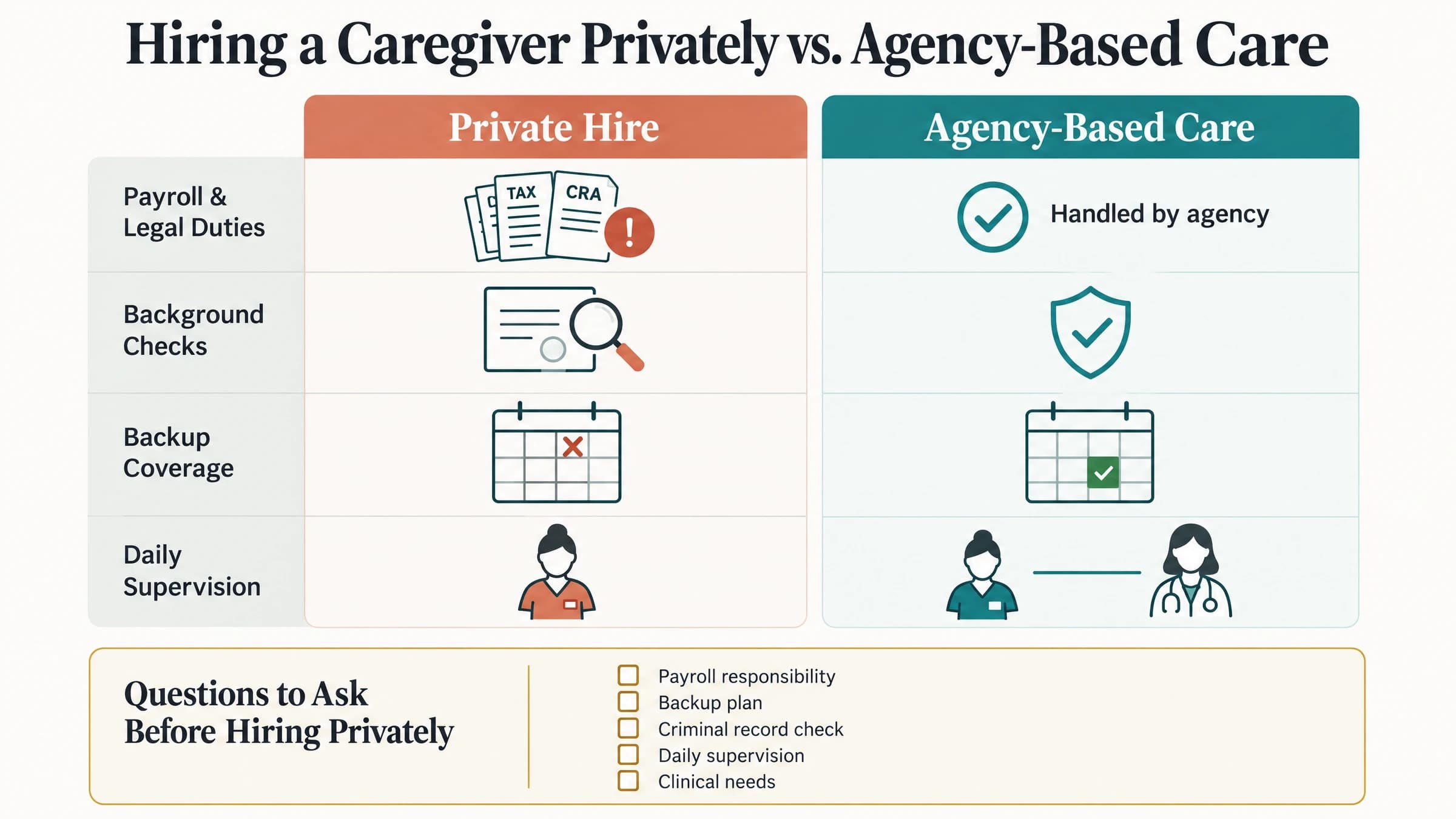
Hiring a private caregiver directly in Winnipeg puts legal, financial, and safety responsibilities on the family that an agency would otherwise carry. The biggest risks fall into three categories: becoming an employer under federal and provincial law, verifying a caregiver's background and competence yourself, and arranging backup care if your caregiver is sick or quits. Each one deserves a close look before you sign an agreement.
You become an employer, with real legal duties
When a family hires a caregiver directly rather than going through an agency, the family becomes the employer in the eyes of the law. Federal rules require that employer to register with the Canada Revenue Agency and remit payroll deductions, including income tax, Employment Insurance premiums, and CPP contributions source: Canada.ca.
This also applies to families using Manitoba's Self and Family Managed Care option through the WRHA. Choosing to directly employ your own caregiving staff means taking on full employer responsibilities: CRA registration, Employment Insurance, Workers Compensation, and all required payroll deductions source: WRHA. Missing a remittance deadline or misclassifying a caregiver as a contractor can create tax penalties months or years later, often discovered only when a caregiver files for Employment Insurance or leaves on bad terms.
There is no licence to check
Unlike nursing or other regulated health professions, home care work itself is not a regulated profession in Canada. There is no mandatory licensing body that verifies an independent caregiver's training, competence, or standing source: Guide to Becoming an Independent Home Care Provider in Manitoba. That means a family hiring privately is responsible for confirming credentials, checking references, and judging whether the person is a safe fit for a parent with dementia, after a stroke, or with complex medication needs, without the structure a regulated profession would provide.
Security checks are your responsibility too
Manitoba policy requires that families retaining a caregiver privately under a self-administered services agreement obtain a criminal record check, a Child Abuse Registry check, and character references before hiring source: Manitoba Families. For comparison, regional health authority Home Care positions in Manitoba require a completed Police Information/Criminal Record Check and Vulnerable Sector Check before a worker can even be scheduled to start source: Shared Health Manitoba. A family hiring privately has to replicate that same diligence on its own, request by request, with no agency compliance team checking the paperwork behind the scenes.
It is also worth knowing that under the Protection for Persons in Care Act and Vulnerable Persons Act, Manitoba officials are required to notify an employer if a prospective caregiver has a documented history of abusing or neglecting a vulnerable adult source: Province of Manitoba. A private family needs to know this registry exists and ask the right questions to trigger that notification, since it will not happen automatically.
Backup care is on you
Families using Manitoba's Self and Family Managed Care program are explicitly responsible for arranging backup services themselves if their caregiver is unavailable source: WRHA. In practical terms, that means if your caregiver calls in sick on a Saturday, or gives two weeks' notice, you are the one scrambling to find coverage, often with little notice and few local options vetted in advance. For a parent who needs live-in or 24-hour care, even a single uncovered shift can mean missed medication, a fall with no one present, or a trip to hospital that could have been prevented.
What assessed, agency-based care looks like instead
Manitoba's regional health authority Home Care program begins with a professional assessment of a person's needs, and RHA staff hold responsibility for ensuring the service delivered in the community is reliable and safe source: Your Guide to Home Care Services in Manitoba. That assessment-and-oversight model is also how private nurse-led agencies work, and it is the core difference from hiring one person directly.
Integracare provides nurse-led care at home, built around the same principle: a registered nurse plans the care and supervises it, 24/7. Every caregiver sent into a client's home has already been screened, trained, and matched to the person's needs, whether that is daily health care aide support, nursing care, or support through palliative care. If a scheduled caregiver is sick, the agency arranges replacement coverage so a family is never left managing a gap alone.
Questions to ask before you hire anyone privately
- Who is responsible for payroll remittances and year-end tax slips?
- What happens if my caregiver is sick, injured, or quits with no notice?
- Has a criminal record check and Vulnerable Sector or Adult Abuse Registry check been completed, and who paid for it?
- Who supervises the quality of care day to day, and who do I call if something goes wrong?
- Does my parent's condition (dementia, Parkinson's, recovery from a hospital stay) require clinical judgment a non-regulated caregiver may not have?
If a parent is coming home from hospital and the answers to these questions feel overwhelming, this guide to the gap between hospital discharge and home care walks through what Winnipeg families typically face in that window. A free in-home assessment is also a low-pressure way to compare what assessed, supervised care actually involves before deciding how to proceed.
Frequently Asked Questions
Is it legal to hire a caregiver directly in Winnipeg without going through an agency?
Yes. Families can hire a caregiver directly or use Manitoba's Self and Family Managed Care program. Doing so means taking on employer duties yourself, including CRA registration, payroll deductions, Employment Insurance, and Workers Compensation source: WRHA.
Who pays a private caregiver's Employment Insurance and CPP?
As the employer, the family is required to register with the Canada Revenue Agency and remit these deductions on the caregiver's behalf source: Canada.ca. An accountant or payroll service can help set this up correctly from the start.
Do private caregivers in Manitoba need a criminal record check?
Families retaining a caregiver privately under a self-administered services agreement are expected to obtain a criminal record check, a Child Abuse Registry check, and character references before hiring source: Manitoba Families. Always ask to see original documents rather than relying on a caregiver's word.
What happens if my private caregiver cannot show up for a shift?
Under Self and Family Managed Care, arranging backup coverage is the family's own responsibility source: WRHA. Families without a backup plan in place often turn to agencies specifically to close this gap, since agencies schedule replacement caregivers as part of the service.
Should I speak with a doctor before changing my parent's care arrangement?
Yes. If your parent has a medical condition that requires monitoring, such as dementia, Parkinson's disease, or recovery after a stroke, speak with their doctor or a care coordinator before changing who provides day-to-day care, so any clinical needs are properly accounted for in the new arrangement.
Free In-Home Assessment
The Care Your Family Deserves Starts Here
Speak with our team about a personalized care plan. Book a free, no-obligation in-home assessment and we will help you find the right support for your loved one.