
Blog
Can a Caregiver Stay With My Parent While I Work? Home Care Options for Daytime Support
Published
Written by Lee Grunberg, M.B.A. — President & CEO
Reviewed by Bethel McMaster, BScN, RN — Director of Business Development
On this page9 sections
Key Takeaways
- Daytime care can range from a few hours to full-workday support.
- Missed medications, falls, and household changes can signal a need for help.
- Companion care and PSW care support different daily needs.
- Flexible schedules can adapt as your parent's care needs change.
- Caregiver matching helps create familiarity, comfort, and consistency.
You can call Mom on your lunch break. You can leave dinner in the fridge, organize appointments around your work schedule, and stop in on the way home. What you cannot do is be in two places at once.
That becomes harder to ignore when a parent who has always managed well at home begins needing a little more throughout the day. Perhaps Dad is forgetting lunch unless you remind him. Mom is still independent, but you are no longer comfortable with her taking the stairs alone. Medication times are becoming harder to keep straight, or a recent fall has changed how you feel about leaving either parent alone until five.
You may not be looking for round-the-clock care. You may simply want someone you trust to be there when you cannot.
A daytime Caregiver can spend several hours or the full workday with your parent, providing the level of companionship, personal care, and practical assistance they need while preserving the routines and independence they still value. For working sons and daughters, it can close one of the hardest gaps in caring for an aging parent: the hours between leaving in the morning and walking back through their door at the end of the day.
Signs Unsupervised Daytime Hours Are Becoming Risky
It is not always one major incident that makes you question whether Mom or Dad should still be home alone all day. Often, it is a collection of smaller things you start noticing when you visit: medication that was not taken, lunch still untouched in the fridge, a new bruise they cannot quite explain, or a pot left on the stove longer than it should have been.
Your parent may still be managing much of their day independently. The question is whether certain routines are becoming harder, less consistent, or less safe when no one else is there.
Paying attention to these changes can help you introduce the right support while your parent can still participate fully in decisions about how they want to live and what kind of help they are comfortable receiving.
Medication Inconsistency and Unopened Blister Packs
Medication is often one of the first routines worth looking at closely.
You may notice that a dose is still sitting in the pill organizer hours after it should have been taken. A blister pack has not been opened on the correct day. A prescription that Mom said she would refill is still waiting at the pharmacy. Or Dad insists he took his medication, but neither of you can confidently tell whether he did.
A complicated medication schedule can become difficult to manage when memory, vision, or dexterity changes. Even someone who has taken the same medications for years may begin having trouble remembering which pill is taken when, whether a dose has already been taken, or when a prescription needs to be renewed.
That deserves attention, particularly when medications are helping manage chronic health conditions.
When missed medications are accompanied by increasing confusion, changes in judgment, wandering, or difficulty completing familiar routines, families may also need to consider whether more specialized dementia care at home would provide the consistency and supervision their parent now needs.
Transitioning to Simplified Medical Routines
Sometimes a few practical changes are enough to make medication routines easier to follow.
A pharmacist can help determine whether blister packaging is appropriate, while clearly visible reminders, written schedules, or automated dispensing alarms may help a parent who simply needs a little extra structure.
Families who are beginning to coordinate care between physicians and other healthcare providers can also review the CPSO Care Guide for information about navigating Ontario's healthcare system and continuity of care.
It is also worth asking your parent what is making the routine difficult. Forgetfulness may be part of the problem, but so can trouble reading labels, opening packaging or getting to the pharmacy.
How Attentive Care Plans Protect Health
When reminders and organizers are no longer enough, having someone there at the appropriate time can bring greater consistency to the day.
With Integracare, care begins by understanding what your parent needs help with and what they are still comfortable managing themselves. Medication reminders can be incorporated into a personalized care plan alongside meals, personal care, mobility assistance, and other parts of the daily routine.
Registered Nursing oversight also means changes do not have to go unnoticed. If a Caregiver begins seeing that Mom is increasingly confused about her medication or Dad is struggling with another part of his routine, those observations can become part of the ongoing conversation about his care.
The intention is to support your parent's health while respecting the independence and familiar routines that remain important to them.
Household Management Delays and Kitchen Hazards
The kitchen can tell you quite a bit about how your parent is managing when no one else is around.
Maybe there is more expired food in the refrigerator than usual. Meals you prepared have barely been touched. You find a scorched pot in the sink, or Mom casually mentions that she forgot the kettle was on.
These moments can be easy to brush aside, especially when your parent has always cooked and cared for their own home. But changes in memory, strength, balance, vision, or dexterity can make familiar kitchen routines surprisingly demanding.
Even preparing a simple lunch requires standing, reaching, carrying hot dishes and remembering that appliances have been turned off. If those tasks are becoming difficult, your parent may begin eating less often or choosing whatever requires the least effort rather than preparing a proper meal.
Creating a Hazards-Free Living Space
Small changes around the kitchen can help your parent continue doing more independently.
Frequently used dishes and ingredients can be moved within easy reach. Meals can be prepared in advance so there is less need to use the stove when no one else is home. Heavy cookware can be replaced with lighter alternatives, and commonly used areas can be reorganized to reduce unnecessary bending and reaching.
The home safety checklist from the Canada Safety Council is also a useful resource for identifying practical adaptations throughout the home.
Most importantly, make these changes with your parent rather than simply changing their kitchen around them. A home that has been arranged a certain way for decades is deeply familiar. Safety improvements are much easier to accept when Mom or Dad understands what is changing and has a say in it.
Introducing Subtle Daily Assistance
If preparing lunch has become difficult, that does not mean your parent needs someone taking over the entire kitchen.
If your parent only needs support during certain parts of the day, hourly PSW care can provide help with meal preparation, personal care, mobility, feeding assistance, and other daily routines without introducing more care than they currently need.
That distinction matters.
Perhaps Dad still wants to decide what is for lunch but needs help preparing it. Maybe Mom enjoys sitting at the kitchen table and chatting while her Caregiver cooks. Good home care pays attention to these preferences instead of turning familiar parts of the day into a checklist of tasks.
Physical Unsteadiness and Increased Fall Risks
You may notice Mom reaching for the back of a chair as she crosses the living room. Dad pauses before stepping into the shower. There is a bruise on his arm, but he cannot remember exactly how it happened. Or a parent who used to move freely between floors has quietly stopped going downstairs.
These are the kinds of changes worth noticing.
Balance, strength, and mobility can change gradually with age, illness, or recovery from hospitalization. A parent may adapt without mentioning it, holding onto furniture, avoiding certain rooms or simply moving less because they no longer feel as steady as they once did.
When you are there, offering an arm takes only a moment. During the workday, however, your parent may be navigating those same stairs, bathrooms, and thresholds alone.
Implementing Home Safety Protocols
Begin with the places your parent uses every day.
Clear clutter from regular walking routes. Secure loose rugs. Improve lighting around stairs, hallways, and bathrooms. Make sure frequently used items are easy to reach, and check that footwear provides adequate support.
The federal government's Safe Living Guide provides additional room-by-room guidance on reducing fall and injury risks in a Senior's home.
A home safety assessment can also help identify risks that are easy to overlook when you are accustomed to the space.
Restoring Daily Confidence and Peace of Mind
There is an important difference between making a home safer and making sure your parent has help when they need it. You can secure the rug, improve the lighting, and add a grab bar. But those changes cannot offer Mom a steady arm when she gets up from her chair or notice that Dad seems less stable today than he did yesterday. That is where attentive daytime care becomes valuable.
An Integracare Caregiver can provide mobility assistance, safety monitoring, and fall-prevention support as part of your parent's normal routine, while encouraging them to continue doing what they can comfortably manage themselves.
For the family, it means you do not have to spend the workday wondering whether Mom made it safely downstairs or whether Dad is avoiding lunch because getting around the kitchen has become difficult. For your parent, it means having a familiar person nearby who knows when to offer a hand, and when to let them do something on their own.
That balance between attentive support, personal dignity, and continued independence is at the heart of Integracare's approach to care.
Companion Care vs. Personal Support Worker (PSW) Care
Determining the right level of home support depends directly on your parent's physical mobility and clinical profile.
| Support Model | Primary Daily Tasks | Best Fit For |
| Companion Care | Active engagement, meal planning and prep, light housekeeping, routine safety monitoring, local errands. | Seniors who are physically mobile but experience social isolation, mild memory changes, or need structured routines. |
| Personal Support Worker (PSW) | Personal care and hygiene protocols, manual transfers, medication management, meal preparation and feeding assistance. | Seniors managing chronic illnesses or disabilities, significant mobility loss, post-hospitalization, or dementia and Alzheimer's care. |
A parent who mainly needs company, lunch preparation, and a walk may be well suited to companion care. A parent who needs help transferring from bed to chair, bathing, toileting, or eating may require a PSW or another qualified professional.
How a daytime home care schedule works
A daytime schedule should reflect your parent's actual routine, not simply fill a set number of hours. At Integracare, every plan is built around the Client's day and supervised by a Registered Nursing Coordinator, so the right level of support is in place as needs change.
Families may choose hourly visits, longer daytime shifts, or a repeating schedule based on work commitments and care needs. Some Clients need a short check-in; others need someone present for most of the day.
Short daytime visits
A two- or three-hour visit may be enough when your parent is independent for part of the day but needs help with a specific routine.
A short visit can support:
- Morning personal care (bathing, dressing, grooming).
- Breakfast and medication reminders.
- A safety check and brief mobility support.
- Lunch preparation and hydration.
- A short walk, social visit, or meaningful activity.
- Support with an appointment or errand.
These visits are often used when a Family member covers evenings and weekends, but the middle of the day has become difficult to manage alone.
A full workday
A longer daytime shift may be appropriate when your parent needs ongoing supervision, frequent assistance, or reassurance while you are away. This is still hourly or shift-based visiting care, not live-in or 24-hour care.
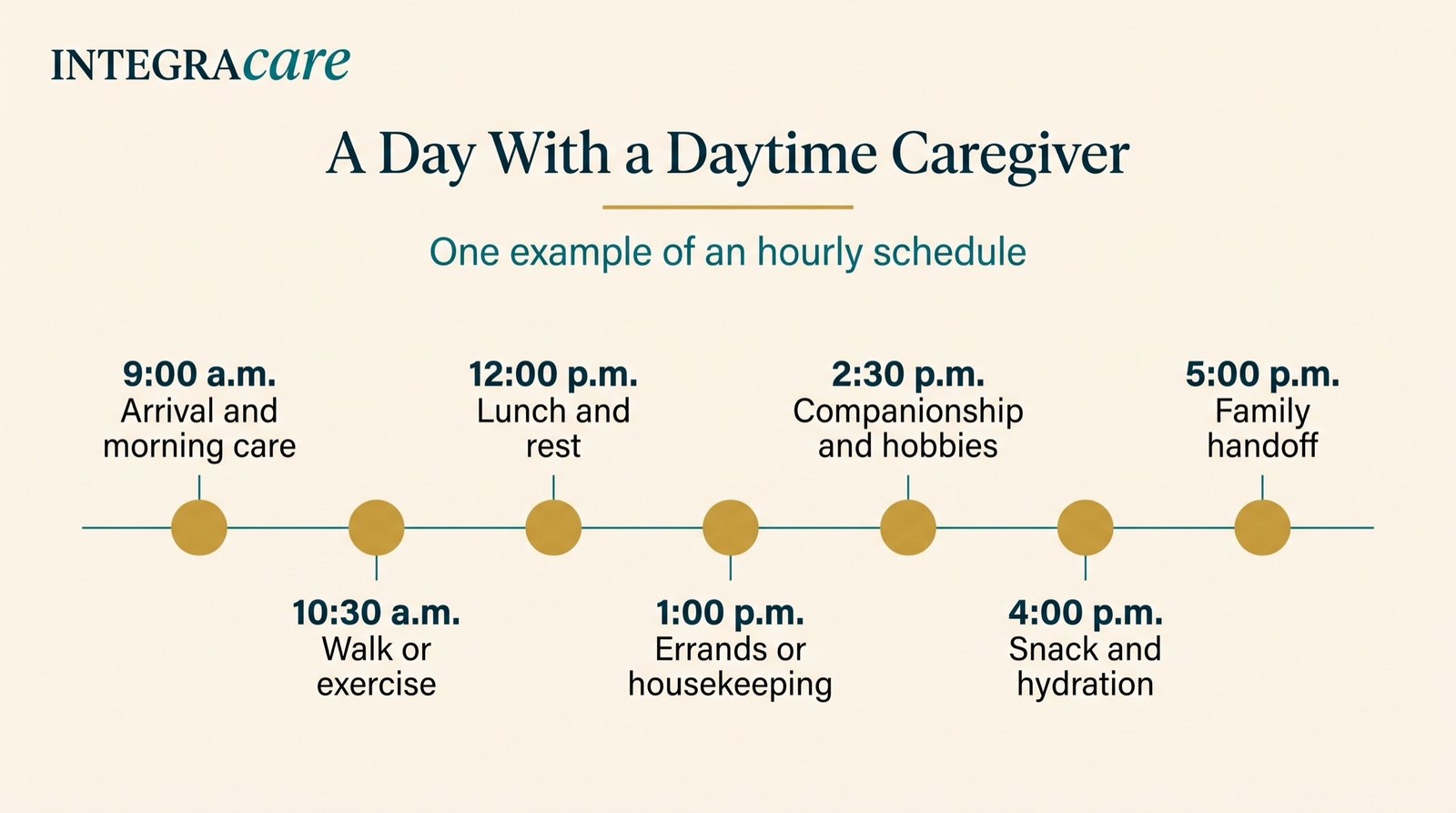
A typical daytime schedule might look like:
- 9:00 a.m.: Caregiver arrival, wellness check, assistance with dressing, breakfast, and morning medication routine.
- 10:30 a.m.: Walk, prescribed exercise, or another meaningful activity.
- 12:00 p.m.: Lunch, fluids, and rest.
- 1:00 p.m.: Light housekeeping, laundry, errands, or transportation to an appointment.
- 2:30 p.m.: Companionship, reading, music, or a preferred hobby.
- 4:00 p.m.: Snack, hydration, and preparation for the evening.
- 5:00 p.m.: Family handoff and update on the day.
The schedule should remain flexible. Some days may involve more personal care, while others may centre on rest, social connection, or an appointment. All care is documented and overseen by a Registered Nursing Coordinator, who can adjust the plan as needs evolve.
Several days each week
Your parent may not need weekday coverage every day. A schedule could include support:
- On the days you work in person.
- During the hours when confusion or fatigue tends to increase.
- When another Family member cannot visit.
Flexible scheduling can also provide respite for a Family Caregiver who is managing care before or after work. Planned relief is often easier to maintain than waiting until the primary Caregiver is exhausted or an urgent situation occurs. Integracare's care team can help design a repeating schedule that balances cost, coverage, and Family availability.
More complex daytime needs
When a Client needs frequent hands-on care, has high-acuity needs, or cannot safely be left alone for any period, a longer shift or more than one Caregiver may be necessary. In these situations, Families often consider:
- Live-in care: A caregiver lives in the home and provides steady daytime support, with a dedicated sleep period overnight. This arrangement is designed for Clients who do not require continuous awake overnight supervision.
- 24-hour home care: Continuous care through rotating caregiver shifts, with someone awake overnight and a Registered Nursing Coordinator overseeing the care plan. This is the appropriate option when awake overnight support is needed.
Overnight coverage, awake-overnight care, live-in care, and 24-hour shift care are different arrangements and should not be treated as interchangeable. Integracare's nursing team can assess whether daytime visiting care, live-in care, or 24-hour rotating shifts best match your parent's needs.
Establishing Caregiver Familiarity Early
Introducing a Caregiver before care needs become urgent allows Seniors to build rapport and feel comfortable. When Caregivers are already an established part of the home environment, shifting to expanded levels of support, such as overnight home care or a live-in caregiver, feels natural rather than disruptive.
Starting with flexible daytime shift care allows a Care Planner or Care Coordinator to build a personalized care plan aligned with personality compatibility and health requirements.
Personal Support Worker (PSW) vs. Registered Nurse (RN) Care in the GTA
When your parent begins needing more help at home, knowing the difference between PSW vs. RN in the GTA can clarify which type of professional should be involved in their care. Understanding the scope of practice for each professional ensures your parent receives the appropriate level of daily oversight.
| Personal Support Worker (PSW) Care | Registered Nurse (RN) Care |
|
|
While a PSW provides essential assistance with daily living, routines, and safety, an RN delivers skilled clinical care for high-acuity health conditions. Many care plans blend both roles, with Registered Nursing Coordinators providing supervision to ensure care plans adapt as health needs evolve.
Integracare considers care needs, personality, interests, and personal preferences when matching Caregivers with Clients. That attention to compatibility is one of the reasons why families choose Integracare when they are inviting someone into a parent's home.

Keep Home Comfortable, Familiar and Well Supported
Integracare brings attentive, personalized care into the home while respecting your parent's routines and independence. Schedule a free in-home assessment to discuss their needs.
Frequently Asked Questions
How does Integracare screen and qualify Caregivers?
Integracare uses a structured caregiver screening and qualification process designed for private home support in Ontario. Caregivers undergo a background check, employer reference checks, and education certificate verification, along with health and immunization verification. Candidates complete a skills assessment and testing, and many have completed a comprehensive training path with ongoing education. Caregiver matching also considers personality compatibility and scope of practice, so the right person is assigned to your parent's specific needs. Back-up caregivers are available if a scheduled Caregiver is unavailable.
What does home care cost, and are there private pay or subsidized options?
Home care costs depend on the level of support, hours per day, and whether you choose hourly care, a flat daily rate, or live-in care. Integracare provides private home support on a private pay basis, with transparent pricing and no hidden fees. Some Families may also be eligible for publicly subsidized home and community care services through Ontario Health atHome. That eligibility is based on assessed health and daily living needs, not on age or income, so it is worth asking for an assessment even if you assume you would not qualify. Direct billing is not typically available for private home care, but Families can explore government income benefits and other financial supports.
Who qualifies for daytime home care, and what needs are appropriate?
Daytime home care is suitable for Seniors and adults with chronic illnesses or disabilities, those recovering from post-hospitalization, and individuals living with dementia and Alzheimer's disease. General eligibility criteria focus on whether your parent can safely manage daily routines alone during the day. A clinical assessment or geriatric assessment may be helpful when there have been recent falls, medication changes, or new mobility concerns. Integracare supports Clients who need personal care and hygiene protocols, medication reminders, meal planning and prep, and safety monitoring, as well as those requiring more complex clinical oversight.
How flexible are scheduling and care plans for working Families?
Integracare offers flexible scheduling and customized care plans that can adapt as your parent's needs change. A care planner or care coordinator works with your Family to design a personalized care plan that may include daytime visits, several days per week, overnight coverage, or awake-overnight care. Shift care can be arranged to cover your work hours, with rest periods built into longer shifts. Medication management, meal planning and prep, and coordination with clinicians are all incorporated into the plan. Direct billing is not standard for private care, but Families receive clear information about costs and scheduling options.
What are the legal and financial responsibilities if I hire a caregiver privately?
Privately hiring a caregiver makes the Family the employer, with responsibilities under employment standards and occupational health and safety acts. This can include an employment agreement, personnel forms, Canada Pension Plan and Employment Insurance contributions, T4 statements, records of employment, vacation pay, and statutory holiday pay. Employers may also need workplace safety insurance, liability insurance, and, in some cases, a malpractice policy. Working with a home care agency shifts these responsibilities to the agency, which handles payroll, back-up coverage, supervision, and liability coverage, often resulting in a clearer all-in cost for private duty home care.
Free In-Home Assessment
The Care Your Family Deserves Starts Here
Speak with our team about a personalized care plan. Book a free, no-obligation in-home assessment and we will help you find the right support for your loved one.
About the Author: Lee Grunberg

President & CEO, M.B.A.
Lee joined Integracare as President & CEO on August 2, 2016 after an approximately 20 year career in Private Equity and Investment Banking. Lee brings tremendous operational knowledge and governance experience along with an incredible passion and energy to Integracare.