
Blog
PSW vs RN in the GTA: What Home Care Support Does Your Family Actually Need?
Published
Written by Lee Grunberg, M.B.A. — President & CEO
Reviewed by Bethel McMaster, BScN, RN — Director of Business Development
On this page8 sections
Key Takeaways
- Distinct Scopes: PSWs assist Seniors with daily personal routines, while RPNs and RNs deliver licensed clinical care.
- Medication Boundaries: Under College of Nurses of Ontario (CNO) standards, PSWs cannot legally administer prescription medications or give injections.
- Integrated Nursing Oversight: Combining PSW daily support with 24/7 Registered Nursing Coordinators ensures clinical safety and cost clarity.
- Specialized Dementia Care: Integracare educates 100% of its PSWs in dementia care alongside the Alzheimer Society of Toronto.
When a parent or spouse begins to need extra support at home, Families often notice small shifts in daily life, a missed prescription, extra time needed for morning routines, or difficulty preparing meals. Balancing these changing needs alongside your own work and family responsibilities can feel like a heavy responsibility, especially when trying to understand the different credentials in Ontario’s healthcare system.
Getting this wrong has real consequences. A family might pay nursing rates for non-medical help like bathing and meal prep, or worse, expect a caregiver to handle medical tasks they aren’t legally permitted or trained to perform.
The following breakdown outlines the education, clinical scopes of practice, and provincial regulations governing PSWs, RPNs, and RNs across Toronto and the Greater Toronto Area.
What is the Difference Between a PSW, RPN, and RN?
The main difference between these roles comes down to education, clinical scope, and how they are regulated in Ontario.
Personal Support Workers (PSWs)
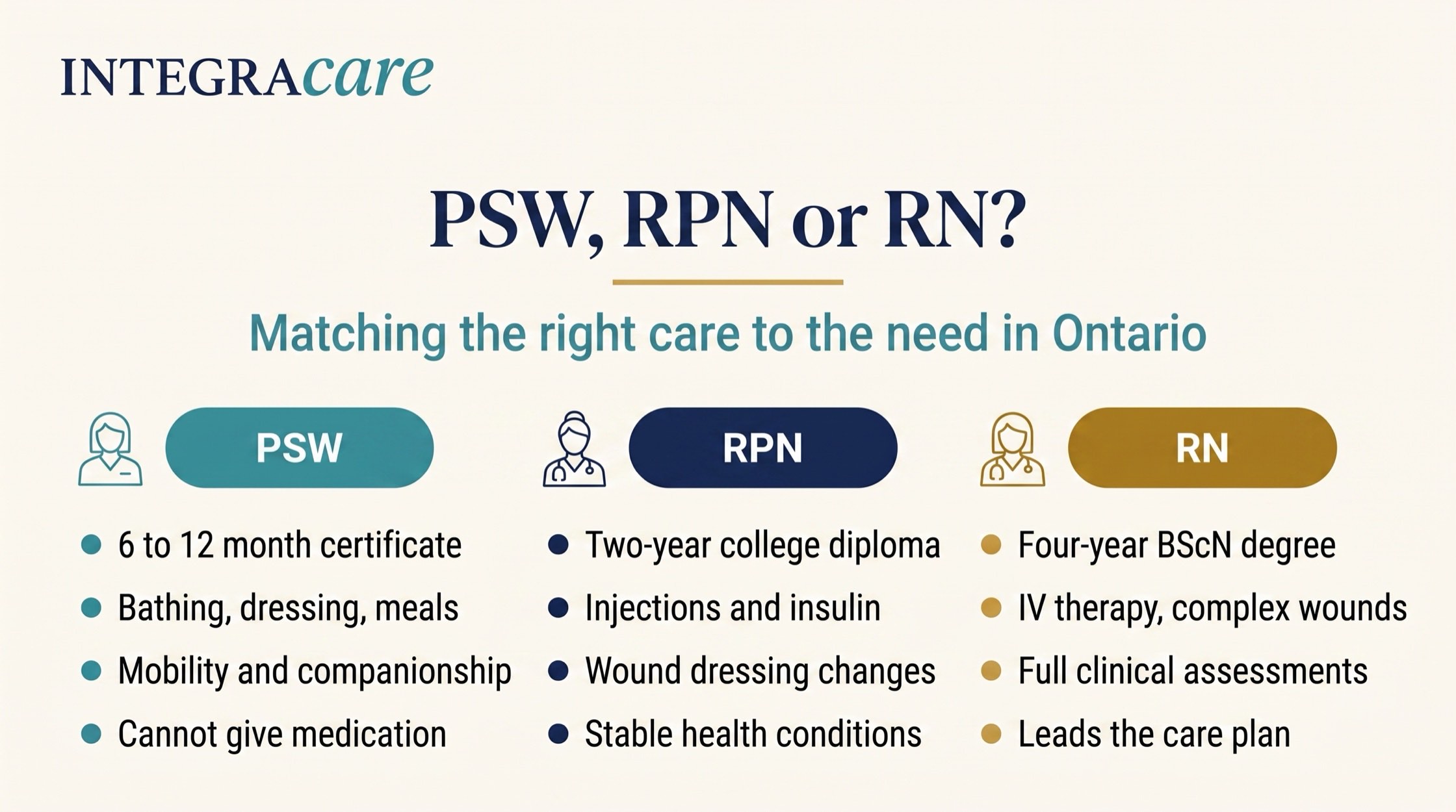
A Personal Support Worker (PSW) completes a 6- to 12-month college certificate program focused on non-clinical personal care, such as assistance with morning routines, meal preparation, and mobility. In Ontario, oversight for PSWs is managed through the Health and Supportive Care Providers Oversight Authority (HSCPOA) , which maintains a public registry and code of ethics to hold Caregivers accountable to professional standards.
Registered Practical Nurses (RPNs)
A Registered Practical Nurse (RPN) holds a two-year college diploma in nursing and is registered with the College of Nurses of Ontario (CNO) . RPNs deliver specialized nursing support for Clients whose health conditions are stable and predictable.
Registered Nurses (RNs)
A Registered Nurse (RN) completes a four-year university Bachelor of Science in Nursing (BScN) degree and is registered with the CNO. RNs provide professional oversight and clinical leadership, managing complex, fluctuating, or high-acuity medical requirements for Clients.
Scope of Practice: What Can They Legally Do at Home?
In Ontario, the Regulated Health Professions Act, 1991 governs “controlled acts”—specific medical procedures that carry clinical risk if performed without proper licensure. Understanding these legal boundaries helps Families select the appropriate Caregiver for every task.
Personal Support Workers (PSWs): Hands-On Daily Care and Medication Rules
PSWs provide essential hands-on personal support, helping Seniors stay comfortable, clean, and connected to familiar routines at home.
- What they can do: Assist with bathing, dressing, grooming, toileting, light housekeeping, meal preparation, feeding, transferring/mobility, and companionship.
- Medication limits: Per CNO standards , a PSW cannot legally administer medication . They can offer reminders or open a pill box, but cannot measure doses or give injections unless a specific task is formally delegated by a nurse under strict training.
- Clinical limits: PSWs cannot perform sterile wound care, manage catheters, or monitor clinical vital signs for diagnostic purposes.
Registered Practical Nurses (RPNs): Specialized Clinical Procedures at Home
RPNs manage established, ongoing clinical care and nursing procedures for Clients at home. Alongside their clinical expertise, RPNs bring the attentiveness, compassion, and personal connection that remain an important part of being a nurse .
- Clinical scope: RPNs administer prescribed medications (including subcutaneous and intramuscular injections such as insulin), manage wound dressing changes, perform catheter care, monitor blood glucose levels, and conduct routine physical health checks.
- Limitation: RPNs do not manage high-acuity, rapidly fluctuating, or critical medical emergencies that require advanced acute care intervention.
Registered Nurses (RNs): Advanced Clinical Leadership and Complex Care
RNs lead care planning and deliver advanced clinical interventions when a Client’s health condition is complex or rapidly changing.
- Advanced clinical scope: RNs manage complex medication regimens, administer intravenous (IV) therapy, manage specialized feeding tubes, perform advanced wound management , and conduct comprehensive physical and cognitive assessments.
- Care Leadership: RNs develop, evaluate, and adjust overall clinical care plans, coordinating directly with physicians and specialists.
How Integracare Elevates PSW and Nursing Care
The true value of home care rests in the relationship, consistency, and professional oversight surrounding that care. Integracare carefully matches Personal Support Workers to Clients based on personality, daily routines, interests, and health needs, ensuring Seniors are supported by familiar faces who understand their preferences.
To support Clients living with memory loss, Integracare is the only private home care provider in Toronto that educates 100% of its Personal Support Workers in dementia care in partnership with the Alzheimer Society of Toronto . Every Caregiver and Client is supported by 24/7 Registered Nursing Coordinators who create and evaluate Client-centred care plans. Whether delivering Registered Practical Nursing care, wound management, or daily personal assistance, Integracare provides vigilant attentiveness that keeps Seniors safe, comfortable, and connected to joyful living at home.
Decision Guide: When to Hire Which Provider
Selecting care comes down to matching medical needs with your budget. Use these common situations to see which provider fits best:
| Scenario | Primary Care Need | Recommended Provider |
| Aging in Place | Help with bathing, getting dressed, making meals, light dusting, and reminders to take daily pills. | PSW (Provides safety and comfort without high clinical costs) |
| Advanced Dementia & Safety | A senior with moderate-to-severe Alzheimer’s who wanders, requires redirection, and needs help with toileting. | PSW (Dementia-trained PSWs specialize in behaviour redirection and physical care) |
| Diabetes Management | A senior with stable diabetes who is physically unable to draw and self-administer daily insulin injections. | RPN (A nurse is legally required to administer the injection, but a stable routine fits an RPN’s scope) |
| Post-Surgical Discharge | Returning home after major abdominal surgery requiring IV antibiotics and complex wound care with high infection risk. | RN (Demands advanced assessment skills to catch complications early and manage IV lines) |
| Palliative / End-of-Life Care | A Senior requires pain management via specialized pumps and frequent clinical comfort assessments. | RN or RPN (Clinical pain management must be handled by nurses, with an RN overseeing care plan changes) |
Integrated Home Care: Supporting Clients and Their Families
Coordinating home care is simplified when personal support and nursing oversight work together. Integracare Home Care provides an integrated care model across Toronto, Mississauga, and Ottawa, pairing the consistent daily support of carefully matched PSWs with professional Registered Nurse coordination so Seniors can age well at home.
A major worry for Families is what happens if a Senior’s health changes unexpectedly. Integracare supports every Client and Caregiver with 24/7 Registered Nursing Coordinators. If a PSW observes a subtle shift in demeanour, mobility, or appetite, an on-duty RN steps in immediately to evaluate whether Registered Practical Nursing care or an updated care plan is needed. This proactive level of attentiveness keeps Clients safe around the clock without incurring nursing fees when non-clinical personal support is all that is required.
For Seniors living with memory loss, gentle consistency and specialized knowledge are essential for joyful living. Integracare is the only home healthcare provider in Toronto that educates 100% of its Personal Support Workers in dementia care in partnership with the Alzheimer Society of Toronto. This ensures Clients receive dignified, Client-centred care that protects their familiar routines and supports their independence.
Because Integracare maintains a complete care circle, including Registered Nurses, RPNs, PSWs, and Physiotherapists, care plans adapt as health needs evolve. If a Client’s requirements transition from help with morning routines to complex clinical care, support scales internally without disrupting established relationships.
Build a Client-Centred Care Plan for Your Loved One
Every Senior deserves care built around their unique personality, health needs, and familiar routines. Contact Integracare today to speak with a Registered Nursing Coordinator and discover how integrated personal support and 24/7 nursing oversight can help your loved one remain safely and comfortably at home.
Frequently Asked Questions About Ontario Home Care
Can a PSW legally administer medication to a Senior in Ontario?
No, Personal Support Workers (PSWs) cannot legally administer prescription medications or give injections under College of Nurses of Ontario standards. They can offer reminders or help open a pill box, but actual medication administration requires a licensed RPN or RN unless delegated under strict nursing protocols.
What is the main difference between an RPN and an RN for home care?
The main difference between an RPN and an RN lies in their education and the complexity of care they provide. RPNs hold a two-year college diploma and deliver specialized nursing care for Clients whose health conditions are stable, while RNs hold a four-year university degree (BScN) and manage complex, fluctuating, or high-acuity medical requirements.
Why would a Family pay for a private nurse if a PSW is less expensive?
PSWs provide essential hands-on personal support for daily living routines, but they cannot legally perform clinical procedures like sterile wound care, catheter management, or IV therapy. Paying for a private nurse is necessary when a Senior requires clinical assessment, specialized medication administration, or complex health monitoring that falls outside a PSW’s legal scope of practice.
Can a Family hire both a PSW and a private nurse at the same time?
Yes, combining PSW daily personal care with nursing oversight is often the most practical and cost-effective approach for Families. Integracare provides an integrated home care model in which PSWs handle daily living activities, while Registered Nursing Coordinators provide 24/7 oversight and clinical support as health needs shift.
How do I know if my parents need a PSW or a registered nurse?
Your parent needs a PSW if they primarily require help with morning routines, bathing, meal preparation, mobility, and companionship. They require a registered nurse (RPN or RN) for clinical wound care, daily insulin injections, catheter management, or complex health assessments.
Are Personal Support Workers regulated in Ontario?
PSW oversight in Ontario is managed through the Health and Supportive Care Providers Oversight Authority (HSCPOA). The HSCPOA maintains a public registry, code of ethics, and professional standards to hold Caregivers accountable and protect vulnerable Seniors.
What happens if a Senior’s health condition suddenly changes during a PSW shift?
Independent PSWs must rely on family members or emergency services if a Senior’s health changes. At Integracare, every PSW has immediate 24/7 access to Registered Nursing Coordinators who evaluate subtle clinical changes promptly and coordinate RPN or RN support without delay.
Does private home nursing care replace hospital or OHIP home care services?
Private home care works alongside publicly funded healthcare rather than replacing it. Private nursing and personal support fill coverage gaps, provide consistent Caregiver matching, and deliver one-on-one attention beyond what government-funded programs can offer.
Why is specialized dementia training important for Personal Support Workers?
Dementia care requires specialized understanding of cognitive decline, communication techniques, and gentle behavioural redirection. Integracare educates 100% of its Personal Support Workers in dementia care in partnership with the Alzheimer Society of Toronto, ensuring Seniors receive dignified, person-centred support tailored to their familiar routines.
Free In-Home Assessment
The Care Your Family Deserves Starts Here
Speak with our team about a personalized care plan. Book a free, no-obligation in-home assessment and we will help you find the right support for your loved one.
About the Author: Lee Grunberg

President & CEO, M.B.A.
Lee joined Integracare as President & CEO on August 2, 2016 after an approximately 20 year career in Private Equity and Investment Banking. Lee brings tremendous operational knowledge and governance experience along with an incredible passion and energy to Integracare.