
Blog
Can Your Parent With Mid-Stage Dementia Stay at Home? How Families Decide Between Home Care and Memory Care
Published
Written by Lee Grunberg, M.B.A. — President & CEO
Reviewed by Bethel McMaster, BScN, RN — Director of Business Development

On this page12 sections
Key Takeaways
- Mid-stage dementia does not automatically mean your parent needs to leave home.
- Falls, getting lost, nighttime needs, and medication problems can signal a need for more support.
- Dementia-trained Caregivers can help with personal care, familiar routines, and responsive behaviours.
- Home care can increase from scheduled visits to live-in or 24-hour support as needs change.
- Memory care may be appropriate when your parent’s care or safety needs can no longer be managed safely at home.
When a parent has mid-stage dementia, the support they need at home can start to look quite different. Maybe they need more help getting through the morning, have started forgetting medications, become confused later in the day, or can no longer be left alone as comfortably as before.
As dementia progresses, it can be hard to know when your parent needs more help than they are getting now. Many Toronto Families find themselves worrying more about their parent's safety at home and wondering what the next stage of care should look like.
For some Families, staying at home is still very possible with more support in place. For others, the changes in their parent's care and safety needs may mean it is time to consider memory care. Knowing what to look for can help you understand which option makes the most sense for your parent and your Family.
What Does Mid-Stage Dementia Look Like at Home?
Dementia progresses differently for everyone. Two people with mid-stage dementia can have very different abilities, routines, and care needs.
At this stage, a parent who once needed an occasional reminder may begin needing regular help with activities of daily living and other parts of the day. When cognitive changes advance, you can generally learn what to expect in the moderate stage by observing how they interact with their surroundings.
You may notice functional changes such as:
- Needing help with bathing, dressing, grooming, or toileting
- Forgetting meals or medication
- Having difficulty preparing food safely
- Becoming confused about the time of day
- Struggling with familiar tasks
- Needing more help with walking or transfers
- Waking or walking around during the night
- Getting lost in familiar places
- Having more difficulty explaining what they need
- Becoming anxious, suspicious, frustrated, or angry
- Needing more supervision than before
Needing more help does not automatically mean your parent can no longer live at home. It does mean their care needs should be looked at again so the right support can be put in place.
Can Someone With Mid-Stage Dementia Stay at Home Safely?
Yes, many people with mid-stage dementia can continue living at home with the right care and safety measures in place.
For many people living with dementia, there is comfort in being at home and following the routines they have known for years. As your parent's needs change, those familiar routines can often continue with a little more help. You may need to make some changes around the house, add more supervision, or have someone there to help with the parts of the day your parent can no longer manage safely on their own.
Families can significantly reduce household risks by focusing on making the home safe to accommodate changes in balance or judgment. Simple adaptations such as improving lighting, removing tripping hazards like loose rugs, installing grab bars, and making potentially dangerous household items less accessible can help prevent accidents while supporting their independence.
Home modifications are only one part of staying safely at home. Your parent may also need more help with personal care, medication, meals, mobility, or supervision. Looking at a few areas of everyday life can help you see where those needs are changing.
Is Your Parent Getting Lost or Leaving Home Unsafely?
Walking is not a problem simply because someone has dementia. Many people enjoy walking and benefit from being able to continue doing it.
The concern is what happens if your parent becomes disoriented and cannot find their way home.
The Alzheimer Society of Canada uses terms such as walking, getting lost, or losing one's way rather than "wandering." Its walking guidance explains that walking can have a purpose, even when that purpose is not obvious to the people around them.
Families searching for information about dementia wandering are often trying to understand a more immediate safety concern. What happens if their parent leaves home alone?
Can your parent find their way back? Can they cross the street safely? Do they know their address? Would they know what to do if they became confused or tired? Have there already been times when someone needed to go looking for them?
If your parent is getting lost or leaving home without being able to return safely, they may need more supervision. Door alerts, other safety technology, and changes to the home can also be useful, depending on the situation.
What Happens Overnight?
Nighttime can tell you a lot about whether the current care arrangement is still working.
Some people with mid-stage dementia sleep well most nights. Others wake frequently, become confused about the time, walk around the house, try to go outside, or need help getting to the bathroom.
If your parent needs someone available during the night, it is important to look at what kind of support they actually need.
Someone who generally sleeps through the night may be well suited to a live-in care arrangement. A person who regularly wakes and needs assistance, is at risk of leaving the home, or cannot safely be alone while a Caregiver sleeps may need awake overnight or 24-hour care.
The right arrangement depends on what is actually happening between bedtime and morning.
Are Falls or Mobility Changes Becoming More Frequent?
Changes in judgment, perception, and memory can make it harder for someone with dementia to recognize a hazard. At the same time, changes in strength, balance, or mobility can increase the chance of a fall.
One fall does not necessarily mean your parent can no longer live at home. Frequent falls, difficulty using stairs, unsafe transfers, or forgetting to use an assistive device are more concerning.
Simple safety modifications can make the home easier to move around. Better lighting, clear walking paths, railings, grab bars, and non-slip surfaces can all help. An occupational therapist can also assess the home and recommend changes based on your parent's abilities.
If mobility is becoming more difficult, in-home Caregivers can provide physical assistance with walking, transfers, toileting, and other daily activities.
Are Meals, Medication, and Personal Care Becoming More Difficult?
Changes in dementia often show up in ordinary parts of the day.
Your parent may tell you they have eaten when lunch is still sitting in the refrigerator. They may forget a medication or accidentally take it twice. Bathing may become confusing, or getting dressed may suddenly involve much more help than it used to.
These changes can often be supported with the right level of dementia home care. Depending on your parent's needs, care at home may include:
- bathing, dressing and grooming
- toileting and continence care
- meal preparation and hydration
- mobility and transfers
- medication reminders or appropriate medication support
- companionship
- help maintaining familiar routines
Support should focus on the things your parent needs help with while allowing them to continue doing what they safely can for themselves.
When Behaviour Starts to Change
As dementia progresses, your parent may begin behaving in ways that feel very different from the person you know. They may become more anxious or suspicious, get angry when someone tries to help, or accuse a spouse or Family member of doing something they haven't done.
In dementia care, these changes are known as responsive behaviours because there is often something behind the reaction, even when it isn't immediately obvious. Your parent may be confused, frightened, uncomfortable, or trying to make sense of something they no longer remember clearly.
Why a Spouse or Caregiver May Be on the Receiving End
Often, the person providing the most help is also the person dealing with the most frustration or suspicion. A spouse may be managing medications, helping with bathing, taking over the finances, or putting away the car keys. If your parent doesn't remember why something was done, they may misunderstand what happened or blame the person closest to them.
A Calmer Response Can Help
If your mother is convinced someone stole her purse, telling her she is wrong may only make her more upset. You might have better luck saying, "You're worried because you can't find it. Let's look for it together."
You don't have to agree with something that isn't true. The idea is to acknowledge what your parent is worried about and help them move on from the situation without turning it into an argument. The Alzheimer Society's behaviour guidance offers similar advice for responding when someone with dementia is distressed.
Dementia Training Can Make These Moments Easier
An experienced dementia Caregiver knows when to slow things down, change their approach, or give your parent a little space before trying again. This can be particularly helpful with personal care, agitation, aggression, or other situations that are becoming difficult for Family members to manage.
Integracare's dementia Caregivers receive specialized training through our partnership with the Alzheimer Society of Toronto, including the Gentle Persuasive Approach and practical techniques for responding without escalating the situation.
If you notice a sudden or significant change in your parent's behaviour, speak with their healthcare professional as well. Pain, infection, medication, or another health issue can sometimes be behind a change that seems related to dementia.
Weighing Your Options: Staying at Home Versus Moving to a Facility
When your parent needs more dementia care, there are usually two options to consider. You can bring more support into their home, or you can look at moving them into a residential setting that provides dementia care.
Both can provide the help your parent needs. The biggest difference is what their days will look like and how much of their familiar routine they can keep.
Staying Home Keeps Care Centred Around Your Parent's Routine
At home, care can fit around the routines your parent already has. If your dad likes to get up early, have his coffee in the kitchen and take his time getting ready, he can keep doing that even when he needs more help.
Integracare's personal support workers can help with bathing, dressing, meals, mobility, companionship, and other parts of the day your parent may no longer manage safely on their own. Care can start with a few hours of support and increase as their needs change.
The home may need some changes too. Better lighting, grab bars, clear walking areas, or door alerts can help make familiar surroundings safer as dementia progresses.
Memory Care Provides Support in a Residential Setting
In Ontario, dementia care may be available in some retirement residences and long-term care homes. Each setting is different, so it is important to understand what dementia care, nursing support, and supervision are actually provided.
Your parent will be living alongside other residents, with staff providing care throughout the residence. Depending on the setting, there may be secured entrances and exits, shared dining, walking areas, group activities, and programs for people living with dementia.
For someone who enjoys being around other people or needs the safety and supervision available in a residential setting, this may be a good fit.
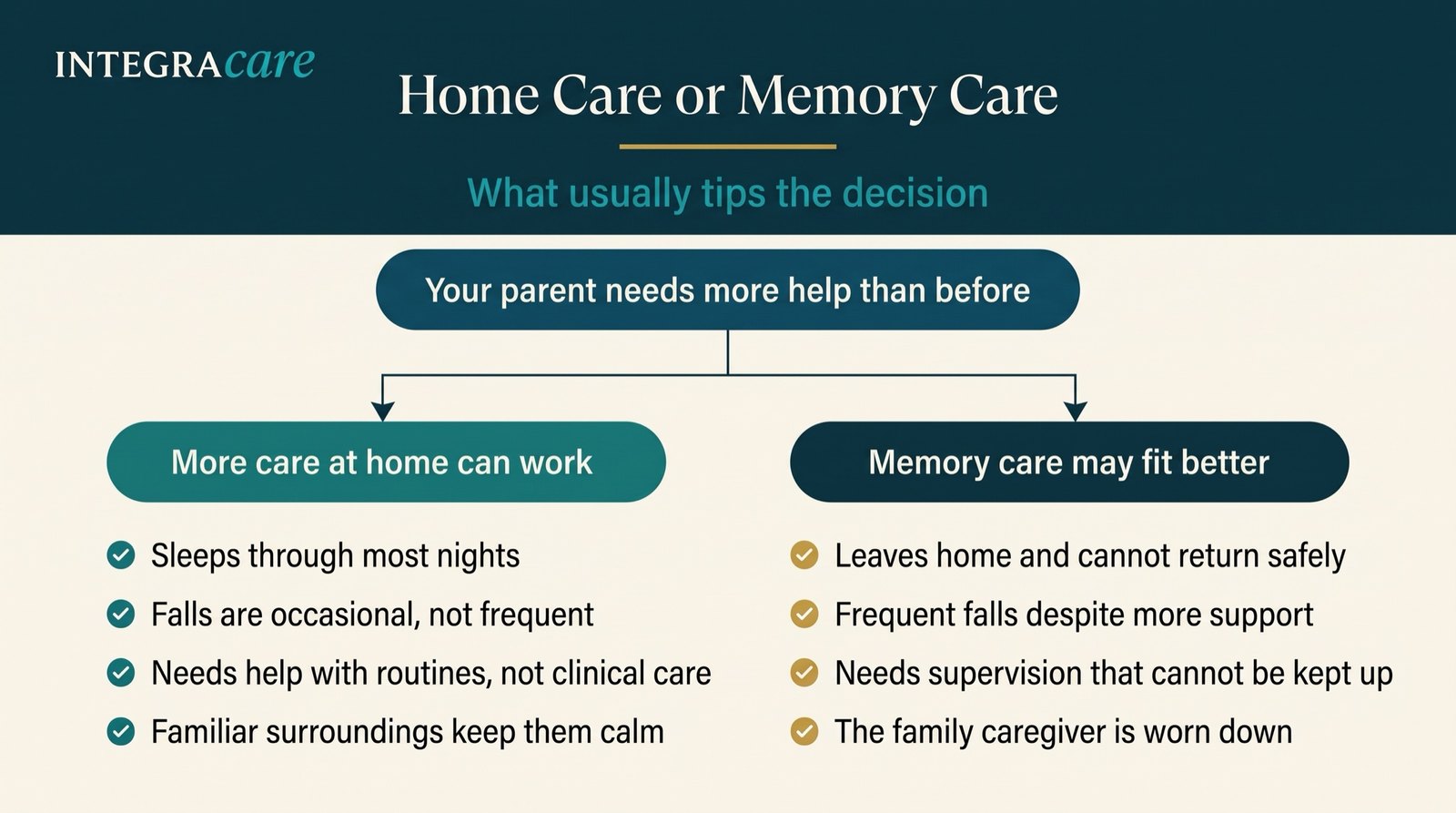
Some Care Needs Become Harder to Manage Safely at Home
There can come a point when your parent's needs are difficult to manage safely at home.
They may develop more complex health needs, have frequent falls despite added support, require equipment that cannot be safely accommodated in the house, or need a level of supervision that cannot reasonably be maintained at home.
The person providing most of the care needs to be considered too. If a spouse is regularly awake throughout the night or providing physical assistance they can no longer safely manage, it may be time to look at a different care arrangement.
More Care at Home Can Help Your Parent Stay There Longer
If your parent's main needs are help with personal care, meals, medication, mobility, supervision, or familiar routines, those needs can often be supported at home.
Who provides that care is important, especially for someone living with dementia. Having familiar Caregivers who get to know your parent's routines, preferences, and ways of communicating can make care easier and less disruptive. Families who are beginning that search can learn more about finding the right dementia caregiver in Toronto and what to consider when choosing someone to support a parent at home.
Depending on your parent's needs, care may mean scheduled visits, overnight support, live-in care, or 24-hour care.
Nursing Support as Dementia Progresses
The amount of help your parent needs will likely change as dementia progresses. They may be managing well with help at certain times of the day now, but later need more support with mobility, personal care, medication, or overnight supervision.
At Integracare, Registered Nurses supervise each care plan and stay involved as a Client's needs change. Care can be adjusted along the way, whether that means adding more hours, providing more hands-on help, or moving to overnight, live-in, or 24-hour care.

Help Your Parent Stay Safe and Comfortable at Home
If you are wondering whether your parent can continue living at home, you don't have to have all the answers before reaching out. A free in-home assessment allows your Family to talk through what has been changing, any concerns you have about safety, and the kind of help your parent may need now.
Contact Integracare to learn more about dementia care at home and how we can support your parent as their needs change.
FAQs
What activities and amenities are available in memory care?
Activities and amenities vary by memory care community. Some purpose-built settings may offer secured environments, alarmed doors and windows, indoor and outdoor walking paths, therapeutic gardens, sensory stimulation spaces, game rooms, arts and crafts rooms, shared dining and memory-enhancing programming. Some residences may also have barbershops or beauty salons. At home, activities can be arranged around a Senior’s familiar interests and routines, with support from Caregivers, Family members, or adult day care programs.
What are the challenges of caring for someone with dementia at home?
Supporting a parent with dementia at home may involve help with activities of daily living, instrumental activities of daily living, meals, hydration, medication routines, mobility, incontinence and sleep. Families may also need to respond to aggression, responsive behaviours, unsafe walking or frequent falls. Assistive devices, safety modifications, technology, respite care, adult day care programs and dementia education may help. An assessment can clarify whether scheduled visits, live-in care or 24-hour home care is appropriate.
What complex care needs can be managed at home?
Some Seniors living with dementia receive support at home with bathing, dressing, toileting, continence care, meals, hydration, medication reminders, mobility, transfers and companionship. In-home Caregivers can also observe changes in appetite, sleep, walking, and responsive behaviours and report them to the care team. As severe cognitive impairment or health instability develops, the plan may require more frequent supervision or Registered Nursing oversight. Sudden changes, signs of depression, repeated falls, or a hospital admission should be discussed with a healthcare professional.
Is home care less expensive than memory care?
There is no universal answer because costs depend on location, hours, and the level of support required. Home care costs may include hourly Caregiver support, full-time or 24-hour home care, live-in care, transportation, respite, and safety modifications. Memory care costs may include a monthly residence fee, meals, activities, medication support, and additional personal care. Families should compare the complete care contract and services provided rather than comparing one home care rate with one monthly memory care fee.
How can Families reduce caregiver exhaustion?
A primary Caregiver may need help with bathing, meals, transportation, medication routines, companionship, or supervision. In-home Caregivers, a care aide, professional carer, live-in care, respite sitting services, and adult day care options may share the work. Families can also speak with a social worker, charity, community support organization, or caregiver support group. Regular respite can be particularly useful when there are frequent falls, unsafe walking, incontinence, nighttime waking, or difficult responsive behaviours.
When should a Family consider memory care instead of home care?
Memory care may be worth considering when a Senior has a history of unsafe walking, repeated falls, frequent nighttime risks, complex health needs, or aggression that cannot be managed safely at home. Forgetting medication, significant eating or drinking problems, severe cognitive impairment, and the primary Caregiver’s declining health may also influence the decision. Families can request an initial assessment, seek a doctor’s input, and use a memory care touring checklist to compare care homes, dementia care units, safety features, staffing, and available activities.
Free In-Home Assessment
The Care Your Family Deserves Starts Here
Speak with our team about a personalized care plan. Book a free, no-obligation in-home assessment and we will help you find the right support for your loved one.
About the Author: Lee Grunberg

President & CEO, M.B.A.
Lee joined Integracare as President & CEO on August 2, 2016 after an approximately 20 year career in Private Equity and Investment Banking. Lee brings tremendous operational knowledge and governance experience along with an incredible passion and energy to Integracare.