
Blog
Dementia Home Care in Toronto: How to Find the Right Caregiver for Your Parent
Published
Written by Lee Grunberg, M.B.A. — President & CEO
Reviewed by Bethel McMaster, BScN, RN — Director of Business Development
On this page12 sections
Key Takeaways
- The right dementia Caregiver is defined by education, consistency, and clinical oversight, not just years of experience. Ask what dementia-specific education a provider requires before anyone enters your parent’s home.
- A parent does not need to be struggling before home care begins. Care can start with a few hours a week and grow as needs change, which also lets your parent build familiarity with their Caregiver early.
- If your parent is alone while you are at work, a structured supervision plan matters. Changes such as wandering, missed medications, and confusion signal that daytime support may be needed.
- Two providers can quote similar hourly rates while offering very different levels of support. Ask what an hour of care actually includes before comparing prices.
- Public and private home care can be combined. Ontario Health atHome services can be coordinated with private care to build the level of support your parent needs.
Caring for a parent with Alzheimer’s disease or another form of dementia often becomes more complicated as their needs change. Tasks your mom or dad once managed independently may require reminders or hands-on help. Changes in judgement, sleep, mobility, or behaviour can also make it harder to leave them alone safely, even when they are still comfortable and settled in their own home.
When Toronto Families start to notice these signs, they begin searching for someone trained in dementia care who can be trusted alone with their parent. The options range from a few hours of help with everyday routines to continuous care for a Senior who requires more supervision. The challenge is knowing what to look for, what to ask, and how to tell one provider from another.
Canada is projected to see nearly one million people living with dementia by 2031, according to a mid-2026 report from Retirement Sherpa . Demand for dementia-trained Caregivers in Toronto is growing with it.
Find out step by step: what specialized dementia home care is, what “dementia-trained” actually means, how to keep your parent safe at home while you are at work, and the questions that separate the right provider from the rest.
What Is Specialized Dementia Home Care?
Specialized dementia home care supports a Client in familiar surroundings while adapting care to the cognitive, behavioural and physical changes associated with Alzheimer’s disease and other forms of dementia.
The amount and type of support will differ from one Client to another. A Senior may initially benefit from meal preparation, medication reminders, companionship and help maintaining familiar routines. As dementia progresses , personal care, mobility assistance, nighttime support or closer supervision may become necessary.
The Person Comes Before the Behaviour
Changes such as agitation, pacing, resistance to care, aggression and sundowning are often described as responsive behaviours. They may occur when a Client is experiencing pain, fatigue, fear, overstimulation, confusion or another unmet need.
A Caregiver who understands dementia can consider what happened before the behaviour, what has changed in the Client’s routine, and whether there may be a physical or environmental cause. Knowing the Client’s preferences, communication style and personal history can also help the Caregiver choose an approach that is familiar and respectful.
Person-centred dementia care uses this knowledge to support the individual rather than applying the same response to every Client with the same diagnosis. This is the standard your search should be measured against.
What Does “Dementia-Trained” Actually Mean?
Almost every provider will describe its Caregivers as experienced with dementia. Experience supporting Seniors provides an important foundation, but it is not the same as structured, dementia-specific education. That education prepares Caregivers for changes in communication, cognition, and behaviour that can affect everyday care.
A routine that has worked for years may suddenly cause resistance. A mom who previously explained when something hurt may begin expressing discomfort through pacing or agitation. Caregivers need to recognize these changes and adjust how they approach the Client.
What Has the Caregiver Been Taught About Dementia?
Families can ask providers to explain exactly what dementia education their Caregivers receive.
Recognized programs include:
- Dementia Foundations: Developed by the Alzheimer Society, this provides foundational education about dementia, cognitive changes, and approaches to communication.
- Gentle Persuasive Approaches (GPA): Created by Advanced Gerontological Education (AGE) Inc., GPA teaches healthcare professionals how to understand and safely respond to responsive behaviours using respectful, person-centred and non-pharmacological approaches.
- U-First! and U-First! Advanced: These programs help frontline professionals recognize changes, consider factors contributing to behaviour, and collaborate with Families and healthcare professionals.
- Palliative Care in Dementia: Specialized education can help Caregivers understand comfort and physical care needs associated with advanced dementia .
How Dementia Education Changes Care at Home
Dementia education shapes everyday interactions between a Caregiver and Client. It can influence how a Caregiver approaches personal care when a Client is resistant, adapts communication during confusion, responds to pacing or agitation, and recognizes changes that may require closer attention.
Integracare has made Alzheimer Society education a core part of its approach to dementia care.
In 2026, Integracare renewed its four-year partnership with the Alzheimer Society of Toronto (AST) . As detailed in Integracare’s Professional Development schedules , 100% of Integracare Caregivers are educated across all five facets of the Alzheimer Society of Toronto curriculum.
A Consistent Standard Across the Caregiving Team
For Families, consistency in education matters because a Client may receive care from multiple Caregivers.
Lee Grunberg, President & CEO of Integracare Inc., explains: “The Alzheimer Society of Toronto sets the gold standard for dementia care education, and being the only home care company to train all our caregivers across all five of its courses remains the foundation of everything we do.”
When comparing providers, Families can ask whether dementia education applies across the Caregiving team and how that knowledge is incorporated into each Client’s care plan.

Keeping a Parent With Dementia Safe at Home While You Are at Work
Many Toronto Families have raised concerns about their dad living at home with his dementia progressing, and the Family cannot be there during working hours. The question is not whether he needs care in general. It is who is with him between nine and five.
A dementia diagnosis alone does not determine how many hours of care a Client requires. Current abilities, routines, mobility, behaviour, home environment and individual safety risks all need to be considered. A Client who manages much of their day independently may need support during particular routines or times of day. Another Senior may require continuous supervision because they are no longer safe alone.
Signs that unsupervised daytime hours are becoming a risk include appliances being left on, medications being taken incorrectly or missed, confusion about the time of day, and a parent becoming lost on a route they have used for years.
Wandering is the most serious of these risks. According to the Finding Your Way safety initiative, 60% of people living with dementia will go missing or wander at least once. Christina Stergiou-Dayment, Senior Director of Programs and Partnerships at the Alzheimer Society of Ontario, noted in a MedicAlert Canada report that if a missing person living with dementia is not located within 24 hours, up to 50% are found severely injured or deceased.
Daytime home care exists precisely for this gap. A consistent Caregiver during working hours can maintain routines, handle meals and medications, and provide the supervision that makes it safe for your parent to keep living at home while you keep working. Regular reassessment then allows the care plan to change as your parent’s abilities and needs change.
How to Create a Wandering Prevention and Safety Plan
Wandering does not always begin with a Client unexpectedly leaving home. A Senior may start pacing, repeatedly approach an exit, follow a familiar route, or talk about needing to return to a previous home or workplace.
Noticing when these behaviours occur and what happens immediately before them can help Families and Caregivers identify possible patterns.
What Could Be Contributing to the Wandering?
The Regional Geriatric Program of Toronto (RGP) recommends considering factors that may contribute to wandering behaviour.
Start with basic physical needs:
- Is the Client hungry or thirsty?
- Do they need to use the washroom?
- Could they be too hot or cold?
- Could pain or physical discomfort be contributing?
- Has something changed in the environment or daily routine?
A Client who has difficulty describing discomfort may communicate it through pacing, agitation, or another change in their behaviour.
Pay Attention to When the Behaviour Happens
Timing can provide useful information. If restlessness regularly occurs in the late afternoon or evening, for example, it may be associated with sundowning .
A quieter environment and calm, structured activities may help during these periods. The Alzheimer’s Association provides additional guidance for reducing wandering risks and responding when wandering occurs. Consistent Caregivers can also help identify patterns because they become familiar with the Client’s usual routines, communication, and behaviour.
If a Client Goes Missing, Every Detail Helps
Families can prepare essential information before a wandering incident occurs.
Keep a recent, clear photograph, current physical description, relevant medical information, emergency and Family contacts, previous home and workplace addresses, and familiar destinations the Client may try to visit in a place Family members can access quickly.
Families can also consider medical alerts , which provide identification connected to a registry that can help first responders identify someone who has gone missing and reunite them with their Family. A wandering plan should be reviewed as the Client’s routines, mobility, and behaviour change.
Does Your Parent Need to Be Struggling Before Home Care Begins?
A common belief about dementia home care is that Families should wait until a loved one can no longer manage safely without substantial assistance.
Dementia can affect some abilities while others remain intact. A Senior may still dress independently, prepare breakfast, and enjoy familiar activities while beginning to miss medications, become confused about appointments, or have difficulty completing tasks with several steps.
Home Care Can Begin With a Few Hours a Week
A Client may initially need support only at particular times. A consistent Caregiver might visit several times a week to help prepare meals, accompany the Client on a walk, provide medication reminders, or support a familiar morning or evening routine. Care can focus on the tasks that have become difficult while the Senior continues to do the things they can safely manage independently.
Familiarity Can Be Established Before Care Needs Increase
Introducing a Caregiver gradually gives the Client time to become familiar with another person in their home and incorporate visits into their normal routine.
If care needs increase later, the Client may already know the Caregiver, and the Caregiver may already understand the Client’s preferences, routines, and communication. Families can use changes in everyday routines as a practical signal to review whether additional care would be useful.
3 Steps to Take Before You Contact Any Provider
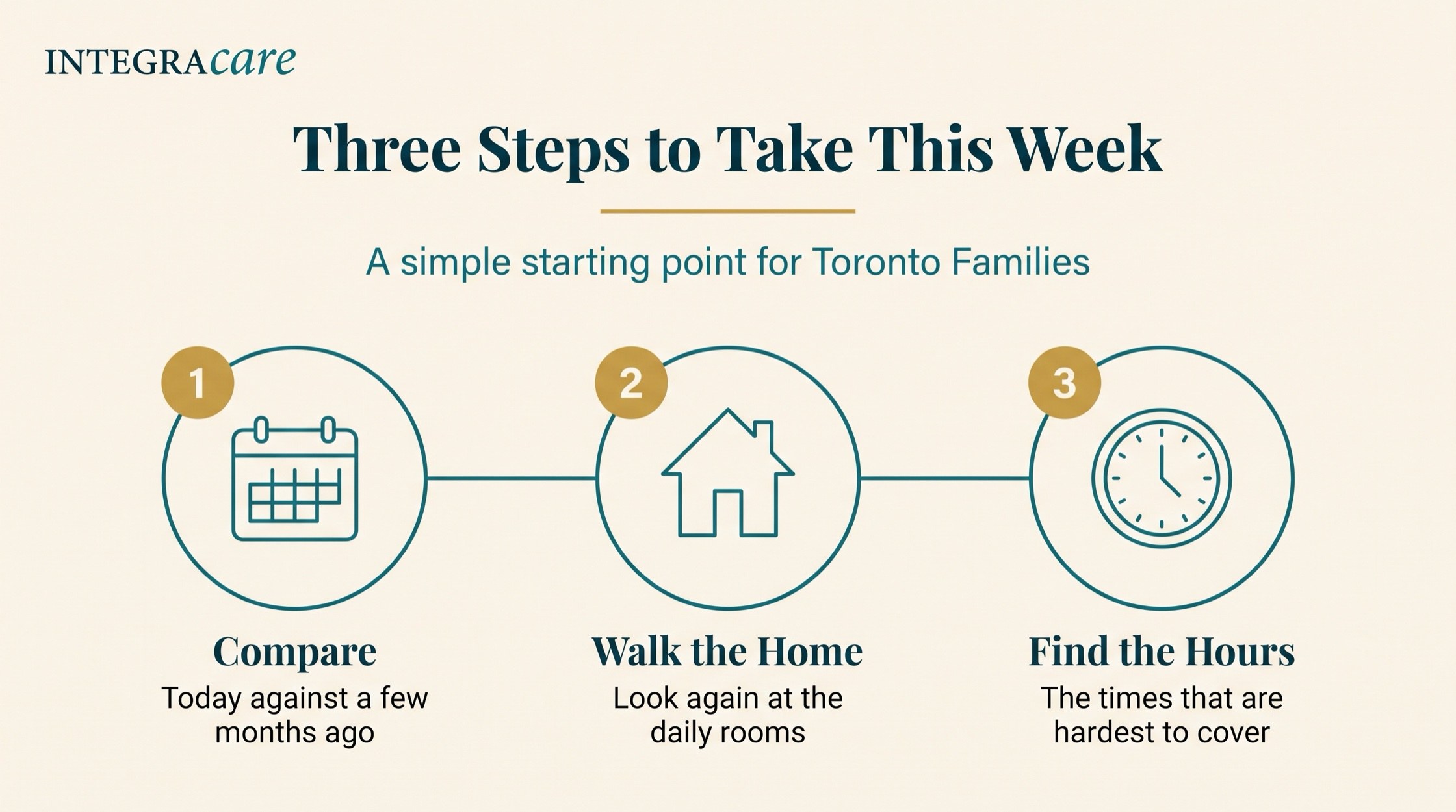
Families do not need to predict every future stage of dementia to recognize when something at home may need attention. Start with what has changed recently, what is happening in the home now, and where the Family is providing more help than before. These three steps will also make every conversation with a provider more productive.
Step 1: Compare Today With a Few Months Ago
Think about routines that were manageable a few months ago. Has your loved one started missing medications, skipping meals, or becoming confused about the time of day? Perhaps getting dressed takes longer, sleep has changed, mobility is less steady, or a familiar route has become difficult to follow.
Changes can also appear in the amount of help the Family is providing. More frequent phone calls, medication reminders, meal preparation, or evening visits can indicate that a Senior’s day-to-day needs are changing even when they continue to manage many things independently.
Writing down a few specific examples can be helpful when speaking with the Senior’s healthcare professionals or discussing home care options.
Step 2: Walk Through the Home With Fresh Eyes
A home that has worked well for decades may need adjustments as memory, judgment, or mobility changes.
Walk through the spaces your loved one uses every day. Check whether medications are organized appropriately, pathways are clear, nighttime lighting is adequate, and frequently used belongings are easy to reach. Consider whether appliances are still being used safely and whether household products that could pose a risk need to be secured.
If wandering is a concern, review exterior doors, keep a recent photograph and emergency information readily available, and make sure Family caregivers know what to do if your loved one goes missing. Knowing who to call and getting assistance from home care may be the most appropriate step to keeping your loved one safe. The Finding Your Way resources and Alzheimer’s Association wandering guidance provide additional information for Families.
Step 3: Find the Hours That Are Becoming Hard to Cover
Look at the times of day when your loved one increasingly depends on someone else. Morning personal care may be becoming difficult. Meals and medications may require regular reminders. Late afternoons could bring more confusion, or a Senior may no longer be comfortable or safe alone overnight.
Identifying these specific periods gives Families a clearer starting point than trying to decide whether a loved one simply “needs home care.” It helps establish what support is needed, when it would be most useful, and which routines the Family is finding difficult to cover consistently. These observations can then guide a conversation with the Senior’s healthcare professionals or a dementia home care provider about the level of support that fits their current needs.
What Should You Ask a Dementia Home Care Provider in Toronto?
Choosing dementia home care involves understanding who will be spending time with your loved one and how their care will be managed. Guidance from Parkinson Canada and Peace In-Home Health Care Services can help Families prepare for conversations with prospective providers.
Start With the Caregivers
Ask how Caregivers are hired, screened, and educated before entering a Client’s home. Families can find out whether Caregivers are direct employees, whether Vulnerable Sector Checks and reference checks are completed, and what dementia-specific education is required. It is also worth asking how Caregivers are matched with Clients and how the provider maintains consistency. For a Senior living with dementia, seeing familiar Caregivers can help preserve established routines and allows Caregivers to become familiar with the Client’s usual behaviour, communication, and preferences.
Find Out Who Oversees the Care
Ask who assesses the Client, develops the Client-centred care plan, and oversees care as needs change. If Registered Nurses or Registered Nursing Coordinators are involved, find out what that involvement looks like in practice. Families should also know who they can contact when they notice a change in their loved one and how new information is communicated across the Caregiving team.
Ask What Happens When Needs or Schedules Change
Dementia care may need to change over time. Ask whether additional hours, overnight care, or 24/7 support can be arranged if appropriate, and how the provider reassesses a Client when their needs change.
It is equally useful to understand what happens when a regular Caregiver is unavailable. Ask how replacement coverage is arranged and how another Caregiver learns about the Client’s routines, preferences, and current care needs before arriving at the home.
Ask What an Hour of Care Actually Includes
Two providers can quote similar hourly rates while offering very different levels of support. Families should ask what is included before comparing prices.
Consider whether Caregivers receive dementia-specific education, whether a Registered Nurse is involved in the care plan, how Caregivers are supervised, and how the agency maintains consistency. Replacement coverage also matters when a regular Caregiver is unavailable. For a Client living with dementia, these details can influence who enters the home, how well that person understands the Client, and how consistently established routines are followed.
Can Families Combine Public and Private Home Care?
Ontario Health atHome provides publicly funded home and community care services to eligible Ontarians based on assessed needs. The amount and type of care available depends on the individual assessment and available services.
Some Families add private home care when a Senior requires additional hours, supervision, companionship, or greater Caregiver consistency. Public and private services can be coordinated around the Client’s schedule and care plan. This can help Families build the level of support their loved one requires to continue aging in place.
Care Should Reflect How the Client Lives
A useful care plan captures the details that shape a Client’s day: how they prefer to start their morning, which approaches to personal care they respond to best, what helps them feel comfortable, and which changes in behaviour or routine are unusual for them.
Documenting these details also gives the Caregiving team a shared understanding of the Client. As needs change, Caregivers can adapt their approach while maintaining as much familiarity and consistency as possible.
Keeping Your Parent at the Centre of Care
Dementia can change what a Senior can manage independently, while their preferences, relationships, interests, and personal history remain important to how care is provided. For Families comparing dementia home care in Toronto, Caregiver education, consistency, Client-centred care, and clinical oversight are the considerations that matter most alongside scheduling and cost.
Integracare’s approach to dementia care combines Alzheimer Society-educated Caregivers, Registered Nursing Coordinator oversight, and Client-centred care at home. Care can adapt as a Client’s needs change while preserving the routines, activities, and familiar surroundings that are important to them. Contact us to discuss how Integracare can support your mom or dad in aging well and finding opportunities for joyful living at home.
FAQs
How do I find a dementia-trained caregiver in Toronto?
Start by asking providers what dementia-specific education their Caregivers complete, whether that education applies to the whole Caregiving team, and who provides clinical oversight. Structured programs such as the Alzheimer Society curriculum, Gentle Persuasive Approaches, and U-First! are stronger signals than experience alone. Then ask how Caregivers are screened, matched, and kept consistent.
Can a Senior with dementia continue to age in place?
Yes, many Seniors living with dementia can continue to age in place when their care and home environment are suited to their current needs. Support may change over time as memory, mobility, personal care, or safety needs change. A Client-centred care plan can help Families determine where additional assistance or supervision may be appropriate.
How do you know when a loved one with dementia may need more help at home?
Look for changes from the Senior’s usual routines and abilities. Missed medications, skipped meals, increasing confusion, changes in personal care, wandering, nighttime disorientation, or a growing reliance on Family members can all warrant closer attention. Families can document these changes and discuss them with the Senior’s healthcare professionals and home care provider.
Is it safe for a parent with dementia to be home alone while I work?
It depends on their current abilities and risks, and the answer changes as dementia progresses. Missed medications, appliances left on, confusion about time of day, and any history of wandering are signs that unsupervised hours are becoming unsafe. Daytime home care can cover working hours specifically, and a wandering prevention plan adds a further layer of protection.
Why does Caregiver consistency matter in dementia care?
A consistent Caregiving team has the opportunity to learn how a Client communicates, the routines they are accustomed to, and what is typical for them. That familiarity can support more consistent care and help Caregivers recognize changes in behaviour, mobility, or daily functioning that may need attention.
What dementia education should a professional Caregiver have?
Families should ask about structured dementia-specific education rather than relying on experience alone. Integracare Caregivers are educated across all five facets of the Alzheimer Society of Toronto curriculum, providing a consistent foundation for understanding dementia, communication, and responsive behaviours.
What is the role of a Registered Nursing Coordinator in dementia home care?
Registered Nursing Coordinators provide clinical oversight and help ensure care continues to reflect the Client’s changing needs. At Integracare, this oversight works alongside the Caregiving team and Client-centred care plan, giving Clients and their Families a clear point of clinical coordination as care needs evolve.
Can dementia home care start with only a few hours a week?
Yes. Home care can begin around the times and routines where a Client currently needs assistance. This might include morning or evening routines, meals, medication reminders, personal care, companionship, or activities. Care can then be adjusted if the Senior’s needs change.
What should Families ask when choosing a dementia home care provider in Toronto?
Ask about dementia-specific Caregiver education, screening, Caregiver consistency, clinical oversight, and how care plans are updated. Families should also understand who they can contact when a Client’s needs change and how replacement Caregivers are prepared when a regular Caregiver is unavailable.
Free In-Home Assessment
The Care Your Family Deserves Starts Here
Speak with our team about a personalized care plan. Book a free, no-obligation in-home assessment and we will help you find the right support for your loved one.
About the Author: Lee Grunberg

President & CEO, M.B.A.
Lee joined Integracare as President & CEO on August 2, 2016 after an approximately 20 year career in Private Equity and Investment Banking. Lee brings tremendous operational knowledge and governance experience along with an incredible passion and energy to Integracare.