
Blog
Private Home Care vs. Personal Care Home in Winnipeg
Published
Written by Dennis Fancy
Reviewed by Bethel McMaster, BScN, RN — Director of Business Development
On this page6 sections
Choosing between a personal care home and private home care comes down to one practical question: can your parent's needs be met safely at home, and for how long? Manitoba's personal care homes are built for people whose medical needs require 24-hour nursing support. Integracare provides nurse-led care at home, with registered nurse supervision, 24/7, for families who want to stay in their own home as long as it is safe and sensible to do so. The right answer depends on your parent's health, your family's capacity, and what each option actually costs.
What each option costs in Manitoba
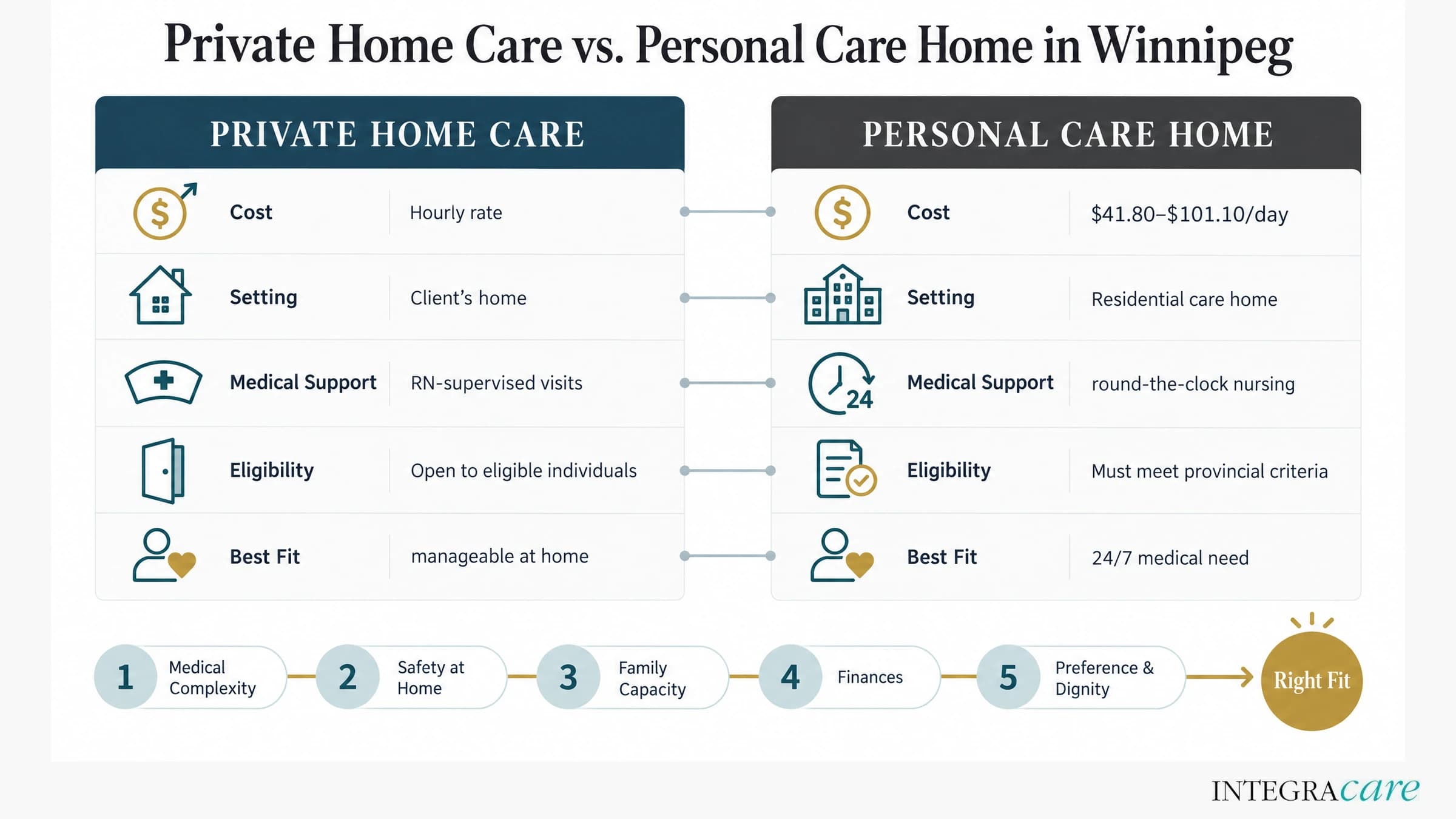
A personal care home (PCH) charges residents a daily Residential Charge based on net income. For the 2025/26 rate year, that charge runs from $41.80 to $101.10 a day, which works out to roughly $1,250 to $3,030 a month. Manitoba Health, through the regional health authority, covers the majority of the actual cost of care; the resident pays only the Residential Charge, not the full cost of the bed.
Private home care is priced by the hour, so the monthly cost depends entirely on how much support your parent needs: a few visits a week for medication and meals costs far less than live-in or 24-hour care. There is no single public rate to quote, so ask directly for an hourly rate based on your parent's care plan. There is also a cost to waiting. Manitoba seniors who are assessed as ready for a personal care home but remain in hospital because no bed is available have been charged as much as $101 a day in hospital residential fees, totalling more than $15 million province-wide over three years. Arranging home care sooner can sometimes avoid that extended hospital stay altogether. For more on that specific situation, see what Winnipeg families do when they're home from hospital and waiting on home care.
What you get for that cost
Manitoba's public home care program, delivered through WRHA Home Care, can include nursing care, personal care and hygiene, medication assistance, meal assistance, household maintenance, laundry, health education, adult day programs and respite care, depending on the assessed need. A personal care home adds 24-hour nursing support in a residential setting, with staff on-site around the clock.
Private home care is arranged around your parent's own home and schedule. A registered nurse plans the care, and health care aides deliver the day-to-day support: bathing, dressing, medication reminders, mobility, companionship, and more, with the plan adjusted as needs change. For many families the appeal is simple: your parent keeps their own bedroom, their own routine, and their own say over who comes through the door. You can see the range of what that looks like on the home care in Winnipeg page, including options for 24-hour home care when overnight support becomes necessary.
Can your parent get into a personal care home
This is the question families sometimes skip. Manitoba does not allow someone to simply apply and move into a PCH because they, or their family, prefer it. To be eligible, a person must meet residency requirements, require 24-hour nursing support, and be medically, functionally and behaviourally stable enough for that setting, with consent from the person or their substitute decision-maker. The WRHA oversees 38 long-term care facilities with more than 5,200 personal care home beds in Winnipeg.
Just as importantly, the WRHA treats a personal care home as a last resort. Placement is considered only once a client can no longer be supported through existing community supports, which explicitly includes private care. That means for many seniors, private home care is the option that keeps a PCH bed unnecessary for months or years longer.
A simple decision framework
Work through these questions with your family and, where possible, your parent's doctor or care coordinator:
- Medical complexity. Does your parent need 24-hour nursing support in a facility, or can scheduled visits and periodic nursing care manage their condition at home?
- Safety at home. Are falls, wandering, medication errors or isolation creating real risk, or can those risks be managed with regular check-ins and support?
- Family capacity. Is an unpaid family caregiver providing most of the support now, and are they at risk of burnout? Respite care can relieve pressure without a move.
- Finances over time. Compare the PCH Residential Charge range against an hourly home care quote for the hours your parent actually needs.
- Preference and dignity. What does your parent want? Capacity to choose should weigh heavily while it still exists.
When each option tends to be the better fit
Private home care tends to fit when your parent is largely managing with some support, wants to remain in their own home, or is waiting for an assessment or a PCH bed and needs safe support in the meantime. It also fits well for couples where one spouse wants to remain at home with the other.
A personal care home tends to fit when a doctor or care coordinator has confirmed the medical need for 24-hour nursing support, and when that need is expected to be ongoing rather than temporary.
Families weighing a move sometimes start by looking at what private care could cover first. If you are unsure which category your parent falls into, a conversation with a registered nurse about your parent's specific needs is a reasonable next step before applying anywhere. If you decide to hire privately rather than through an agency, it is worth understanding the risks of hiring a private caregiver directly in Winnipeg before you do.
Frequently Asked Questions
Can we use private home care while waiting for a personal care home assessment or bed?
Yes. Private home care can support your parent safely at home during an assessment, and it can reduce the risk of an extended, costly hospital stay while a bed becomes available. A registered nurse can build a plan that flexes as your parent's needs change during that waiting period.
Does Manitoba Health or WRHA Home Care pay for private home care?
No, with one exception. WRHA Home Care is a separate, publicly funded program with its own eligibility assessment. The exception is Self and Family Managed Care, a provincial program run through WRHA Home Care. If your parent qualifies for home care, your family can receive funding for the assessed hours each week and arrange the care yourselves. That funding can pay a private agency such as Integracare, and your family pays the difference in the hourly rate plus any hours above the funded amount.
What if my parent's needs change after we choose a path?
Both paths can change. A home care plan is reviewed and adjusted by a registered nurse as needs increase, including a move to live-in or 24-hour support. If a personal care home later becomes medically necessary, your parent's care coordinator can reassess eligibility at that time.
How do we get a real cost estimate for home care in Winnipeg?
The most accurate way is to describe your parent's daily needs, including hours of support and any nursing tasks, and ask for an hourly quote based on that specific plan. Contact us about Winnipeg care to confirm availability at your address and get a plan-based estimate.
Free In-Home Assessment
The Care Your Family Deserves Starts Here
Speak with our team about a personalized care plan. Book a free, no-obligation in-home assessment and we will help you find the right support for your loved one.