
Blog
The Four Most Common Types of Dementia
Published
Updated
Written by Lee Grunberg, M.B.A. — President & CEO
Reviewed by Bethel McMaster, BScN, RN — Director of Business Development
On this page15 sections
Key Takeaways
- Dementia includes various conditions affecting memory and daily functioning.
- Four main types are Alzheimer’s, vascular, Lewy body, and frontotemporal dementia.
- Each type has unique symptoms and progression, making personalized care vital.
- Early signs impact memory and decision-making; later stages affect mobility and communication.
- Knowing the specific type helps families provide better support, while home care allows familiar surroundings.
There's nothing quite like watching someone you love slowly lose their memory, sense of self, or experience personality changes. It can be heartbreaking, frightening, and confusing. Many families like yours lie awake at night in search of answers. At Integracare, we help families that are experiencing confusion, fear, and heartache over a loved one experiencing symptoms of Dementia. Let's get started with some basic facts.
What is Dementia
Dementia is not a disease; it's a term used to describe a group of symptoms (memory, thinking, social skills, and the ability to perform daily tasks) caused by various diseases and conditions. When these symptoms are significant enough to affect a person's life (including their ability to perform routine activities), healthcare providers use the term "dementia" to refer to their symptoms.
Many people are surprised to learn that dementia isn't a single condition; many underlying conditions and diseases can cause it, and each one manifests differently. For this reason, no two people living with dementia may have the same experience.
If there is someone in your life who has recently been diagnosed with a specific type of Dementia, the more you know about it, the more you will understand their behavioural and personality changes. You’ll be able to cope better in challenging times when you have some educational tools behind you.
Finding The Right Support
People often struggle with this battle alone, juggling too many things at once and not knowing how to care for their loved ones, wondering how they will manage. If you are feeling this way, you are not alone. There are home care services in Toronto to help you cope and find the right support services for your loved one experiencing cognitive delays.
For over 30 years, Integracare has provided families with the companionship and support they need to navigate life's greatest transitions. We understand the pressure of managing your own busy life and the anxieties that can come with ensuring the safety of a loved one.
We offer Home Nursing, Personal Support Services, and our complete suite of home health services to seniors all across Toronto, Mississauga, and Ottawa, allowing you to access the level of assistance based on your family’s unique circumstances.
Receiving a dementia diagnosis can be difficult and frightening, but home care will help and support your loved one during this time. Home healthcare helps maintain stability that is so crucial to the safety and care for people struggling with Dementia. Our highly qualified caregivers have gone through continuous training by the Alzheimer’s Society of Toronto to provide our clients with customized care based on their individual needs.
Are There Different Kinds of Dementia?
Dementia is a broad term for a variety of conditions that impact memory, thinking, and communication. Often, changes in speech or subtle forgetfulness are among the earliest signs of Dementia families begin to notice. Recognizing these changes early is the first step toward finding the right support.
Understanding the differences between the varying levels of memory loss is critical to managing the behavioural challenges your loved one might experience. In the earlier stages, it might just look like forgetting to take medication or falling behind on finances. As it advances, they may need an extra hand with groceries and meals, eventually requiring full support with daily essentials like dressing and eating. Knowing where your family member stands helps you choose the right level of care so they can live comfortably, safely, and with dignity.
How Dementia Progresses Over Time
Movement and daily care become progressively challenging as Dementia progresses. In the initial stages, the problems may be minor, such as missed medications and debts. Your loved one will later require help with everyday chores such as shopping and cooking, before eventually requiring complete assistance with personal care. Being aware of what is to be expected will allow you to be prepared and provide the appropriate care and attention to ensure their continued safety and well-being.
Why Are There Different Types of Dementia?
While the symptoms of dementia appear the same, the reasons behind them differ greatly depending on what part of the brain is affected. There are varying types of dementia, usually identified by how brain tissue is damaged, most often by proteins or interrupted blood flow.
- Alzheimer's Disease is caused mostly by proteins and they form plaques throughout the brain that obstruct nerve signals.
- Vascular dementia is caused by interruptions in blood flow to the brain, and most often the causes are stroke or other recurring conditions affecting the blood vessels and blood clots.
Learning the exact cause is more than just a clinical fact, but a roadmap that can help you prepare for what your loved one may need, why they may have trouble with specific tasks, and also determine what kind of care will be most effective for them.
Although there may be similarities among different types of dementia, symptoms can differ greatly depending on the subtype, affecting individuals in different ways. Models such as the 7 A’s of Dementia could assist families in deciphering these particularities and understanding how the disease affects individuals in various aspects, such as their language skills and perception.
Due to the differences in symptoms, particular drugs and coping techniques are needed for each type of dementia. Care must be customized to match the unique needs of each client. Integracare works closely with Families, Clients, and primary medical care providers to coordinate and deliver a personalized Care experience. Everyone’s experience with Dementia is different, and the Care that they receive should reflect that.
How Many Types of Dementia Are There?
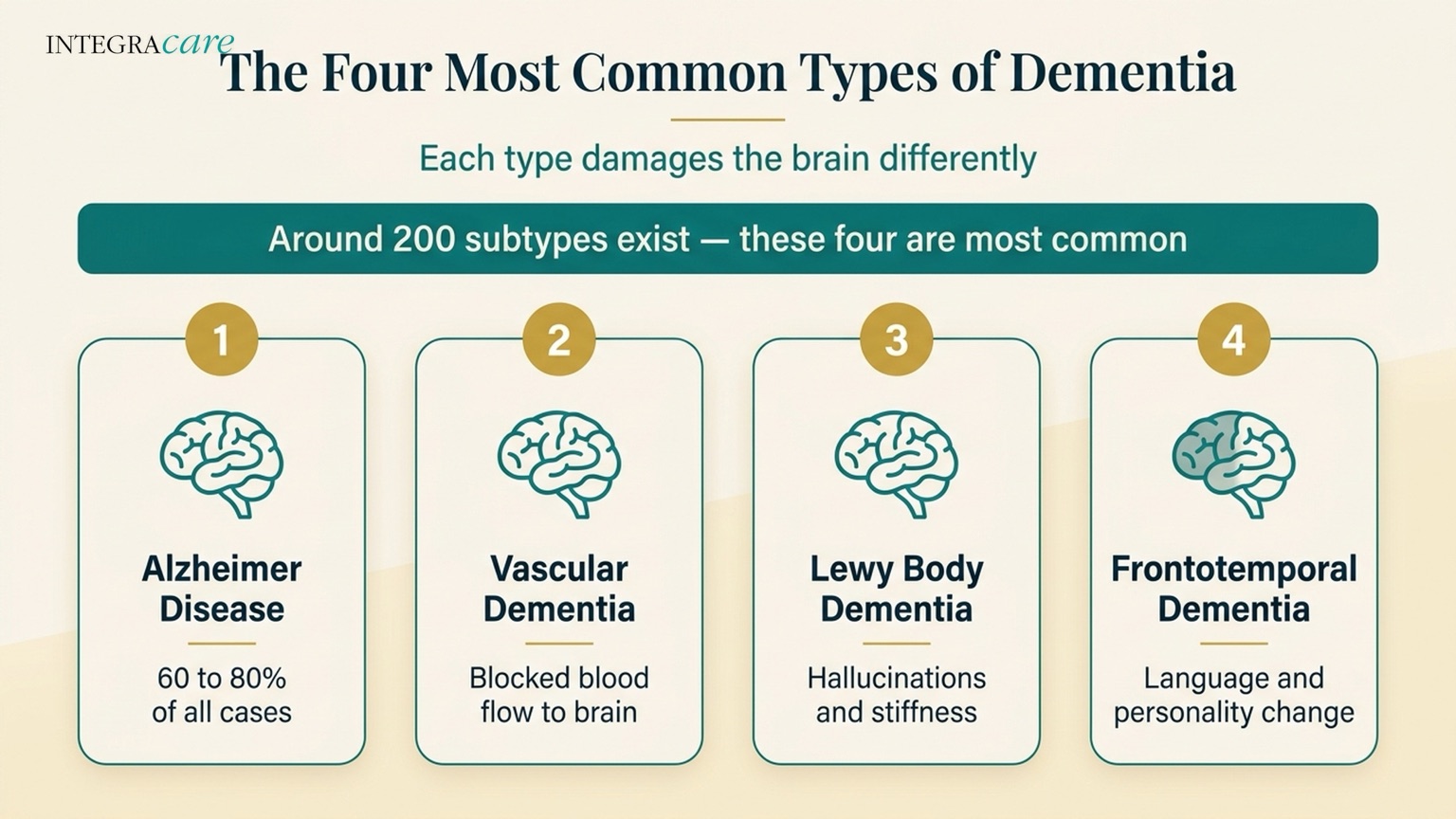
There are about 200 different subtypes of Dementia, although you can also find estimates claiming that there are around 100 or closer to 400 different types of Dementia. It is also possible for a person to get Mixed Dementia, where they have more than one type of this condition at the same time and can be affected by symptoms of both.
Only about 1 in 20 people have one of the rarer Dementia types. The four most common types of Dementia make up the bulk of people who go through this disease.
What Are the Rarer Dementia Types?
There are too many subcategories to list in full here. However, some of the rarer types of Dementia include conditions like:
- Posterior cortical atrophy
- Frontal variant Alzheimer’s disease
- CADASIL
- Progressive Supranuclear Palsy
- Creutzfeldt-Jakob disease
- HIV-associated neurocognitive disorder
- Huntington’s disease
- Normal pressure hydrocephalus
There are many others, but even combined, they are in the minority when it comes to Dementia. Below, we’ll look at the more common types of Dementia that you’re much more likely to encounter with a loved one.
Young-Onset Dementia: Understanding Dementia Before Age 65
Adults under 65 years can also develop dementia. About 2 to 8% of cases of dementia in Canada occur with onset in young adulthood. When it occurs in this population, symptoms may involve changes in personality, behaviour primarily, or language, and not simply memory loss.
Younger adults often have families to support and may still be working when symptoms of young-onset dementia start to appear. These factors, such as unemployment, financial hardship, and lack of appropriate support resources and services for a younger demographic, pose different types of challenges. If you note any unusual changes in someone under 65, consider having him or her checked by a healthcare provider for an early diagnosis and access to specialized resources.
What Are the Different Types of Dementia: The 4 Main Types of Dementia
When a loved one is recently diagnosed with Dementia, understanding the specific type they have makes all the difference. Explore the four common types below to help you navigate their care with confidence and compassion.
1. Alzheimer’s Disease
The most common form of Dementia is Alzheimer’s disease. It accounts for about 60 to 80 percent of all Dementia cases. Some people like to describe it as a slow process of going backwards in time. An individual with Alzheimer’s Disease will usually begin with short-term memory loss. They’ll repeat themselves often, forget where they put their keys, and ask the same question over and over. As the condition progresses, some individuals may also experience what sundowning is, where confusion and agitation tend to worsen later in the day.
Eventually, the individual will essentially go back in time to earlier days because the days of the present are no longer remembered. Long-term memories remain while short-term memories disintegrate. Going backwards in time means that Clients with the disease may not recognize a spouse or a child, for example.
Individuals with Alzheimer’s exhibit trouble with thinking and reasoning. The progress of the disease has been divided into seven stages. It starts with simple confusion, and as time passes, the person loses significant abilities, including swallowing and speaking. Full-time care is absolutely necessary once these stages occur.
No family should have to walk the path of Alzheimer’s disease alone. Our Senior caregiver services connect you with deeply compassionate caregivers who are available 24/7, ensuring your loved one is safe and your family is fully supported every step of the way.
2. Vascular Dementia
Understanding the underlying causes of memory issues in loved ones due to health concerns can make things easier. Vascular Dementia, also known as “Post Stroke Dementia,” is quite different from Alzheimer’s disease. In fact, Vascular Dementia is brain damage traced to cardiovascular problems or mini-strokes that create bleeding or harm in the brain.
You can identify Vascular Dementia symptoms when drastic changes occur immediately following a stroke. These symptoms could include changes in personality and reasoning. Trouble remembering, paying attention, and organizing thoughts can all be symptoms of this type of Dementia.
It’s not always a result of a stroke. Vascular Dementia can also result from other conditions that damage blood vessels and weaken circulation, depriving the brain of vital nutrients and oxygen.
How We Help Your Loved Ones
With a loved one struggling with memories, daily life may become overwhelming for the whole family.
Our caring, judgement-free Dementia Care in Toronto & Mississauga is 100% committed to making a difference in your loved one's quality of life. With the changes, we partner with you and your family's medical team to craft an adaptive care plan, so they can continue to feel safe, respected, and comfortable in the environment they love.
Here are three ways our highly trained caregivers support families through common daily challenges:
- Thoughtfully Managing changes in behaviour: We are prepared to address moments of confusion or frustration with gentle and specialized care that ease the distress without disrupting routine.
- Helping with Essential Activities: We offer discreet assistance in the process of doing such activities as taking medications, having nutritious meals, and maintaining proper hygiene, allowing your dear one to maintain respect while helping you relieve stress.
- Coordinating Familiar Relationships: To establish continuity, our professional dementia caregivers get matched with your family members for regular interaction.
As the disease progresses, we’ll work closely with you and your loved one’s doctors to create the best and most beneficial plan for them.
3. Lewy Body Dementia
It is difficult trying to figure out what you can do to help when you discover that your loved one’s ability to remember things and move physically is being affected at the same time, but knowing more about their illness makes things clearer. Lewy Body Dementia (LBD) is a common yet frequently undiagnosed or misdiagnosed type of Dementia. LBD has been described as a combination of Alzheimer’s symptoms with Parkinson’s disease symptoms.
There is a cognitive decline that is similar to Alzheimer’s, but it creates a stiffness or rigidity in the body that is typically associated with Parkinson’s. In addition to these symptoms, individuals experience visual hallucinations and problems with sleep patterns (such as sleepwalking). They can experience periods of total clarity and then very abruptly become confused and display nonsensical thinking.
Clients with LBD who suffer from body stiffness and rigidity enjoy regular visits from Integracare RMTs because it helps to alleviate pain in the limbs and joints. Massage therapy is an excellent tool for patients with Dementia, not simply because it provides pain relief (although that is very important), but also because it provides the healing power of touch.
Integracare offers an array of home healthcare services, including massage therapy and physiotherapy. Our specialized Registered Massage Therapists (RMTs) are trained to be gentle with Seniors, particularly those who suffer from Dementia.
Dementia can feel incredibly isolating, and, for some Clients, it’s hard and sometimes impossible to express these lonely feelings to others. A gentle massage lets your loved one feel wanted and acknowledged.
4. Frontotemporal Dementia
It is very difficult to witness your loved one’s personality and way of communicating with you change dramatically, but knowing why this has happened from a biological perspective can help make things easier for you. Frontotemporal Dementia (FTD) happens when deterioration occurs in the Frontal and Temporal Lobes of the brain. The individual will experience difficulties with language and big changes to their personality and behaviour.
The Temporal lobe affects how people behave and react to stimuli, and the Frontal lobe has to do with cognitive and emotional processes, as well as voluntary movement. The executive functions of the brain, including judgment, planning, and analysis, are all housed in the Frontal lobe.
When an individual has been diagnosed with FTD, they will slowly begin to withdraw into themselves. They may also lose inhibitions, and their actions can sometimes be shocking. As the illness progresses, they tend to lose interest in others around them and their surroundings. They tend to convey emptiness in their emotions, lacking sadness and having little need to engage with others.

Compassionate Care When You Need It Most
Watching a loved one experience the profound personality and language changes of FTD is incredibly challenging, and you shouldn't have to carry the responsibility of daily care all by yourself.
If you need a helping hand, you can contact us anytime to learn how our home healthcare services can bring relief to your family. Our compassionate caregivers are here to step in whenever you need a break, assisting with everything from meal preparation and light cleaning to bathing and medication management. Whether you need a few hours of support or dedicated live-in care, we are here to ensure your loved one stays safe, comfortable, and deeply cared for.
Treatments and Supports for Dementia in Canada
There is currently no cure, but treatments and supports can help with the symptoms of dementia and make daily life more manageable.
Certain medications may slow the worsening of some dementia symptoms.
Occupational therapy or speech therapy may help support independence and communication.
Healthy lifestyle choices-exercise, a good diet, and staying socially active can contribute to well-being.
Canadian families can get help in the form of support groups, dementia advisors and help lines through the Alzheimer Society of Canada. Work on making the home safer, keep a "life story" book and remember to take care of your own well-being as a caregiver. Local resources are available to support both you and your loved one.
In Conclusion
There is no simple answer or solution to Dementia. However, we’d like to think we bring a little bit of joy, if not reprieve, into the lives of our Clients and their families. Regardless of the type of Dementia your loved one is living with, they deserve the absolute highest quality of life. With our professional and empathetic healthcare providers and services, we want to help them receive just that.
Frequently Asked Questions About The Types of Dementia
Is Alzheimer’s a Type of Dementia?
Yes, Alzheimer’s is a type of dementia. It is caused by an abnormal buildup of amyloid and tau proteins in the brain. This buildup becomes deposits that interfere with the normal functioning of the brain and lead to the condition.
What Is the Most Common Type of Dementia?
Alzheimer’s Disease is the most common type of Dementia. It affects anywhere from 60 to 80% of people who are living with some type of Dementia. Alzheimer’s is best known for featuring cognitive decline and progressive memory loss. In many ways, it has shaped our cultural understanding of Dementia, though it is important to recognize that other types can present and progress differently.
What Is the Difference Between Different Types of Dementia?
Different types of Dementia will present in different ways. Although all types share commonalities in that they tend to impact memory and brain functions. Some Dementias are more closely associated with delusions and hallucinations, some can result in symptoms like shaky hands, while others will present muscle rigidity, and some can make it harder to understand language. There are many different symptoms, although they are related.
What are the early warning signs of dementia?
Early signs of dementia often include short-term memory loss, difficulty finding words, confusion with time or place, and trouble completing familiar tasks. These symptoms may appear subtle at first but tend to become more noticeable and disruptive over time.
Can someone have more than one type of dementia?
Yes, it is possible to have more than one type of dementia at the same time, a condition known as mixed dementia. This most commonly involves a combination of Alzheimer’s disease and vascular dementia, leading to overlapping symptoms and more complex care needs.
Free In-Home Assessment
The Care Your Family Deserves Starts Here
Speak with our team about a personalized care plan. Book a free, no-obligation in-home assessment and we will help you find the right support for your loved one.
About the Author: Lee Grunberg

President & CEO, M.B.A.
Lee joined Integracare as President & CEO on August 2, 2016 after an approximately 20 year career in Private Equity and Investment Banking. Lee brings tremendous operational knowledge and governance experience along with an incredible passion and energy to Integracare.