
Blog
What to Do When Ontario Home Care Hours Aren't Enough: Your Private Care Options
Published
Written by Lee Grunberg, M.B.A. — President & CEO
Reviewed by Kristine McGinn, BScN — Director of Integracare East
On this page9 sections
Key Takeaways
- Ontario home care hours often cover only the basics, leaving gaps in daily support.
- Private home care can add flexible hours, overnight care, and consistent caregivers.
- Public and private care can work together to cover personal care, companionship, and meals.
- Private care is often helpful after hospital discharge or when needs change quickly.
- The right support can help your loved one stay safe and comfortable at home.
Finding the right balance of care for your loved one can be challenging, especially when public home care hours don’t fully meet their needs. You've done everything right. You navigated the Ontario home care system, waited for assessments, and finally received those precious home care hours for your loved one. But as you watch the clock counting down on each brief visit, you're left with that familiar knot in your stomach, the realization that these allocated hours simply aren't enough. Many Families experience uncertainty and frustration as they strive to support their loved ones effectively.
Perhaps you've noticed the rushed nature of publicly funded visits, the lack of flexibility when your loved one's needs change, or the gaps in care during evenings and weekends. You're not alone in feeling exhausted, worried, or even guilty that you can't fill all the gaps yourself. The Ontario healthcare system is stretched to its limits. While publicly funded home care provides essential support, it wasn’t designed to address the full spectrum of needs many families face. When publicly funded hours fall short of what is required to maintain safety, comfort, and independence, understanding how to integrate private home care options provides a practical way forward.
Recognizing the Hidden Gaps in Daily Care
When public support covers only an hour or two a day, the remaining twenty-two hours can leave Families feeling unsettled about their loved one's safety at home. Understanding exactly when these unassisted moments happen helps you plan, ensuring your loved one always has someone nearby when they need it most.
- The Midnight and Early Morning Hours: Most public care plans do not provide overnight support. This leaves a long stretch from late evening to early morning completely unassisted, a time when waking up disoriented in the dark can significantly increase the risk of a fall.
- Late Afternoon and the Dinner Routine: For Seniors navigating dementia or Alzheimer’s, the late afternoon often brings "sundowning," which can cause increased anxiety, confusion, or restlessness. Public schedules rarely align with these complex hours, leaving family members to manage these changing needs alone.
- Coming Home from the Hospital: The first few days back at home after a hospital stay require close attention to manage medications and support physical healing. Because public scheduling backlogs can cause delays before a provincial PSW arrives, having immediate private care ensures your loved one is never left unsupported during this critical transition.
- The Need for Real Connection: Publicly funded visits are focused strictly on essential clinical tasks like bathing, which leaves no room for genuine human engagement. Missing out on regular conversation, shared activities, or a gentle walk outside can often lead to feelings of isolation.
How to Assess Care Needs at Home
Families often notice that something feels unsettled, but it can be difficult to describe exactly where support is missing. A short, structured review of daily routines usually reveals patterns that are easy to overlook.
Tracking care needs for three to seven days can help Families identify when additional support may be helpful. During this period, note the time of day, the type of assistance required, and whether the need is personal, clinical, household, or social. It is also useful to record how long each task usually takes and what happens when help is not available.
A simple way to organize this information is to create a daily log that includes:
- Time of day when assistance is needed.
- Type of support required (for example, bathing, meal preparation, supervision, medication reminders, or companionship).
- Whether the need is predictable or changes from day to day.
- How long the task typically takes.
- What occurs when no one is available to assist.
- Whether a Family member is currently filling the gap.
This exercise often highlights recurring periods when a Client is left without support, such as early mornings, late afternoons, evenings, or overnight. It may also reveal that certain tasks require more time than a brief visit allows, or that a Senior’s condition has changed since the last public assessment.
Once these patterns are clear, Families can use the information during a comprehensive care assessment or when discussing options with a care provider. This helps ensure that any new plan reflects the Client’s actual daily needs rather than an estimate based on a single appointment.
What Ontario Health atHome Covers and Where the Common Gaps Exist
Publicly funded home care in Ontario is designed specifically around helping Seniors manage complex medical recovery or physical limitations so they can safely live at home for as long as possible. Following an in-home assessment by a care coordinator, an individualized public care plan may include scheduled nursing visits for wound care, short-term rehabilitation services like physiotherapy, and brief Personal Support Worker (PSW) visits to assist with basic activities of daily living (ADLs) such as bathing and dressing.
While these services provide an essential foundation, provincial resources face system caps that naturally leave service gaps for Seniors who live independently in their own homes. Findings from the Canadian Institute for Health Information (CIHI) indicate that publicly funded home care programs across Canada are largely optimized to prioritize short, task-specific visits rather than continuous oversight. These daily challenges typically manifest in several observable ways:
- Hourly and Scheduling Gaps: Public personal support services are typically restricted to rigid, brief time slots focused entirely on completing a specific clinical task. This leaves significant unassisted windows during overnights, mealtimes, and evenings.
- Reduced Weekend and Holiday Availability: Public home care capacity often operates on reduced schedules during weekends and statutory holidays, leaving Families to manage complex care routines independently.
- Lack of Caregiver Continuity: Because public providers must balance rotating system demands, multiple Caregivers may cycle through a Senior's home. A lack of consistency can be highly disruptive, particularly for individuals navigating cognitive changes or dementia who rely on familiar routines.
- Exclusion of Instrumental Support: Public care plans generally do not cover non-clinical, day-to-day necessities that preserve standard functional health, such as meal preparation, light housekeeping, and consistent companionship.
Data compiled by Statistics Canada highlights that more than half of family Caregivers who provide 20 or more hours of support per week report that their responsibilities are highly stressful. This pressure builds up naturally when you are trying to balance your own job and family life around a public care schedule that can feel scattered and rushed.
Public vs. Private Home Care: When You Need More Than Basic Support
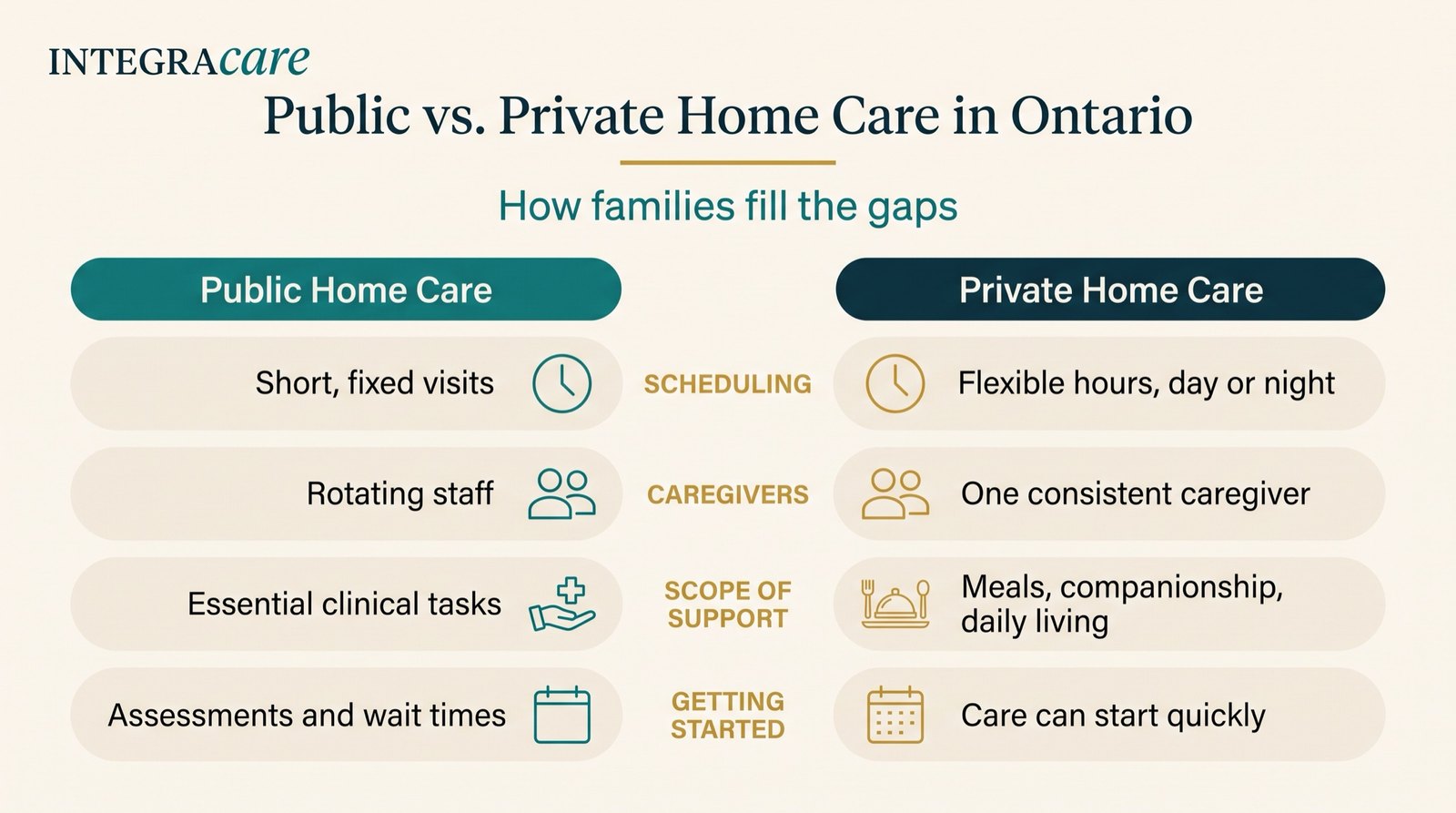
| Aspect | Public Home Care | Private Home Care (Designed Around Your Life) |
| Coverage Scope | Focuses on essential medical care and safety-based support. | Delivers comprehensive, day-to-day care that supports independence, comfort, and quality of life at home. |
| Scheduling Flexibility | Limited to short, scheduled visits based on availability. | Fully flexible scheduling that fits your routine, including longer visits, evenings, overnight, or 24/7 care. |
| Caregiver Continuity | Multiple caregivers may rotate based on system demands. | Dedicated caregivers provide consistency, building trust and a more comfortable daily experience. |
| Start Time | Access may involve assessments and wait times. | Care can often begin quickly, so support is there when you need it, not weeks later. |
| Service Customization | Care plans are based on clinical priorities and system capacity. | Personalized care plans that adapt to your needs, preferences, and lifestyle as they change. |
| Cost Structure | Publicly funded for eligible individuals. | Privately funded, with options such as tax credits, insurance, and flexible care plans to fit your budget. |
| Scope of Daily Support | Focuses on specific tasks during brief visits. | Ongoing support including meals, mobility, companionship, and meaningful daily routines. |
Combining Public and Private Home Care
Publicly funded and private home care can work alongside one another, but the most effective arrangements begin with a clear understanding of what each part of the care plan is responsible for.
Ontario Health atHome coordinates publicly funded services according to a Client’s assessed needs and eligibility. Private care can then be arranged separately to address needs or scheduling preferences that fall outside that plan.
Start With What Is Already in Place
Before arranging additional care, Families should map out the support the Client already receives.
That means looking at:
- which services Ontario Health atHome has arranged
- when those visits take place
- which tasks are being addressed during each visit
- which daily needs remain unsupported
- whether the Client’s needs have changed since the most recent assessment
This makes it easier to identify service gaps without unnecessarily duplicating care.
For example, if a publicly funded visit is already addressing a specific clinical or personal-care need, private support may be better used at another point in the day rather than covering the same task at the same time.
Coordinate Around One Client’s Needs
Public and private providers may maintain separate care plans, but they can still be coordinated around the same Client’s routines, abilities, preferences, and health goals.
With the Client’s appropriate consent, relevant information may be shared between Caregivers and healthcare professionals to support continuity of care.
Useful information can include:
- current mobility or transfer instructions
- established personal-care routines
- changes in appetite, cognition, skin condition, or function
- medication information relevant to the Caregiver’s role
- safety concerns within the home
- who should be contacted when a meaningful change is observed
Clear communication helps everyone understand their role and reduces the risk of conflicting routines or missed information.
Reassess When Needs Change
A private care plan should not automatically replace a reassessment of publicly funded services.
If a Client’s mobility, cognition, health, or ability to manage activities of daily living changes, Families should speak with their Ontario Health atHome care coordinator. A reassessment can determine whether the publicly funded care plan should also be updated.
The most practical approach is often to review both sides of the care picture: what the public system currently provides, what the Client now needs, and where additional private support would add the most value.
This creates a more coordinated care arrangement without assuming that every need must be addressed by the same provider.
How Families Use Private Care on Its Own or Alongside Public Support
Private home health care is completely flexible, serving as a comprehensive, independent care solution or wrapping smoothly around your existing provincial services. Whether your Family chooses to use private care alone for full-time support or combines it with a public schedule to fill vulnerable overnight windows and critical weekend gaps, the focus remains entirely on ensuring your loved one is never left without a dedicated Caregiver.
At Integracare, our team delivers tailored home health care solutions directly across Ottawa neighbourhoods, from Kanata and Westboro to the Glebe, Orleans, and Barrhaven. Depending on what works best for your situation, we can manage your loved one's entire routine independently or align our services to complete your public care circle:
- Nurse-Supervised Model of Care: Integracare’s Personal Support Workers (PSWs) provide personalized support as part of a care plan supervised by Registered Nurses (RNs). Our nursing team provides clinical oversight and helps adjust care as a Client’s needs change, whether your Family needs a few hours of support or a full 24-hour schedule.
- Specialized Dementia & Cognitive Support: Navigating dementia requires an extra layer of patience and specialized expertise. We are deeply committed to cognitive wellness; through our longstanding partnership with the Alzheimer Society of Toronto, 100% of our Caregivers receive continuous, specialized education in all facets of dementia care. We use personalized, gentle approaches and Sensory Tool Kits to keep your loved one safely engaged, calm, and comfortable at home.
- Advanced Clinical Nursing & Rehabilitation: If you are managing complex health needs independently, or if your public care plan lacks adequate medical hours, our in-home Registered Practical Nurses (RPNs) and RNs step in to provide expert wound care, palliative support, and complex medication optimization. We can even integrate specialized in-home physiotherapy and Registered Massage Therapy to help restore mobility right where they feel most relaxed.
You deserve to step back into your role as a daughter, son, or spouse, rather than acting as a full-time care coordinator. What truly sets Integracare apart is an exceptional quality of personal attentiveness. This high standard ensures that your family escapes the stress of missed details, rushed visits, or unaddressed safety risks. By tailoring a private plan around your family's unique lifestyle, your loved one is supported by consistent, gentle Caregivers who protect their safety, respect their dignity, and bring joy back into their daily routine.
Not Getting Enough Home Care Hours? Build a Care Plan Around Your Loved One
If your loved one needs help beyond the hours provided through Ontario Health atHome, Integracare can step in where support is missing. From mornings and mealtimes to evenings, overnight care, and weekends, our Caregivers and nursing team can provide the additional help your Family needs to keep your loved one comfortable and well cared for at home. Contact our team to design a personalized, flexible care plan designed around what makes the day easier and safer for your loved one at home.
FAQs
What are the benefits of combining public and private home care?
Combining public and private home care can provide broader support when publicly funded services do not cover every daily need. Ontario Health atHome arranges eligible services according to assessed needs, while private home care can add companionship, meal preparation, mobility support, longer visits, overnight support, or flexible scheduling. This coordinated approach may help address weekend gaps, reduced hours, and changing needs while allowing a person to remain safely and comfortably at home.
How does Integracare approach caregiver matching?
Integracare’s caregiver matching process considers a client’s medical needs, personal preferences, routines, and personality alongside the caregiver’s skills and experience. This helps create predictable continuity of caregivers and a more trusting relationship. Registered Nursing Coordinators remain involved through care coordination, regular communication, and on-site visits. If needs change, the care plan and caregiver arrangement can be reviewed. The goal is to provide dependable support that feels familiar, respectful, and appropriate for each client.
What types of private home care services are available?
Private home care may include personal support, attendant services, companionship, medication support, meal preparation, housekeeping and home support, mobility assistance, dementia care, nursing care, rehabilitation services, wound care, and hospice and palliative care at home. Families may also arrange respite care, in-home respite care, overnight support, or live-in care. Integracare develops services around the client’s assessed needs, desired coverage window, home routine, and family goals rather than using a one-size-fits-all approach.
Can private care provide companionship as well as personal support?
Yes. Private home care can combine personal support with meaningful companionship. A caregiver may assist with bathing, dressing, continence care, meals, and mobility while also providing conversation, shared activities, reading, walks, appointments, or social outings. Companionship can help reduce isolation and encourage engagement, particularly when a person lives alone or has limited mobility. Integracare’s personalized care plans consider emotional well-being, daily preferences, and quality of life alongside practical household and personal care needs.
What is the difference between hourly care, overnight support, and live-in care?
Hourly care assists during an agreed coverage window, such as mornings, afternoons, or evenings. Overnight support is designed for clients who need help, supervision, or reassurance during the night. Live-in care provides a caregiver’s ongoing presence in the home to support routines and daily activities, subject to the specific care arrangement. The right option depends on mobility, continence care, sleep patterns, supervision needs, safety concerns, and whether support is occasional, extended, or continuous.
Can private caregivers help with medication reminders and symptom monitoring?
Private caregivers may provide medication reminders and observe changes in a client’s health, depending on their role, training, and personalized care plan. Symptom monitoring can include noticing changes in appetite, alertness, mobility, breathing, pain, skin condition, or behaviour and reporting concerns to family members, a nurse, or another healthcare professional. When medication administration, wound care, clinical assessment, or treatment is required, private nursing or registered nurse visits may be more suitable.
Does private home care include continence care, mobility support, or meal preparation?
Private home care can be arranged for continence care, bathing, dressing, transfers, mobility support, meal preparation, medication reminders, and other activities of daily living. Caregivers should encourage the client’s participation and independence wherever possible while providing respectful assistance when needed. Meal preparation may include planning suitable meals and helping with groceries or kitchen routines. During a comprehensive care assessment, the care coordinator identifies the required tasks, visit length, caregiver qualifications, and appropriate support schedule.
When might private nursing or registered nurse visits be appropriate?
Private nursing or registered nurse visits may be appropriate when a client needs clinical support beyond routine personal care. Depending on the situation, services can include wound care, post-operative support, chronic illness management, health assessments, palliative care, medication support, and symptom monitoring. Registered nurse visits may also complement publicly funded services when the available frequency and duration do not meet the client’s needs. Integracare’s nursing team helps develop personalized care plans with clients, families, and healthcare professionals.
How can private home care support dementia or complex care needs?
Dementia care and complex care often require consistent routines, patient communication, supervision, and support that can change throughout the day. A personalized care plan may address personal care, meals, mobility, medication support, companionship, safety, and meaningful activities. Predictable continuity of caregivers helps reduce disruption and allows familiar caregivers to notice changes in mood, behaviour, appetite, or function. Integracare supports dementia care through caregiver matching, nursing oversight, and ongoing care coordination.
How is private home care priced?
The cost structure for private home care depends on the service type, caregiver qualifications, number and length of visits, coverage window, overnight or live-in requirements, and whether additional services or nursing care are needed. Private services are generally paid by the client or family, unlike eligible publicly funded services arranged through Ontario Health atHome. Families may explore private insurance plans, financial aid, employer benefits, or applicable tax credits. A no-cost consultation can help clarify expected services, scheduling, and estimated fees.
Free In-Home Assessment
The Care Your Family Deserves Starts Here
Speak with our team about a personalized care plan. Book a free, no-obligation in-home assessment and we will help you find the right support for your loved one.
About the Author: Lee Grunberg

President & CEO, M.B.A.
Lee joined Integracare as President & CEO on August 2, 2016 after an approximately 20 year career in Private Equity and Investment Banking. Lee brings tremendous operational knowledge and governance experience along with an incredible passion and energy to Integracare.