
Blog
Private Home Care vs. Long-Term Care Waitlists in Ottawa: How Families Can Fill the Gap
Published
Written by Lee Grunberg, M.B.A. — President & CEO
Reviewed by Kristine McGinn, BScN — Director of Integracare East
On this page7 sections
Key Takeaways
- Long Wait Times: Ottawa basic long-term care beds regularly face wait times exceeding a year.
- Zero Hospital Fees: Discharging home with private care avoids $400/day Bill 7 fines and forced 70 km transfers.
- Maintain Placement Standing: Seniors stay active on facility waitlists while receiving 1-on-1 support at home.
- Nurse-Supervised Model: Integracare’s Personal Support Workers (PSWs) are directly mentored by Registered Nurses (RNs).
When a Senior’s health needs change, finding the right care pathway in Ottawa often comes down to timing and support. With provincial waitlists topping 50,000 people , Seniors can spend months, or years, waiting for a spot in a preferred long-term care facility. When hospital discharge mandates overlap with long facility queues, dedicated in-home care offers a reliable solution. By combining Registered Nurse supervision with tailored, one-on-one personal care, nurse-supervised home care enables Seniors to age well at home while supporting their independence and daily routines.
Ottawa’s Long-Term Care Waitlist Crisis
As health needs evolve, Families across Ottawa are increasingly choosing private home care to ensure Seniors receive dedicated, one-on-one attention. Rather than waiting for a spot in an institutional setting, Seniors can remain at home and keep their cherished routines, social connections, and personal independence intact while receiving professional clinical oversight.
This shift toward in-home care comes at a time when facility placements face significant constraints. According to the Ontario Long-Term Care Association (OLTCA) , nearly 50,000 Seniors are on waiting lists across the province. In Ottawa, municipal homes like the Peter D. Clark Centre maintain waitlists of over 960 applicants for just 216 beds, reinforcing why so many Families prefer the reliability and immediate comfort of private home care.
Data from the Council on Aging of Ottawa shows that 64% of waitlist applicants require basic beds, which make up only 40% of local inventory. Because wait times for facility beds can extend for years, and with 87% of Seniors needing help with daily activities like bathing and dressing, private home care provides immediate, consistent support that supports functional health and peace of mind.
How Ontario Health atHome Prioritizes Placements
Long-term care admissions are managed centrally by Ontario Health atHome, rather than on a first-come, first-served basis. Under the Fixing Long-Term Care Act, 2021 , applicants fall into four main priority categories :
- Crisis Category: Seniors requiring immediate admission due to unsafe home environments or hospitalizations.
- Reunification: Partners seeking placement in the same facility.
- Designated Homes: Applicants requiring specific religious, cultural, or linguistic programming (e.g., Francophone facilities in Ottawa).
- General/High Needs: Community-dwelling applicants managed at home.
Since applicants in the “Crisis” category skip ahead of the general queue, seniors living at home can stay on waitlists indefinitely unless their condition worsens rapidly.
Bill 7 and Forced Hospital Discharges
Enacted in late 2022, Bill 7 (More Beds, Better Care Act) fundamentally changed how hospitals discharge Seniors awaiting long-term care. The law allows placement coordinators to assign Seniors to a long-term care home and mandate transfer without agreement from Families.
In Ottawa, Seniors can be assigned to facilities up to 70 kilometres away from home. Those who decline face a mandatory hospital fee of $400 per day , about $12,000 per month. Ministry of Health records show some Families have faced fines exceeding $5,200 after turning down placements. To avoid distant facilities, Families increasingly choose to discharge loved ones home with support from private nursing agencies.
The Growing Pressure on Family Caregivers
Gaps in public home care leave family members carrying much of the burden. According to OLTCA data, 46.8% of unpaid caregivers in Ontario report high levels of distress. Caregivers experiencing burnout average 40 hours of care per week, effectively working a full-time job alongside their own commitments. Publicly funded support hours are often short and scattered, leaving families with complex medical or dementia needs to arrange supplemental private care.
The Advantages of Dedicated, Nurse-Supervised Care
Private, nurse-supervised home care provides a level of personalized attention that facility-based care simply cannot match. Instead of sharing floor staff across an entire building, Seniors receive dedicated, 1-on-1 care tailored entirely to their schedule, preferences, and clinical needs. This individualized focus allows Seniors to remain safe, comfortable, and active in the home they love.
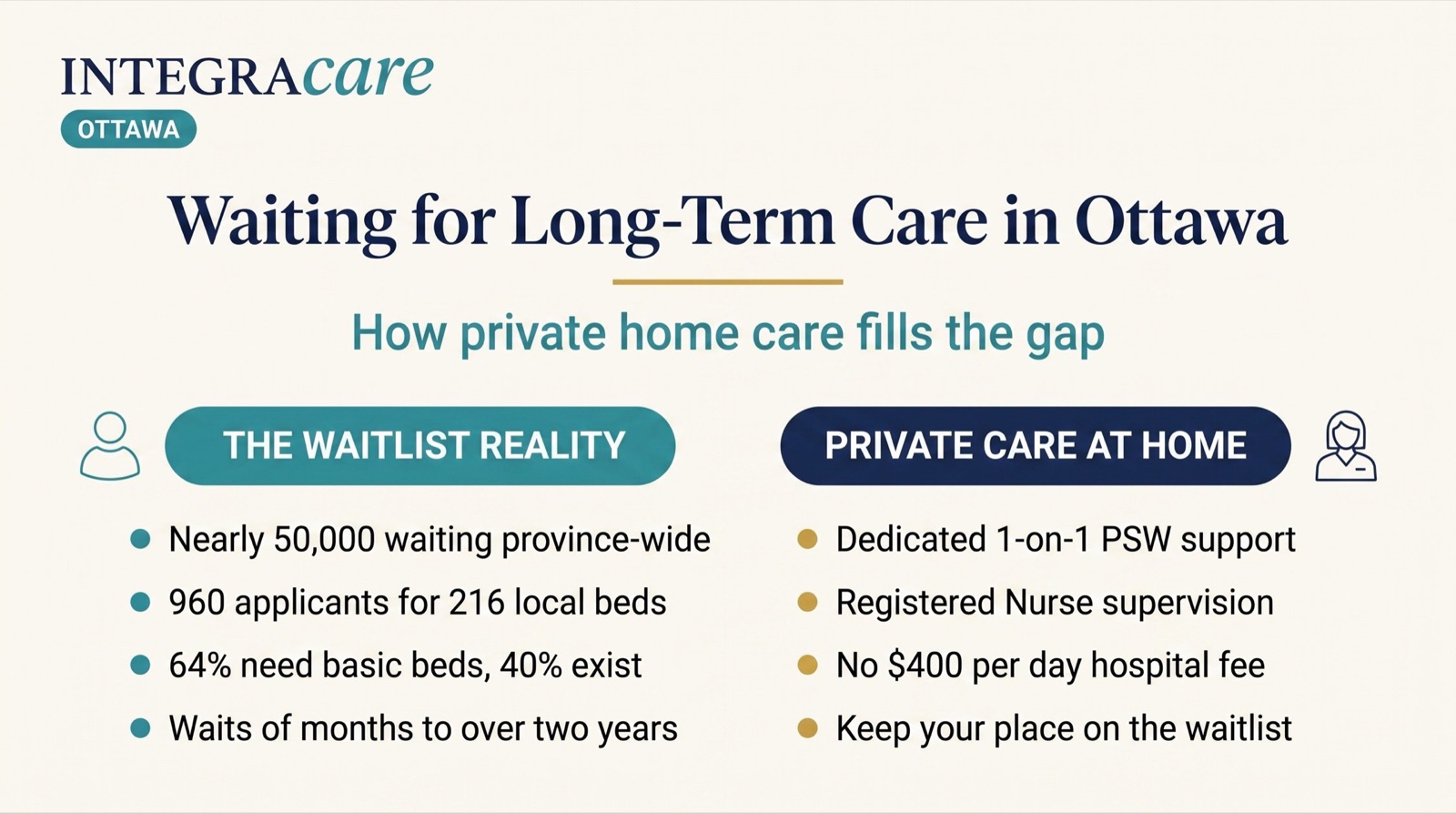
Here is how private care compares with public long-term care pathways during hospital discharge:
| Feature | Public LTC Waitlist Status | Bill 7 Hospital Stay | Private Nurse-Supervised Home Care |
| Location Control | Forced to accept first available bed | Assigned facility up to 70 km away | Senior remains in their own home |
| Financial Risk | Standard LTC accommodation fees | $400/day fine if refusing bed | Flexible hourly or live-in billing |
| Level of Care | Shared floor staff | Hospital ward environment | 1-on-1 dedicated PSW/Nurse care |
| Clinical Oversight | Shared facility nursing staff | Acute hospital focus | Registered Nurse (RN) supervision |
| Caregiver Relief | Delayed until placement | High emotional stress | Immediate 1-on-1 nursing support and caregiver relief |
What to Look for in an Ottawa Home Care Agency
When evaluating home care agencies, the quality of professional supervision and care customization is what makes the greatest difference for Families. For Seniors managing health changes like Alzheimer’s disease, post-hospital recovery, or complex medical needs, having direct nursing oversight with specialized Dementia care ensures care plans are continuously adapted. Hence, Seniors remain safe, comfortable, and independent at home.
Integracare has provided private home healthcare to Ontario Families since 1991, establishing an industry standard for nurse-supervised care. Every Personal Support Worker (PSW) is individually matched, trained, and mentored by Registered Nurses (RNs) and Registered Nursing Coordinators. This unique supervisory structure ensures that every Client receives structured, high-quality clinical care in the safety and comfort of home.
Under the local leadership of Kristine McGinn, BScN, Director of Integracare East , the Ottawa team brings over 25 years of nursing leadership to local Seniors and their Families. Integracare’s specialized services deliver concrete value through:
- 24/7 Personal Support Services: Dedicated one-on-one assistance with activities of daily living (ADLs), personal hygiene, mobility, and medication management.
- Dementia & Cognitive Care: Specialized Caregivers trained in compassionate Alzheimer’s care and cognitive stimulation to foster safe, joyful living at home.
- Hospital-to-Home Transition: Rapid response care coordination to facilitate safe hospital discharges, allowing Families to transition Seniors home smoothly without hospital per diem fees.
- Advanced Clinical Nursing & Rehabilitation: In-home Registered Nurses (RNs) and RPNs providing wound care, palliative care, and specialized in-home physiotherapy and rehabilitation.
Under Ontario’s Bill 7 (More Beds, Better Care Act) , hospitalized Seniors can be assigned to long-term care homes up to 70 kilometres away from their home community. Families often decline these transfers because being placed miles away makes daily visits nearly impossible, separating Seniors from their spouses, children, and familiar surroundings. While refusing a transfer while occupying a hospital bed incurs mandatory fines of $400 per day , discharging directly home with Integracare eliminates hospital per diem charges. With dedicated 1-on-1 PSW care overseen by Registered Nurses, 24/7 care coordination, and custom Client-centred plans, Integracare allows Seniors to age well at home with dignity and complete safety while awaiting placement in their preferred local facility.
Experience Comfort, Independence, and Expert Clinical Care at Home
Every Senior deserves attentive, personalized care in the comfort and safety of home. Whether your Family needs immediate post-hospital transition support, specialized dementia care, or ongoing 24/7 personal support, Integracare’s team of Registered Nurses and Personal Support Workers is here to help your loved one age well at home. Contact Integracare today to schedule a comprehensive, Client-centred care consultation with our Ottawa leadership team.
Frequently Asked Questions About Ottawa Senior Care
How long is the waitlist for long-term care homes in Ottawa?
Wait times for long-term care in Ottawa range from several months to over two years depending on the facility and bed type. Basic subsidized beds face the longest backlogs because 64% of applicants require basic care while basic beds account for only 40% of local inventory.
What happens if a Senior refuses a long-term care bed under Bill 7 in Ontario?
Under Bill 7, hospitalized Seniors who refuse an assigned long-term care placement up to 70 kilometres away face mandatory hospital per-diem fees of $400 per day. These per-diem charges apply as long as the Senior remains in a hospital bed while declining the assigned transfer.
Do Families have to pay the $400 daily hospital fine if they choose private home care?
No, hospital per-diem fees end immediately once a Senior is discharged from the hospital. Choosing private home care allows Families to transition Seniors home safely, eliminating hospital fines while keeping the Senior on the waitlist for their preferred facility.
How much does private home care cost in Ottawa compared to long-term care?
Private home care is billed on an hourly or live-in basis, allowing Families to pay only for the specific care hours needed rather than fixed monthly facility room rates. While public long-term care accommodations feature government-subsidized rates, private home care provides 1-on-1 dedicated nursing oversight in the Senior’s own residence.
How does Ontario Health atHome prioritize long-term care waitlists?
Ontario Health atHome triages applicants into four priority categories under the Fixing Long-Term Care Act, 2021, rather than on a first-come, first-served basis. Seniors in the Crisis Category bypass the general queue, which means community-dwelling Seniors can remain on waitlists indefinitely without supplemental home support.
Can a Senior stay on a long-term care waitlist while receiving private home care?
Yes, Seniors maintain their active placement status on long-term care waitlists while receiving private home care at home. Receiving private care does not jeopardize waitlist standing and allows Seniors to age well at home safely while awaiting their preferred facility.
What is the difference between nurse-supervised home care and standard home care agencies?
In nurse-supervised home care, every Personal Support Worker (PSW) is directly trained, mentored, and supervised by Registered Nurses (RNs) and Registered Nursing Coordinators. Standard agencies often assign workers without ongoing clinical oversight or nursing care plan adaptations.
Does private home care cover specialized needs like dementia or post-hospital recovery?
Yes, comprehensive private home care includes specialized clinical programs such as dementia care, post-hospital rehabilitation, wound care, and palliative nursing. Caregivers receive targeted training to support cognitive health, mobility, and complex health needs at home.
Free In-Home Assessment
The Care Your Family Deserves Starts Here
Speak with our team about a personalized care plan. Book a free, no-obligation in-home assessment and we will help you find the right support for your loved one.
About the Author: Lee Grunberg

President & CEO, M.B.A.
Lee joined Integracare as President & CEO on August 2, 2016 after an approximately 20 year career in Private Equity and Investment Banking. Lee brings tremendous operational knowledge and governance experience along with an incredible passion and energy to Integracare.