
Blog
Coming Home From the Hospital in Ottawa: Planning a Safe Recovery
Published
Written by Kristine McGinn, BScN — Director of Integracare East
Reviewed by Bethel McMaster, BScN, RN — Director of Business Development
On this page10 sections
Key Takeaways
- Discharge planning works best when it starts early in the hospital stay, so there is time to arrange help before your loved one comes home.
- Before discharge, ask for a written medication list, follow-up appointments, warning signs to watch for, and who to call.
- Extra hands help most in the first days at home, especially overnight, when bathroom trips and new medications are hardest to manage.
- Ontario Health atHome can arrange publicly funded services after discharge. Private nursing and personal support can fill the hours in between.
- If your loved one is waiting in hospital for a long-term care bed, ask whether going home with support is an option. It can keep more choices open while you wait.
- Integracare's care is nurse-led, with a nurse available 24/7, and works alongside the services Ontario Health atHome arranges.
The call often comes with little notice: your mom is being discharged tomorrow. A few days after her hip surgery, she still needed help getting to the bathroom, and now the hospital team says she is ready to go home. The practical questions arrive quickly. Who will help her on the stairs? Who will be there if she needs the bathroom at night? Which of the pills on the new list replace the ones already in her cupboard?
Whether your loved one is coming home after surgery, a stroke, a fall or a serious illness, a little planning before discharge day can make the first weeks at home feel much more manageable.
What Is Discharge Planning?
Discharge planning is the process of preparing someone to leave the hospital safely and continue recovering at home or in another setting. It covers medications, follow-up appointments, equipment, home care services, and the warning signs to watch for.
In Ottawa, your loved one may be coming home from The Ottawa Hospital (Civic or General campus), Queensway Carleton Hospital, Montfort Hospital, which serves patients in French and English, or Bruyère Health. Some people move from an acute care hospital to Bruyère for rehabilitation first, so discharge planning can happen in two places.
At each hospital, the discharge team usually includes your loved one’s nurse, a social worker or discharge planner, and a care coordinator from Ontario Health atHome, who arranges publicly funded services after your loved one leaves. In Ottawa, you can reach Ontario Health atHome at 613-745-5525 or toll-free at 1-800-538-0520.
Start Planning Early
The first few days of a hospital stay are a good time to start planning for home, even if discharge still feels far off.
- Ask when discharge is expected. Even a rough estimate gives you time to plan.
- Ask to meet the discharge planner or social worker, and ask whether an Ontario Health atHome care coordinator will be involved.
- Tell the team about the home. Stairs, a bathroom on another floor, or a spouse who cannot help with lifting all change what support is needed.
- Say what you can and cannot do. If you work full-time or live in Kanata while your dad lives in Orléans, the team needs to know.
At Bruyère Health, which follows a "Home First" approach, patients at Saint-Vincent Hospital can visit a Path to Home lounge in the Atrium for resources and tools to help prepare for going home. Ask your loved one's hospital what similar resources it offers.
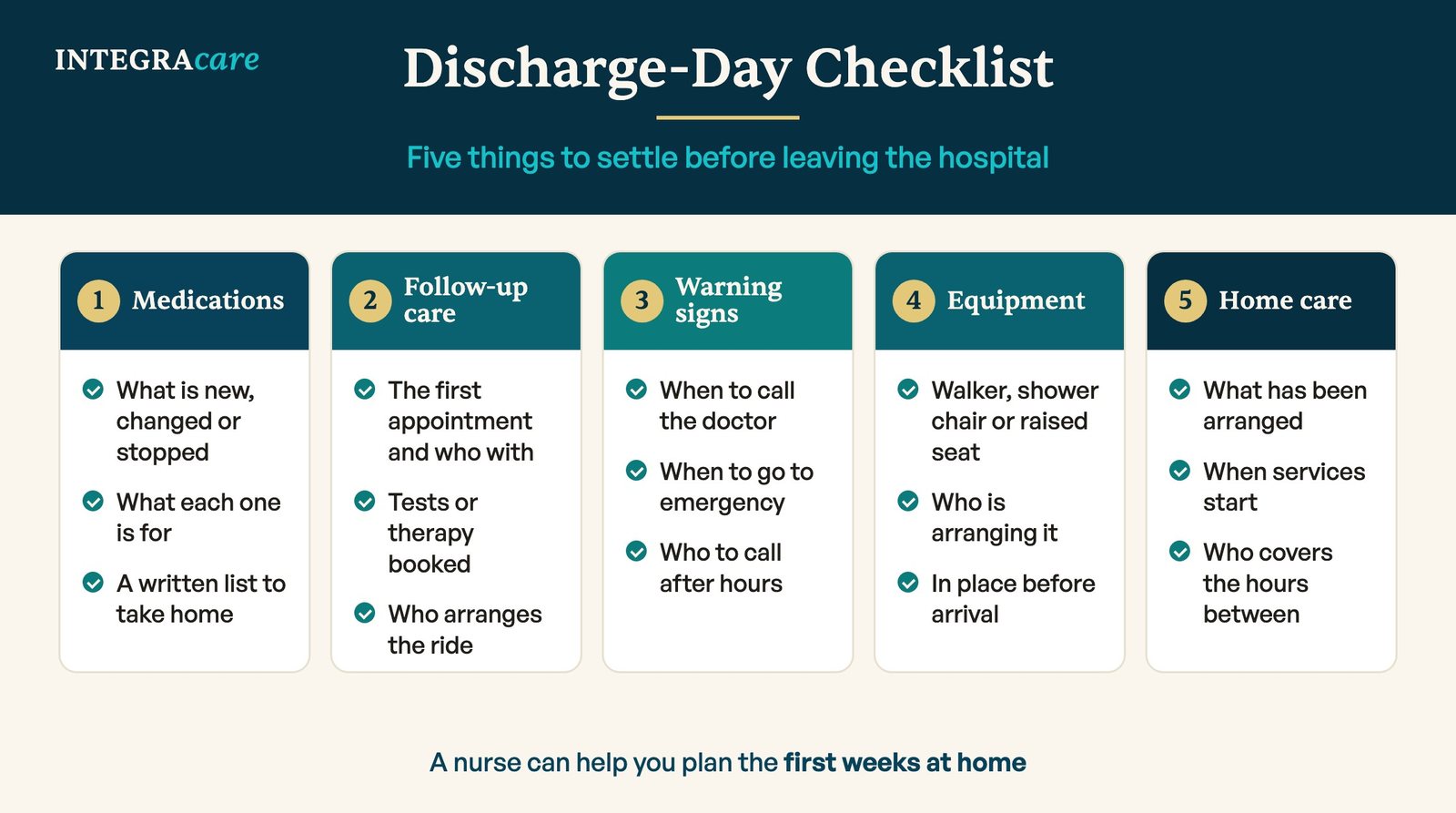
Your Discharge-Day Checklist
Before your loved one leaves the hospital, try to get answers to these questions and write them down. Discharge day moves quickly, and notes help once you are home.
Medications
- What medications are new, which have changed, and which have stopped?
- What is each one for, and when should it be taken?
- Has the prescription been sent to their usual pharmacy?
Ask for a written list. Then, at home, go through the medicine cabinet and set aside anything that has been stopped so it does not get taken by mistake. If your loved one takes 3 or more prescription medications for a chronic condition, they qualify for a free MedsCheck review with their pharmacist once a year. Book one in the first week home and bring the hospital’s medication list, so the pharmacist can sort out what is new, what has changed, and what has stopped.
Follow-up care
- When is the first follow-up appointment, and with whom?
- Are there tests, physiotherapy or wound care visits booked?
- Who will arrange transportation?
Warning signs
- What symptoms mean you should call the doctor?
- What symptoms mean you should go to emergency?
- Who do you call with questions after hours?
Equipment
- Does your loved one need a walker, a raised toilet seat, a shower chair, or a hospital bed?
- Who is arranging it, and will it be there before they get home?
Ontario's Assistive Devices Program (ADP) covers 75% of the cost of some equipment, such as wheeled walkers and wheelchairs, for people who will need it for six months or longer. Some bathroom equipment, such as commode chairs, is not covered, so ask the hospital's occupational therapist what qualifies.
Home care
- What services has Ontario Health atHome arranged, and when do they start?
- How many hours or visits are included?
- What happens between those visits?
Preparing the Home
A few changes before your loved one arrives make the first days easier:
- Clear a wide path from the door to the bed and bathroom.
- Remove loose rugs and cords.
- Add night lights between the bedroom and bathroom.
- Move everyday items to waist height so there is no reaching or bending.
- If stairs are hard, set up a bed on the main floor for the first weeks.
- Stock the fridge with easy meals.
The First Week Home
The first days home are often the busiest. Your loved one may tire more quickly than they did on the ward, sleep poorly, or seem a little confused by the change in routine. The medications are new, and so is the setup at home.
Nights are often the hardest part
Nighttime bathroom trips are a common time for falls, especially with pain medication, a new walker, or a weak leg. If you have been sleeping on a loved one's couch with one ear open, you know how quickly that wears you down. An overnight Caregiver can help them to the bathroom safely while you get a full night's sleep.
Watch for changes
Keep an eye on eating and drinking, pain, confusion, swelling, redness or drainage around a wound, and breathing. Write down anything new and share it at the follow-up appointment, or sooner if it matches a warning sign.
Protect the skin
Seniors who spend a lot of time in bed or in a chair after a hospital stay are at risk of pressure injuries. Changing position regularly and checking the skin each day helps. Our guide on preventing bedsores at home explains what to look for and when to call a nurse.
What Recovery Care at Home Can Look Like
What helps depends on why your loved one was in hospital. Here are the kinds of support Families in Ottawa often arrange after a stay.
| Need | Support that can help |
| Wound care after surgery or for a pressure injury | Nursing visits for dressing changes and monitoring |
| New or complicated medications | A nurse to review medications and set up a routine |
| Getting strength back | Physiotherapy at home |
| Bathing, dressing, toileting and meals | A Personal Support Worker (PSW) for a few hours a day |
| Nighttime safety | An overnight Caregiver |
| Higher needs after a stroke or major surgery | 24-hour care for the first days or weeks |
Nursing care
Registered Nurses and Registered Practical Nurses can manage wound care, medications, and monitoring of conditions such as heart failure or diabetes. Integracare provides nursing care services in Ottawa and wound care at home.
Physiotherapy
After surgery, a stroke, or a fall, a physiotherapist can help your loved one rebuild strength and balance in the place where they actually need to walk, climb stairs, and get in and out of bed. See physiotherapy at home in Ottawa. After a stroke, a little help with getting up, washing, meals, and the exercises the hospital therapists suggested can make each day at home feel steadier. Stroke care at home builds that support around your loved one’s routine.
Personal support
A Personal Support Worker (PSW) can help with bathing, dressing, toileting, meals, and getting to appointments. Every Caregiver is screened before they start, including a police clearance, an annual medical check, and bonding. For Families who work, a few set hours of personal support each day is often what makes going back to work possible.
Short-term 24-hour care
Some Seniors need someone with them around the clock for the first days or weeks. 24/7 home care in Ottawa can cover that period, then step down as your loved one gets stronger.
Recovery care does not have to be permanent. Families often arrange more help for the first 2 weeks and reduce it as recovery goes on.
How Nursing Oversight Fits In
Integracare's care is nurse-led. A Registered Nursing Coordinator oversees each Client's care plan, and the plan changes as recovery moves along, so help can step down as your loved one gets stronger rather than staying fixed. Caregivers are carefully matched to the Client, and a nurse is available 24/7. That matters most in the first weeks: if something looks different at 10 p.m., such as new swelling around a wound or more confusion than usual, there is a nurse to call instead of guessing.
If Your Loved One Is Waiting in Hospital for Long-Term Care
Sometimes a Senior is medically ready to leave the hospital but cannot go home without more support. They are called alternate level of care (ALC) patients, and many are waiting for a long-term care bed.
Under Ontario's More Beds, Better Care Act, 2022 (Bill 7), an ALC patient waiting for long-term care can be placed in a home that was not on their list, within 70 km in southern Ontario (150 km in northern Ontario). A hospital can charge $400 a day to a patient who declines that placement.
Going home with enough support can keep more choices open while your loved one waits for a home the Family chose. Private home care can sometimes make that possible: a nurse assesses what is needed at home, and care such as overnight or 24-hour support can be arranged alongside Ontario Health atHome services. Whether home is the right place depends on their needs, so talk it through with the hospital team. Our guide to long-term care waitlists in Ottawa explains how this works.
How Integracare Supports Recovery at Home in Ottawa
Integracare has supported Families for more than 30 years. Our home care in Ottawa is led by Kristine McGinn, BScN, Director of Integracare East, from our office at 343 Preston Street. Our care is nurse-led, with Registered Nursing Coordinators overseeing each Client's care and a nurse available 24/7, so there is always someone to call if something changes.
We work alongside the services Ontario Health atHome arranges and can fill the hours in between. If a discharge date is coming up, calling before it gives the most time to plan.
If your loved one is coming home from hospital soon, book a free in-home assessment. A nurse will help you plan the first weeks at home and the support your loved one will need. You can also call our Ottawa office at (613) 212-7567.
Frequently Asked Questions
What should I ask before my loved one is discharged from hospital?
Ask for a written medication list showing what is new, changed or stopped. Ask when follow-up appointments are, what warning signs to watch for, who to call after hours, what equipment is needed, and what home care has been arranged.
Who arranges home care after a hospital stay in Ottawa?
A care coordinator from Ontario Health atHome (613-745-5525 or 1-800-538-0520) assesses your loved one and arranges publicly funded care. Ask the hospital team to involve them early. Families often add private nursing or personal support to cover the hours in between.
How can we lower the chance of going back to hospital?
Take medications exactly as prescribed, keep follow-up appointments, watch for warning signs and act early, and reduce fall risk at home. Extra support in the first week, especially at night, can help. Regular nursing visits also mean someone trained is watching for changes and can act on them early.
Does my loved one need someone with them overnight after surgery?
Not always, but many Seniors are at higher risk of falls at night after surgery, especially with pain medication or a new walker. If they need help getting to the bathroom at night, an overnight Caregiver can help while you sleep.
How long will my loved one need help at home after hospital?
It depends on the reason for the stay and their health before it. Some need help for a week or two, others for months. Recovery care can start at a higher level and step down as they get stronger.
What is an ALC patient?
An alternate level of care (ALC) patient is someone who no longer needs hospital care but cannot be safely discharged yet, often because they are waiting for long-term care or for enough support at home. With the right help in place, some ALC patients can go home while they wait.
Can home care start the day my loved one comes home?
It can. Care can often start the same day you call. Calling as soon as you know the likely discharge date gives time for a free in-home assessment with a nurse, so help is in place for the first evening and night at home.
What are our options if my mom can't be alone after discharge?
Start by asking the hospital team what Ontario Health atHome will provide and when. Then look at the hours in between: a Family rota, a Personal Support Worker (PSW) for set hours, an overnight Caregiver, or 24-hour care for the first days or weeks. Families often combine these and reduce help as recovery goes on.
Free In-Home Assessment
The Care Your Family Deserves Starts Here
Speak with our team about a personalized care plan. Book a free, no-obligation in-home assessment and we will help you find the right support for your loved one.
About the Author: Kristine McGinn

Director of Integracare East, BScN
Kristine brings over 25 years of dedicated healthcare experience to her role. She holds a Bachelor of Science in Nursing and has progressed through frontline nursing, team leadership, and strategic management, all focused on enhancing client outcomes. Kristine is committed to continuous quality improvement and healthcare innovation, and has developed a thorough understanding of the complexities of the healthcare industry.