
Blog
Home Health Care vs Long-Term Care: What’s the Difference?
Published
Updated
Written by Lee Grunberg, M.B.A. — President & CEO
Reviewed by Bethel McMaster, BScN, RN — Director of Business Development
On this page22 sections
Key Takeaways
- Home care prioritizes personal freedom and comfort, while long-term care supports those with complex needs.
- Staying at home can enhance emotional well-being, allowing families to be actively involved in care.
- Care is a journey, not a one-time choice; early planning helps families make confident decisions.
- Modern home care adapts to various needs, proving facilities aren't always necessary.
Choosing care for an aging parent or loved one is one of the most emotionally complex decisions a family can face. It rarely happens all at once. Often, it begins with small changes. A missed medication. A fall that shakes confidence. A growing sense that everyday tasks feel heavier than they once did.
When families begin comparing home health care vs long term care, the conversation can feel overwhelming. The terminology is unfamiliar. The options can feel final. The pressure to make the right decision is intense.
This guide is designed to remove fear from the process. Not by oversimplifying it, but by clearly explaining what each option truly offers, how they differ in daily experience, and how families across Canada are choosing care that protects dignity, independence, and emotional well-being.
Understanding the Care Landscape Before You Need It
Most families do not plan for care early enough. Decisions are often made during moments of crisis, when stress is high and clarity is low. Understanding the difference between care models before urgency takes over allows families to make decisions grounded in values rather than fear.
The difference between home-based care and institutional care is not just about location. It is about autonomy, continuity, emotional safety, and how care adapts as needs change.
Many families begin by exploring in-home health care, which allows support to be delivered where life already happens. The kitchen. The bedroom. The neighbourhood. Familiar spaces that carry memory and meaning.
Others consider residential facilities when needs feel unmanageable at home or when safety concerns escalate quickly. Neither path is inherently right or wrong. The right choice depends on timing, care complexity, family capacity, and personal preference.
Research comparing home care to institutional care shows that remaining at home, when supported appropriately, is often associated with better functional outcomes and quality of life for older adults.
Definitions That Actually Make Sense
Before comparing options, it helps to clarify what these terms truly mean in practice. Clear definitions remove much of the anxiety families feel when navigating care conversations for the first time.
Home Health Care
Home health care refers to professional care services delivered in a person’s own home. These services are flexible and can evolve over time. Support may begin with a few hours per week and gradually increase as needs change.
Care may include assistance with daily activities, mobility support, medication reminders, nursing oversight, and condition-specific support. Families often choose this model when the goal is to maintain independence while still ensuring safety and professional care.
The National Institute on Aging notes that home health services are designed to support both medical needs and daily functioning while allowing individuals to remain in familiar environments.
Long-Term Care
Long-term care typically refers to residential facilities where individuals live full-time and receive ongoing care. These settings include nursing homes and care homes with structured schedules, shared living environments, and centralized staffing.
This model is designed for individuals with advanced care needs that cannot be safely managed at home, even with professional support. Understanding this distinction helps families avoid confusing care intensity with care quality.
According to the National Institute on Aging, long-term care is intended for people who require ongoing assistance due to significant physical or cognitive limitations.
Understanding Accessibility and Availability in Care Decisions
Availability and accessibility go hand-in-hand with determining the best solution to your care needs. Being aware of what services are available, and what the qualifications and eligibility requirements for these services are can affect the care decision.
- Eligibility and qualifications: Home health care can be sought when individuals require help with daily activities or if they have certain medical needs that can be safely accommodated at home. Long-term care is generally available to those with a greater degree of care needs, who may no longer be safely managed at home. A health care assessment might be required to determine suitability for each type of care.
- Service availability: Availability varies greatly depending on the region that families live in. Urban centres and major cities will generally have greater access to available care services than some rural locations, where availability may be scarce. Families should make sure to assess the availability in their area.
- Regional differences: Each province/territory manages its own health care system, and service availability and range vary significantly by region. Check local resources for provincial/territorial differences.
- Wait times: Anticipating potential wait times for both home health care and long-term care is important for making a decision and developing a care plan. Some areas have significant waitlists, making early inquiries important.
- Important agreements and programs: Being knowledgeable about relevant bilateral agreements, such as "Aging with Dignity bilateral agreements" and "Working Together bilateral agreements," can assist families in facilitating access.
- Availability of 24/7 care: If round-the-clock care is an important necessity, verify what services will accommodate such a high demand for care. Round-the-clock services are also available from certain home care providers, depending on the family's needs and resource availability.
- Community care providers and their role: Regulated and non-regulated care providers have a role to play in the provision of home health care. The role of family support and community services is key in filling the gap and creating a comprehensive care plan.
Who Provides Care: Regulated and Non-Regulated Providers
The delivery of home care includes regulated health professionals (e.g., RN, PT) as well as non-regulated service providers (e.g., PSW). Gaps between these services are frequently filled by family or community organizations.
Facility-based providers include regulated and non-regulated members of facility teams, with facility staffing coordinated by administration. Knowledge of who provides the care, and the skills, education, and qualifications that providers have, may assist families in making judgments as to whether a particular service is appropriate for their families and helps to account for varying service costs and availability.
Cost and Affordability
When evaluating home care versus long-term care solutions, deciding between balancing costs and the quality of care and coverage can be overwhelming. Families are concerned about the price not only today, but for the long-term as needs evolve.
Cost comparisons can seem confusing because of differences between models of care:
How Costs Are Structured
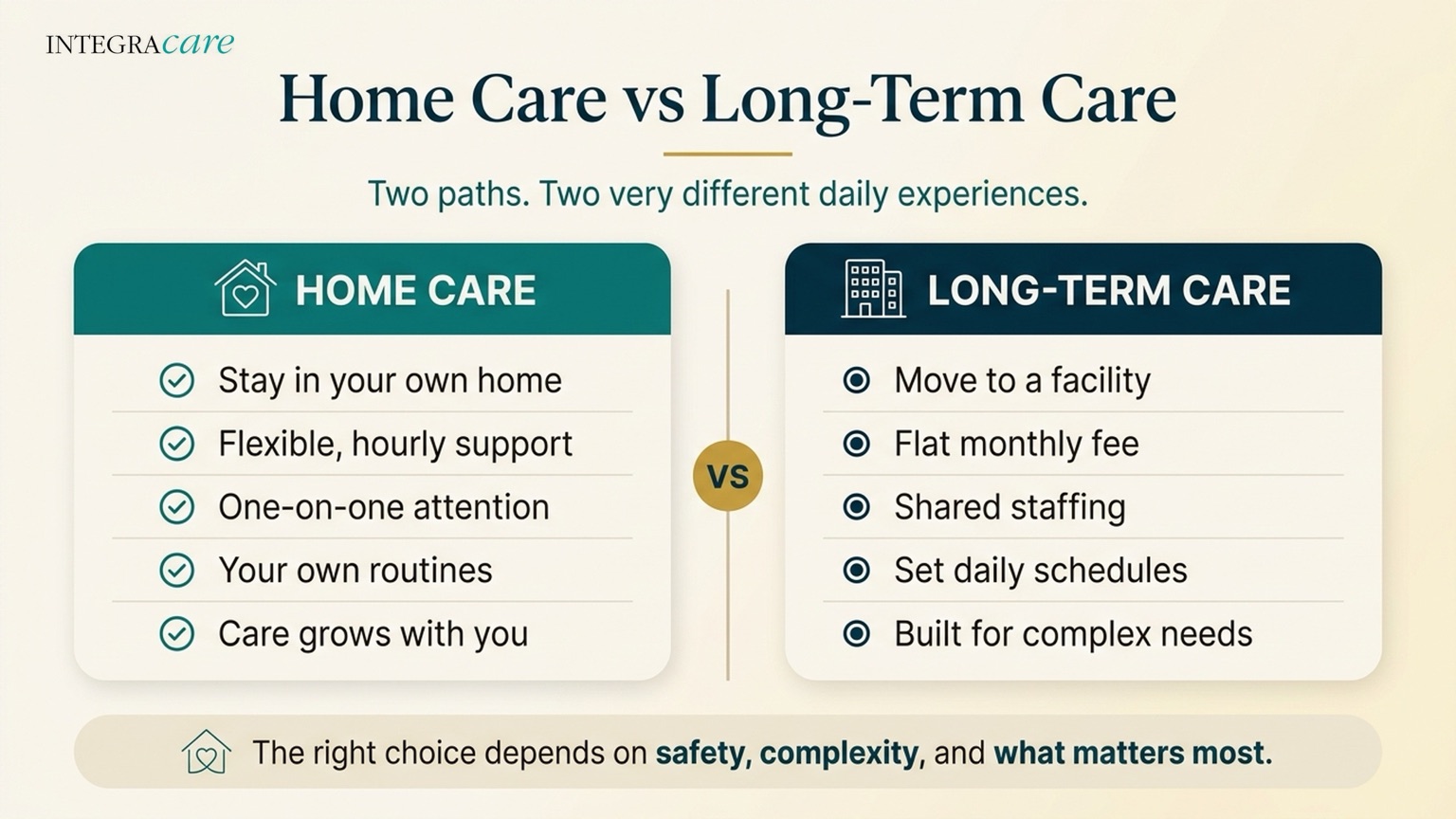
Home health care is normally charged by the hour or by service, allowing families to begin with an amount of care they can afford and add more services as needed. Long-term care is normally charged as a monthly fee, covering accommodation and some core services; there can be additional fees for the level of care required or the room type.
What Families Actually End Up Paying
- Public coverage: Provincial programs only cover a portion of care, not the entire amount, especially if ongoing or complex care is involved.
- Out-of-pocket spending: Many families use a mix of public and private care to ensure continuity and comprehensive support.
- Insurance and benefits: Private or group insurance often helps offset care, but the coverage can vary greatly between plans.
What Will Increase Cost in the Future
By planning for how costs could increase over time, you can help ensure your loved one maintains their independence and dignity. Knowing how much and what kind of care they might require will help you plan financially and ease worries.
- Level of care: if complex medical, mobility, or cognitive issues are present, they add cost through greater time and potentially through the need for specific professionals.
- Amount of care needed: Home care is an ever-increasing financial commitment, whereas with LTC, it becomes somewhat fixed, but higher needs can still add cost.
- Type of care: moving to another care model is often an unavoidable financial increase over the long term.
The decision about cost is almost always linked to the desire to have a family member remain independent, feel safe, and live with as much dignity as possible. Understanding the real costs, expectations of what care will be and potential resources can relieve some anxiety about the unknown.
Cost as Care Needs Increase
The demands on a family member will change over time. Families should prepare for rising costs over several years.
Reasons why care costs can rise significantly over time:
- Medical complexity: Dementia and other chronic conditions are complicated to care for and are expensive.
- Hours required: The more hours per day required for care, the more expensive home care is.
- Care provider: Some providers charge more for highly skilled nursing care than for personal support services.
- Location: Costs can be competitive in urban environments and higher in rural areas due to transportation expenses.
Home care will seem cheaper in the short term. If round-the-clock care is necessary daily, the predictable, flat monthly fee of LTC may seem more financially prudent in the long term.
Seeking out Financial Assistance
There are many ways the cost of care can be reduced, and families need patience in accessing assistance programs:
- provincial care tax credits.
- home modification subsidies.
- Veterans Affairs assistance.
- Indigenous Services Canada Access.
- Subsidies to reduce long-term care costs.
Social workers, family physicians, and elder care financial planners know what sources of help may be available. Many families do not tap into resources that exist because they simply do not know what to ask for. Seeking assistance with the paperwork process indicates smart and organized planning.
Government and Community Support
It is easy to feel overwhelmed by all the decisions required to find the right care for a loved one, unsure of where to start or what resources are available. The reality is that many supports are available to help families navigate these changes, and you do not have to face this on your own.
Who Does What?
Understanding roles helps you direct questions to the right place.
- Federal government: This level offers financial support and policy work and provides some services to certain groups such as veterans, Canadian Forces, federal inmates, some First Nations and Inuit people.
- Provincial and territorial governments: This level is responsible for the organization, management, and delivery of most home care and long-term care services (including assessing need, eligibility, and waiting lists, as well as coordinating care).
- Municipal or local governments: This level may provide some support through various community programs (e.g., transit services, seniors' programming, housing projects, depending on the locality).
The Broader Role of Health Canada
While Health Canada supports national research, policy analysis, and broader system improvements in home, community, and long-term care, the service delivery is generally within provincial/territorial control.
Bridging the Gap With Community Resources
Community resources help support seniors as they age in the comfort of their home.
- Meal programs assist the elderly to have access to pre-prepared meals, which ease the daily burden on family caregivers.
- Transportation may assist the elderly with their medical appointments and visits to community centres, where they are unable to drive
- Day programs for adults-most communities are equipped with such facilities, offering a supervised, activity-oriented program and also provide relief to family caregivers.
- Assistance with navigation-community programs help with the completion of forms, referrals, service options, and resources, but this varies by region.
Extra Coverage to Ask About
The province or territory you are living in may have some income-tested drug or health benefits for seniors. Some regions have supplemental coverage available to those who receive social assistance benefits. EI caregiving benefits are available to help workers who can do so take time away from work to care for a family member.
Where to begin
- Provincial or territorial health authorities' Web pages.
- Community health centres and seniors' groups.
- Organizations that deal with specific conditions like Alzheimer's and caregiving associations.
Health Canada enhances care systems, but local community resources are key to helping seniors age at home. Exploring these supports can ease caregiver burdens and ensure your loved ones receive the care they need.
The Real Difference Lives in Daily Experience
The most meaningful differences between care models appear in the everyday details that shape quality of life.
Familiarity vs Adjustment
Home care allows individuals to remain surrounded by personal belongings, routines, and memories. This continuity can reduce anxiety, especially for older adults who find change disorienting or emotionally distressing.
Residential care requires adjustment to new environments, shared spaces, and facility schedules. For some individuals, this structure is comforting. For others, it can feel disempowering and disruptive.
Flexibility vs Standardization
Home care adapts around the individual. Care plans can change weekly or even daily. Services can expand or scale back without relocation.
Long-term care operates on standardized routines designed to serve many residents at once. While necessary for efficiency, this approach offers less personalization. These contrasts sit at the heart of home care vs nursing home decisions.
Privacy vs Shared Living
Home care preserves privacy by allowing individuals to live within their own personal space, where routines, conversations, and moments of rest remain private.
In residential settings, shared rooms, communal spaces, and constant activity can reduce privacy, which may affect comfort and emotional well-being over time.
Care That Evolves Instead of Forcing Transitions
One of the most common misconceptions is that home care is only suitable for early or mild needs. In reality, modern home care services can support complex and progressive conditions.
Families caring for loved ones with memory loss often assume residential care is inevitable. However, specialized dementia home care allows individuals to remain in familiar surroundings while receiving structured cognitive support, safety monitoring, and compassionate assistance.
Remaining at home can reduce confusion, agitation, and emotional distress. It also allows families to stay closely involved in care decisions, rather than feeling separated from the day-to-day experience of their loved one.
Academic research on aging in place highlights that familiar environments play a critical role in emotional regulation and cognitive stability for older adults.
When Families Begin Looking for Alternatives
Residential care is not the only option when needs increase. Many families across Canada actively seek long-term care alternatives that preserve autonomy while still ensuring safety and professional oversight.
These alternatives include enhanced home care models that combine personal support, nursing oversight, and coordinated care planning. Rather than a single decision point, care becomes a continuum.
This approach reduces pressure and allows families to reassess needs gradually. Transitions are made intentionally, not reactively, and only when truly necessary.
Canadian research consistently shows that community-based care models can delay or reduce the need for residential placement when adequate supports are in place.
What Care Providers Actually Do Day to Day
Understanding how care is delivered helps families make realistic comparisons and set appropriate expectations.
In-Home Care Roles
Care providers working in the home support both practical and emotional needs. Responsibilities may include assistance with bathing, dressing, meal preparation, mobility support, companionship, and safety monitoring.
Many families begin with personal support services that address daily tasks while allowing loved ones to remain independent in decision making, routines, and lifestyle preferences.
Facility-Based Care Roles
In residential settings, care staff manage multiple residents simultaneously. While medical oversight is continuous, individualized attention is divided among many individuals.
Staff roles are clearly defined, but relationships may feel less personal due to staffing ratios and shift rotation. These differences reflect broader roles and responsibilities of care providers across care models.
Medical Needs Do Not Always Require Moving
Another common assumption is that medical needs automatically require residential placement. This is not always the case. Many health conditions can be managed safely and effectively at home with the right clinical oversight, planning, and communication between care providers, families, and medical professionals. Education is the best protection against common home care misconceptions.
With proper coordination, nursing care at home can support wound care, medication management, post-hospital recovery, chronic disease monitoring, and palliative care. These services are delivered by regulated professionals who follow medical directives while adapting care to the realities of daily life in the home.
Home-based nursing allows individuals to receive clinical care without the emotional disruption of relocation. It also enables families to stay informed, ask questions in real time, and participate in care decisions, creating a more transparent and reassuring care experience.
Studies show that home health interventions can reduce hospital readmissions and improve continuity of care for medically complex older adults.
Aging With Control, Not Confinement
Aging is not simply a medical process. It is deeply emotional, social, and personal. The loss of control often hurts more than the loss of physical ability. Being told where to live, when to eat, and how to structure each day can feel disorienting and discouraging, even when care needs are legitimate.
Choosing aging in place care allows older adults to maintain authority over their daily routines, social connections, and personal space. Familiar surroundings support memory, confidence, and emotional stability, particularly during periods of physical or cognitive change.
For families, this approach often brings relief. Care supports independence rather than replacing it, helping aging feel like a supported transition instead of a sudden loss of autonomy. Canadian qualitative research shows that aging in place is closely tied to identity, dignity, and a sense of control for older adults.
The Emotional Impact on Families Matters Too
Care decisions affect more than the person receiving support. They shape the emotional wellbeing of spouses, adult children, and extended family members. Feelings of guilt, anxiety, and uncertainty are common, especially when families worry about making the wrong decision too soon or too late.
Home-based care often allows families to remain involved without becoming overwhelmed. Professional caregivers share responsibility, reduce burnout, and help families shift from constant vigilance to meaningful presence.
Access to coordinated senior home care services also provides reassurance. Families know care is being monitored, adjusted, and supported by experienced professionals, rather than relying solely on personal capacity.
Career Paths Reflect the Care Model Itself
The structure of care models also affects those who work within them. How care is delivered shapes not only client experience, but also caregiver satisfaction, continuity, and the depth of relationships formed over time.
Home care professionals often develop long-term relationships with clients. They work independently, adapt care creatively, and respond directly to individual needs within the context of a person’s life and home environment.
Facility-based roles are more structured and protocol-driven. While essential, they often allow less flexibility and less personal continuity. This contrast reflects broader job outlook and career considerations within the senior care sector.
Planning Ahead Changes Everything
Care works best when it is planned rather than rushed. Decisions made during moments of crisis often feel heavier and more permanent than they need to be. Stress can narrow perspective, making options feel limited when they are not.
A thoughtful home care plan allows families to outline goals, preferences, safety considerations, and boundaries before urgency dictates decisions. It creates space for conversations about values, comfort, and quality of life, not just logistics. Care can then be introduced gradually, tested, and refined over time.
Planning ahead reduces stress, preserves dignity, and helps families feel prepared rather than reactive. It also strengthens trust, ensuring everyone involved understands the plan and feels confident as care needs evolve.
Public health guidance emphasizes early planning as a key factor in avoiding unnecessary institutionalization and crisis-driven care decisions.
Why Families Are Reframing the Question Entirely
The most powerful shift many families make is changing the question from “Which facility is best?” to why choose home health care first. This reframing removes the sense that there is only one correct path forward and helps families feel less rushed into decisions that may not yet be necessary.
Instead of viewing care as a final decision, families begin to see it as a flexible process. Support can grow alongside changing needs without forcing immediate relocation or loss of independence. This mindset encourages thoughtful pacing, open dialogue, and ongoing reassessment.
Residential care remains important for advanced needs, but it no longer has to be the default starting point. For many families, home-based care becomes the foundation, not the exception, allowing care to respond to life rather than dictate it.
A Calm Path Forward
Every care journey is different. There is no universal timeline and no single right answer. What matters most is clarity, compassion, and alignment with personal values. Care decisions are rarely about finding perfection. They are about finding what feels sustainable, respectful, and supportive in real life.
Choosing care that supports emotional well-being, preserves independence, and adapts over time allows families to move forward with confidence rather than fear. It creates space for reassurance, reflection, and adjustment as circumstances change.
At Integracare, families are supported through each stage with coordination, experience, and empathy. Care plans are designed to evolve alongside health, routines, and family dynamics, ensuring support enhances daily life rather than interrupting it.
Frequently Asked Questions About Long-Term Care vs Home Health Care
What is the main difference between home health care and long-term care?
Home health care provides personalized support in a person’s own home, allowing them to maintain independence and familiar routines. Long-term care involves living in a residential facility with structured schedules and shared environments designed for individuals with more advanced needs.
When should someone consider long-term care instead of home care?
Long-term care is typically considered when medical, physical, or cognitive needs become too complex to manage safely at home, even with professional support. This often includes situations requiring 24/7 supervision, intensive medical care, or specialized facility resources.
Can home health care support complex medical conditions?
Yes, modern home health care can support a wide range of medical needs, including chronic disease management, post-surgical recovery, and dementia care. With proper coordination, nursing care and clinical oversight can be delivered safely and effectively at home.
Is home health care more beneficial for emotional well-being?
Home health care often supports better emotional well-being because individuals remain in familiar surroundings with greater control over their daily lives. This continuity can reduce stress, confusion, and feelings of isolation, especially for seniors experiencing cognitive changes.
How do families decide between home care and long-term care?
Families should consider factors like safety, level of care required, personal preferences, and available support systems when making a decision. Planning early and viewing care as a flexible, evolving process helps families choose an option that aligns with both immediate needs and long-term well-being.
Free In-Home Assessment
The Care Your Family Deserves Starts Here
Speak with our team about a personalized care plan. Book a free, no-obligation in-home assessment and we will help you find the right support for your loved one.
About the Author: Lee Grunberg

President & CEO, M.B.A.
Lee joined Integracare as President & CEO on August 2, 2016 after an approximately 20 year career in Private Equity and Investment Banking. Lee brings tremendous operational knowledge and governance experience along with an incredible passion and energy to Integracare.