
Blog
How Long Is the Wait for a Long-Term Care Bed in Toronto? What Families Can Do in the Meantime
Published
Written by Dennis Fancy
Reviewed by Bethel McMaster, BScN, RN — Director of Business Development
On this page10 sections
Key Takeaways
- The long-term care waitlist is the list of people approved for a long-term care home in Ontario who are waiting for a bed in one of the homes they chose. Ontario Health atHome manages it.
- More than 50,000 people in Ontario are waiting for long-term care, and half of people entering long-term care wait at least 165 days. Popular Toronto homes can take much longer.
- You can choose up to five homes, and priority is based on need, so a change in health or in the support available at home can change your loved one's place on the list.
- Refusing a bed offer closes the application, and in most cases you must wait 12 weeks to reapply.
- Home care, from a few hours a week to live-in or 24-hour care, can support your loved one at home while they wait without affecting their place on the waitlist.
Waiting for a long-term care bed in Toronto often takes longer than families expect, and life at home carries on in the meantime. Your loved one may need help with meals, bathing or getting up at night, and some families arrange live-in care so someone is with them through the day and night until a bed is offered.
The Ontario Long Term Care Association reports that more than 50,000 people in Ontario are waiting for long-term care, and half of people entering long-term care wait at least 165 days. Integracare's nurse-led home care works alongside the hours Ontario Health atHome provides, adding visits at the times of day those hours do not cover.
Start a simple daily log of what you notice, such as skipped meals, a near fall, or a restless night. The notes show your family where extra help at home is needed first.
Share it with the Ontario Health atHome care coordinator, so that a new assessment can be done of your loved one’s changing needs.
What Is the Long-Term Care Waitlist?
The long-term care waitlist is the list of people who have been approved for a long-term care home in Ontario and are waiting for a bed in one of the homes they chose. Ontario Health atHome assesses eligibility, keeps the list, and contacts the family when a bed is offered. Each home has its own waiting list, so your loved one can be at a different place on the list for each home they choose. Long-term care is one of several options for a loved one who needs more support. Understanding the differences between home care and long-term care helps your family decide which setting suits your loved one, both during the wait and afterward.
How Long Is the Wait for Long-Term Care in Toronto?
There is no single number, because the wait depends on which homes you choose, the type of room, and how urgent your loved one's needs are. The provincial figures come from the Ontario Long-Term Care Association, which cites Ministry of Long-Term Care data from March 2026, and some people wait much longer than the provincial average.
Waits for individual homes vary widely. Homes with strong reputations, cultural or language programs, or central locations can have the longest lists. When your preferred home has a long list, plan early for how your loved one will be supported at home. The choice between live-in care and 24-hour shift care often comes down to whether they need someone awake through the night.
Our Toronto long-term care waitlist page lists every long-term care home in Toronto with its number of beds and how many people are waiting for it, from the province's figures. As of August 31, 2026, for example, the province listed 572 people waiting for Seniors' Health Centre in North York, 263 for Main Street Terrace, and 239 for Sherbourne Place. These numbers change often, so check them more than once. If you work during the day, a caregiver can stay with your loved one while you are at work, helping with meals, medication reminders, and moving around the home safely.
The waitlist rules are set by the province, so they work the same way across Ontario. Comparing private home care with waiting for a long-term care bed can help your family decide how to plan the months.
How the Toronto Long-Term Care Waitlist Works
Applying
Applications go through Ontario Health atHome, which you can reach at 1-833-515-1234. A care coordinator assesses whether your loved one is eligible and helps you complete the application. In Toronto, the Toronto Central Healthline is a useful directory of homes and community services.
Choosing homes
You can choose up to five homes, in order of preference. Choose carefully: tour the homes if you can, ask about the waitlist at each one, and think about who will visit and how they will get there. A home with a shorter waiting list can be a practical second or third choice.
Crisis and regular priority
Not everyone on the list waits in the same line. People whose condition or circumstances have reached a crisis are placed ahead of those whose needs are serious but stable. This is why one person may receive a bed within weeks while another waits many months for the same home.
If your loved one's situation changes, such as a fall, a new diagnosis, or a change in the support family can provide at home, tell the care coordinator. A change in circumstances can change their priority.
When a bed is offered
When a bed opens in one of your chosen homes, Ontario Health atHome will contact you. You have 24 hours to accept, and if you accept, your loved one usually moves in within five days.
If you accept a home that is not your first choice, your loved one can stay on the waiting list for the others. If you refuse an offer, your file is closed, your loved one is removed from the waiting list of every home you chose, and in most cases you cannot reapply for 12 weeks unless their condition or circumstances change. These rules come from Ontario Health atHome's eligibility and admission guidance.
Paying for Long-Term Care in Ontario
Residents of long-term care homes pay an accommodation co-payment, and the province sets the maximum rates each year. As of July 1, 2026, the maximum rates are:
| Room type | Daily rate | Monthly rate |
|---|---|---|
| Basic | $70.00 | $2,129.17 |
| Semi-private | $84.40 | $2,567.17 |
| Private | $100.01 | $3,041.97 |
Residents in basic rooms with lower incomes can apply for a rate reduction, and the value of a home is not counted as income.
If Your Loved One Is Waiting in Hospital
Some Toronto seniors wait for long-term care in a hospital bed. They are often called alternate level of care (ALC) patients: they no longer need hospital treatment but cannot safely go home without more support.
Under the More Beds, Better Care Act (Bill 7), hospital patients waiting for long-term care can be moved to a home that was not on their list. In southern Ontario, that home can be within 70 kilometres of their preferred location. Hospitals can charge $400 a day to a discharged patient who refuses to leave. For a Toronto family, that could mean a home in Hamilton or Oshawa.
This is one reason some families choose to bring a loved one home with home care while they wait. A senior at home stays on the waitlist for the homes the family chose.
What Families Can Do in the Meantime
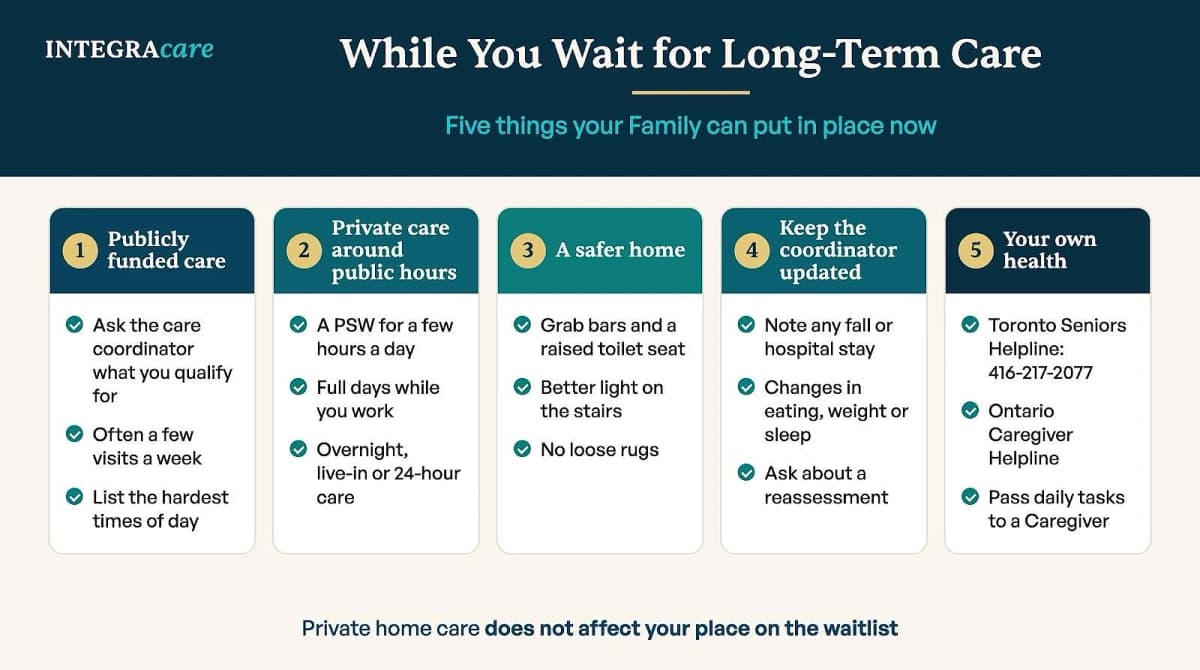
There is a lot your family can put in place while your loved one is on the waitlist. The steps below cover publicly funded care, private care, safety at home and support for you. For some families, this support works well enough that home care becomes a lasting alternative to a nursing home.
Get the publicly funded care your loved one qualifies for
Ask the Ontario Health atHome care coordinator what home care your loved one can receive while they wait. Publicly funded hours are based on assessed need and are often a few visits a week, which gives your family a starting point to build on. Before you speak with the coordinator, list the tasks your loved one needs help with and the times of day that are hardest. That list is the first step in setting up a home care plan for your loved one. The province's overview of home and community care lists the services Ontario Health atHome can arrange, including nursing, personal support and therapy at home. Ask the coordinator about short-stay respite beds in long-term care homes too. They give a family caregiver a planned break of a few days or weeks while your loved one is cared for in a home.
Add private home care around public hours
Private care can add support at the times public care does not reach:
- A few hours a day from a Personal Support Worker (PSW) for bathing, meals and medication reminders.
- Full days while you are at work.
- Overnight care when nights are harder.
- Live-in care or 24-hour care when your loved one needs someone there around the clock.
Whether your loved one needs a PSW or a nurse depends on the kind of help they need: PSWs help with personal care and daily routines, and nurses handle clinical tasks such as wound care and managing medications. Private care is scheduled around your loved one's routine, and it can increase as their needs change without starting over with a new provider. Tell the care coordinator which private hours you have arranged, so publicly funded visits and private care can be scheduled around each other. Private home care may also qualify for the Ontario Seniors Care at Home Tax Credit and the federal medical expense tax credit, so keep your receipts and ask your accountant what applies.
Make the home safer
Grab bars, a raised toilet seat, better lighting on the stairs and removing loose rugs can lower the risk of a fall. Ontario's Assistive Devices Program covers up to 75% of the cost of some equipment, such as walkers and wheelchairs, for people who will need it for six months or longer.
Keep the care coordinator updated
Before each call, note the date of any fall, emergency visit or hospital stay, any change in eating, weight or sleep, and any new medication. Ask the coordinator whether the change means your loved one should be reassessed, since a new assessment can change their priority.
Look after your own health
Supporting a loved one through a long wait takes time and energy. If you are the main family caregiver, the Toronto Seniors Helpline (416-217-2077) and the Ontario Caregiver Helpline (1-833-416-2273) can connect you to support. Passing some daily tasks to a caregiver, such as meals, laundry or driving to appointments, leaves you more time to rest and to simply be with your loved one.
When to Revisit the Decision
Some families find that with steady home care in place, their loved one is managing better at home than they expected. Others find their needs have grown beyond what home can safely support. At Integracare, a Registered Nursing Coordinator oversees your loved one's care plan and updates it as their needs change, so support can increase or ease without starting over. Because the same caregivers spend time with your loved one week after week, your family has a steady picture of how they are managing at home. Every few months, and again before winter, sit down as a family to reassess your loved one's home care needs with these questions:
- Is your loved one safe at home with the current level of care?
- Are they eating, sleeping, and taking medications properly?
- Is the family caregiver coping?
- Has anything changed that the care coordinator should know about?
The Registered Nursing Coordinator who oversees your loved one's care plan can talk these questions through with you and share what caregivers are noticing day to day.

How Integracare Helps Toronto Families While They Wait
When the same caregiver arrives each morning, they come to know how your loved one likes to start the day and can notice small changes early, sharing them with the Registered Nursing Coordinator who oversees the care plan. Each caregiver is carefully matched to the client; we keep the same caregivers in place wherever possible, and a nurse is available 24/7.
Integracare's nursing team brings more than 30 years of experience arranging care at home in Toronto and Mississauga, so we know how to schedule private care around the hours Ontario Health atHome provides. Care can start with a few hours a week and increase to live-in or 24-hour support as needs change.
During a free in-home assessment, our care team reviews your loved one's needs, the hours already arranged through Ontario Health atHome and the times of day that need more support, then puts together a care plan with your family.
Frequently Asked Questions
How long is the wait for a long-term care bed in Toronto?
It depends on the homes you choose, the type of room, and how urgent your loved one's needs are. Across Ontario, half of people entering long-term care wait at least 165 days, and popular Toronto homes can take much longer. Our Toronto long-term care waitlist page shows how many people are waiting for each home.
What can we do while waiting for a long-term care bed?
Ask Ontario Health atHome what publicly funded home care your loved one qualifies for, then add private home care at the times public hours do not reach. Make the home safer, keep the care coordinator updated on any change, and look into support for yourself as the family caregiver.
What happens if we refuse a long-term care bed offer?
Your file is closed, and your loved one is removed from the waiting list of every home you chose. In most cases, you cannot reapply for 12 weeks unless their condition or circumstances change. If you accept a home that is not your first choice, your loved one can stay on the list for the others.
Can my loved one come home from hospital while waiting for long-term care?
Often, yes, if the hospital team agrees it is safe, and enough support is in place at home. Ontario Health atHome can arrange publicly funded services, and private home care can add hours, overnight care, or live-in care. Going home keeps your loved one on the waiting list for the homes your family chose.
Does private home care affect our place on the long-term care waitlist?
No. Using private home care does not remove your loved one from the waitlist. Keep the care coordinator updated on any change in health or in the support at home, since priority is based on need.
Free In-Home Assessment
The Care Your Family Deserves Starts Here
Speak with our team about a personalized care plan. Book a free, no-obligation in-home assessment and we will help you find the right support for your loved one.